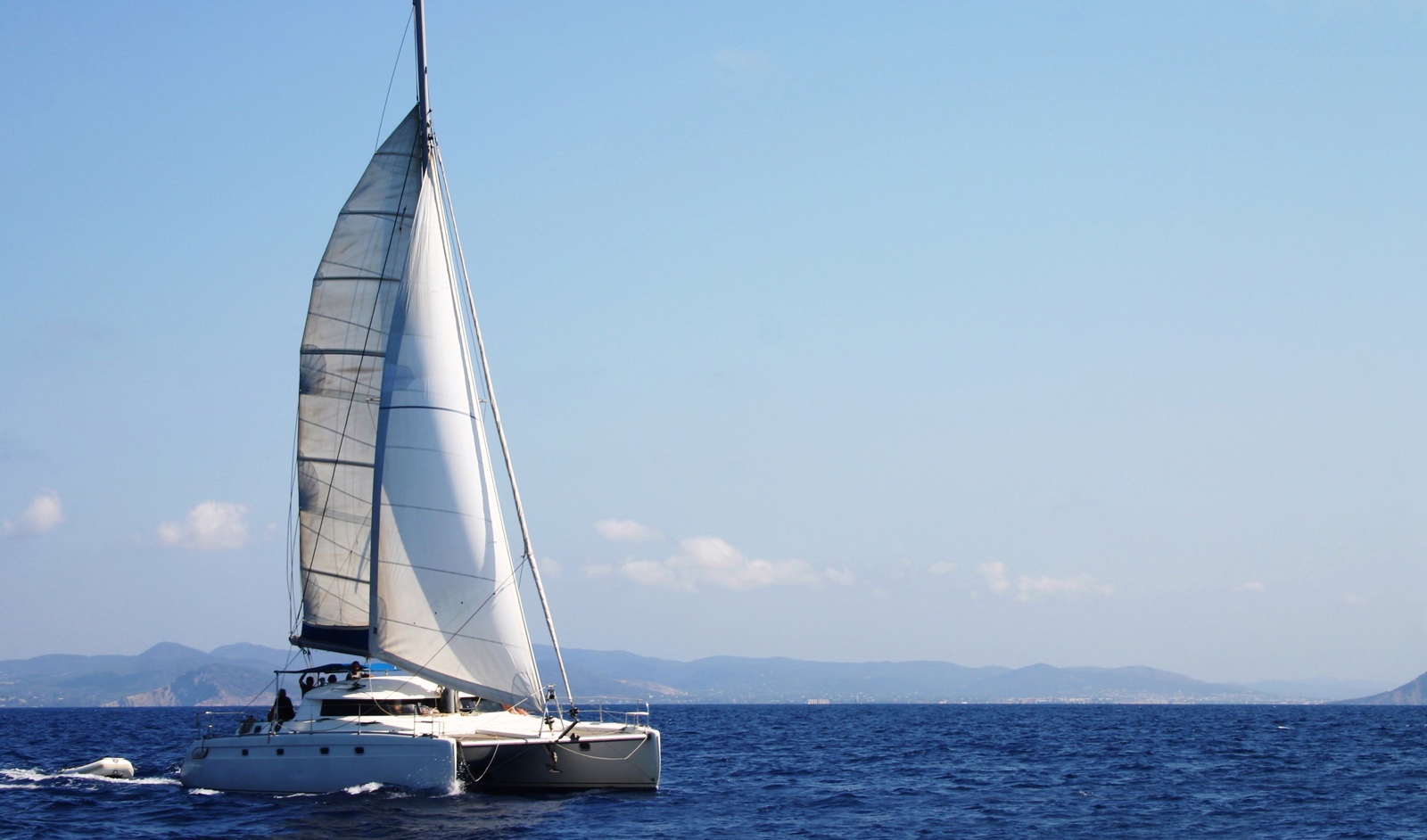
The Leopard 44 is the upper bound of our charter-return catamaran guide. Robertson and Caine built it in Cape Town from 2012 through 2017 for The Moorings and Sunsail charter fleets, with private-owner versions sold through Leopard Catamarans dealers in the US and Europe. Two extra feet of waterline over the Leopard 42, the same construction philosophy that runs across the Leopard line, and a four-cabin layout that sleeps eight in privacy turn it into the boat most owners step up to when they decide a 40 or 42 is not enough room for the cruising they actually want to do.
What is the Leopard 44?
The 44 is a 44-foot 6-inch fiberglass cruising catamaran with a 24-foot 6-inch beam. Two hulls, a bridgedeck saloon, and an aft cockpit big enough to dine eight under cover. Twin Yanmar 4JH4 diesels at 54 horsepower each on saildrive legs, with a fuel capacity that holds a real long-day motoring range with reserve. The standard charter layout is four cabins, four heads, with a forward owners-version layout available on private hulls that combines two of the cabins into one larger forward stateroom. The mast is a deck-stepped aluminum spar with a fractional rig and a self-tacking jib option that most charter boats came rigged with.
The construction is what makes the resale work. Hand-laid fiberglass with vinylester resin in the gelcoat layers, balsa coring above the waterline, solid glass below the waterline, and a structural grid bonded to the hull skin. The saloon roof is a one-piece molding with the hardtop integrated rather than added on, which is part of why the boat surveys cleanly after a decade of charter service. The aft cockpit is fully covered by the saloon overhang, which keeps the helm and the dining table dry in the kind of squall that catches you at anchor in the islands.
The four-cabin charter layout puts a double berth in each corner of the boat with a head and shower in the inboard space alongside. Privacy is real, two couples plus four guests can share the boat for a week without anyone tripping over anyone else. The galley is in the saloon on the port side with a three-burner stove, an oven, and a top-loading fridge plus a separate freezer. Water capacity sits at around 200 gallons across two tanks, which is enough to anchor out for a week with reasonable conservation.
Who is it good for?
Two-couple cruisers are the core buyer. The 44 gives each couple a full private corner of the boat, a saloon big enough to share without crowding, and a cockpit that fits everyone at dinner. Coastal hops or week-long Caribbean cruises, this is the boat that makes a shared trip work without anyone wishing they had stayed home.
Owners stepping up from a Leopard 40 or 42 are the second profile. Two extra feet of waterline shows up in head-sea motion in a way the spec sheet does not show. We crossed from Tortola to Anegada on a 2015 hull in February, six to eight knots of wind on the nose and a one-and-a-half-foot wind chop on top of an underlying ocean swell, and the boat settled into the motion in a way a 40-footer of the same generation does not. The saloon stayed quiet under the bridgedeck because the clearance is high enough that the slap pattern shifts to a different frequency. That is the upgrade buyers are paying the extra money for.
Long-hold owners are the third group. Robertson and Caine boats hold value in a tight band, and the 44 in particular sits at the top of the chartered-fleet resale curve because demand is steady and supply is limited. A buyer who plans to own the boat seven to ten years before selling gets the construction quality, the cabin volume, and a resale price that drops less than most production sailboats of similar length.
Who is it not good for?
First-time multihull owners should look at the Leopard 40 or Leopard 42 before stretching to the 44. The systems load is real (two engines, two saildrives, watermaker if equipped, generator, three or four head systems), and learning the boat is easier when there is less of it. The extra cabin and the extra waterline are not free, and a first-year owner who is still learning the lines and the throttle response benefits from a smaller hull.
Coastal-only sailors who never plan to leave protected water are the second exclusion. The blue-water capability of the 44 over the 42 shows up in offshore motion and water capacity. If your sailing is day-hops within sight of the marina and the occasional weekend trip, you are paying for capability you will not use, and a Leopard 40 or even a Fountaine Pajot Lipari 41 does the job for materially less money.
Buyers tight on slip availability fit the third exclusion. A 24-foot 6-inch beam closes a lot of marina options, and slip rates on a 44-foot catamaran in major coastal markets are well into five figures a year. Charter-return owners who plan to keep the boat at a charter base in the islands sidestep this problem. Owners who plan to dock at home should check the math before they sign.
Pricing
The Leopard 44 is out of production. The current used market for 2012-2017 hulls spans $385,000 at the bottom (early hulls with high charter hours and standing rigging at the end of service life) to $525,000 at the top (2016-2017 hulls with low hours, recent rigging, owners-version layouts, and recent watermaker and electronics refits). The mid-band, 2014-2015 charter-return hulls with 4,000 to 5,500 motoring hours and a current Yanmar service file, lands in the $415,000 to $475,000 range in 2026 listings.
Charter-return hulls come with a known operating history (charter operators run a strict service schedule), but they also come with the cosmetic wear of seven years of guests stepping on and off, plus a saildrive and bellows service file that needs full inspection. A private-owner hull at the same model year is usually $25,000 to $50,000 more, with better cosmetics and a thinner service file. Both are valid buys for different reasons.
Five-year depreciation on a clean Leopard 44 from new sat in the 22 to 26 percent range when these hulls were trading at year five. That is the best number in the cruising catamaran segment of this era, and it is the reason these boats still command a premium against equivalent-length monohulls and against most other production cats. Buyers planning to flip in three to five years can model their depreciation curve with reasonable confidence.
What works
- Forty-four feet of LOA delivers a measurable jump in head-sea motion comfort over a 40-foot platform, and the bridgedeck stays quieter at anchor in chop.
- Robertson and Caine build culture shows in the laminate schedule, the structural grid bonding, and the one-piece saloon roof molding.
- Aft cockpit dines eight under cover and the saloon dines the same crew indoors.
- Four-cabin charter layout sleeps eight in privacy, with the owners-version forward layout available on private hulls.
- Yanmar 4JH4 saildrive service is available everywhere, parts are stocked, and most charter-base mechanics know the engine.
- Resale holds in a tight band against the broader sailing market.
- Water and refrigeration capacity support multi-week cruises without a marina.
What doesn't
- Entry price is $80,000 to $120,000 above a Leopard 40 or 42 of the same vintage.
- Operating costs run roughly 25 percent higher than a 40 (fuel, slip rates, insurance, antifouling area).
- Used inventory is thinner than the smaller Leopards, finding the year-and-trim combo you want takes patience.
- Standing rigging service window at 12 to 15 years means most 2012-2017 hulls are due or close to due, and rigging on a 44-foot cat is not a small invoice.
- Saildrive bellows want replacement every five to seven years and the service is a haul-out job, not a marina-side change.
- Charter-grade winches and deck hardware are mid-tier. Long-hold owners usually refit at least the primaries.
Year-by-year notes
The Leopard 44 ran from 2012 through 2017 on a single hull platform with incremental refinements through the production. Early hulls (2012-2013) carried the first-generation Yanmar 4JH4 package and the original saildrive setup. The 2014 model brought hardware refinements at the helm and on the deck. The 2015-2016 model years are the most-sought used boats, with the standard charter layout settled and the production fully sorted. The 2017 final year is the lowest-volume part of the run and the rarest find on the used market. There is no single defect cutover year buyers need to screen on, but the standing rigging service window catches most 2012-2014 hulls in the 2026 market.
Cost of ownership
Annual operating costs on a Leopard 44 are higher than a comparable monohull and higher than a smaller Leopard. Twin Yanmar 4JH4 service every 250 hours runs $500 to $900 in parts and $400 to $700 in labor per engine. Saildrive oil change at the same interval adds modestly. Bellows replacement every five to seven years runs $4,000 to $7,000 for both legs. Bottom paint on 44 feet of waterline area is a $1,800 to $2,800 job in materials and a multi-day haul-out in labor. Insurance on a $450,000 hull is $5,000 to $8,000 a year in coastal US markets, more for offshore-cruising endorsements.
A five-year hold on a 2015 used Leopard 44 bought at $445,000, kept at a Caribbean charter base under management, used 60 to 90 days a year by the owner with the rest on the management program, can net out close to neutral on cash with the right contract. The same boat held privately at a US coastal marina, used 100 hours a season, costs $32,000 to $48,000 a year all-in including slip, insurance, fuel, and amortized capital cost.
Best year and trim to buy
The 2014-2016 charter-return Leopard 44 with twin Yanmar 4JH4 saildrives under 5,000 motoring hours each, a current standing-rigging file (or rigging replaced within the last two years), and a clean survey is the right buy in 2026. The four-cabin charter layout is the easier resale; the owners-version forward layout is the better cruising boat if you plan to keep the boat. Both are correct depending on use.
Verify five things before purchase. The saildrive bellows service is current and in the file, with the boat hauled within the last two years for inspection. The standing rigging is within service life or has been replaced. The bridgedeck-to-hull bond at the forward bulkhead shows no stress cracks or delamination (a Robertson and Caine specialist surveyor knows where to look). The watermaker, generator, and refrigeration have been run regularly and serviced (systems that sit unused fail on first start). The charter service file is complete and the management company can produce engine logs back to the boat's first commissioning. A clean 2015 hull with these five boxes ticked lands in the $440,000 to $475,000 range from a charter-broker who specializes in Leopard returns.
Alternatives
The closest cross-shop on build and brand is the Leopard 42, which gives up two feet of waterline and a measurable amount of motion comfort in head seas, but costs materially less to buy and to operate. For most coastal cruisers who do not plan offshore passages, the 42 is the right boat. The Leopard 40 is the step further down the Leopard line, the volume seller, and the easiest first cat to own. The cross-brand alternative is the Fountaine Pajot Lipari 41, which sits on a different layup philosophy and a different interior finish, and is worth a side-by-side walkthrough if you can find both at the same broker.