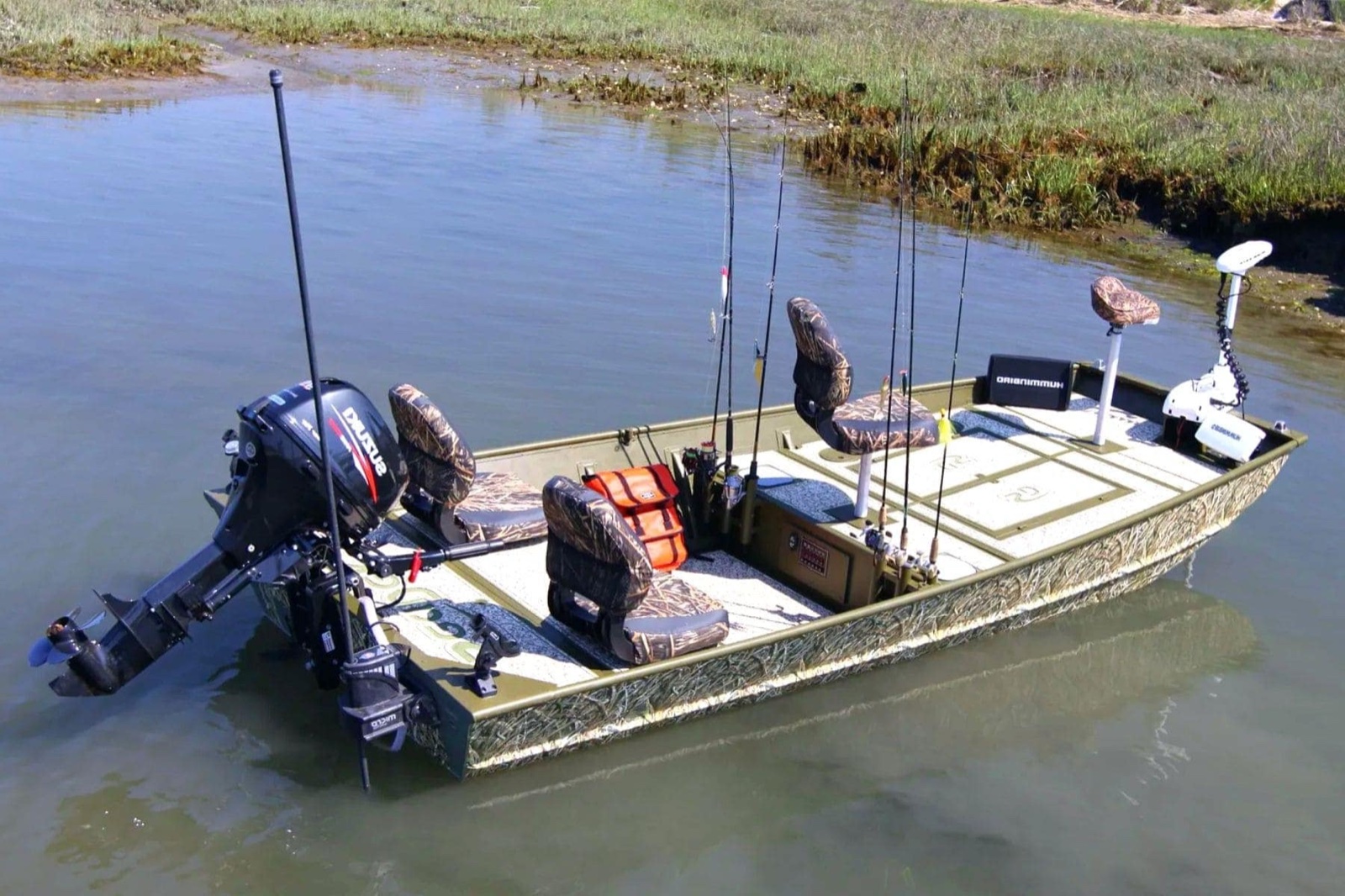
The G3 Jon 1860 CCJ is one of the few center-console jons in the aluminum market. Most jons in this size class ship as tiller or side-console boats. The CCJ build adds a small center console with side-mount controls and a finished floor as part of the standard package. G3 is the Yamaha-owned aluminum boat division, and the dealer footprint reflects Yamaha's outboard distribution.
What is the G3 1860 CCJ?
The 1860 CCJ is an 18-foot all-welded aluminum jon with a 60-inch bottom width, a mod-V bow, and a center console. Beam at the gunwale is 7 feet 2 inches, dry weight sits at 725 pounds. Hull thickness is .100-gauge aluminum throughout the welded construction. There are no rivets in the structural hull.
The center console is the layout signature. A small fiberglass or aluminum console mounted on the centerline, with a tilt wheel, side-mount throttle and shift controls, a small dash for electronics, and a storage compartment underneath. The layout works for one-up running where the owner stands at the helm with the boat under remote control, and it gives a forward console seat for a second angler.
The finished floor and bench-seat package on the CCJ build saves the buyer the cost of building out the deck after purchase. Bench seats are mounted forward and aft of the console, with mounting points for bow trolling motors and stern transducers. The transom rating takes a Yamaha outboard in the 60 to 90 horsepower range, which is the natural pairing given the Yamaha ownership.
Who is it good for?
Serious duck hunters running larger rivers and big-water marshes are the core buyer. The 60-inch floor takes a blind, two hunters, and a dog. The welded construction handles the abuse of submerged debris and tight backwater work. The center console gives a real running position for the long pre-dawn runs to a hunting spot, which a tiller jon would do worse.
Center-console fans are the second profile. A lot of jon buyers come from a center-console bay boat or a flats skiff background, and they want the same running position on an aluminum hull. The CCJ scratches that itch.
River anglers fishing the Tennessee River system or larger southern rivers are the third profile. I spent a long late-spring weekend on a CCJ working the upper Tennessee River, two anglers throwing spinnerbaits along blowdowns, the boat sitting steady under the bow trolling motor while I drove from the side-mount controls when we wanted to relocate. That is the workflow the boat was built for.
Who is it not good for?
Tiller-only purists. A lot of jon buyers want the open floor that a tiller layout gives. The center console takes up real working space, and for owners who fish standing up at the bow and walking the deck, the open-floor tiller jon is the right choice.
Mud-motor users who want the heaviest-gauge hull are the second wrong fit. The CCJ's .100-gauge construction handles a lot, but the dedicated mud-motor hulls from War Eagle and Weldbilt use thicker aluminum and reinforced transoms. Buyers running a Pro Drive or Gator Tail through hard mud every weekend should look at the heavier specs.
Buyers shopping on entry price are the third exclusion. The CCJ is meaningfully more expensive than a tiller riveted Tracker Grizzly or a basic side-console Lowe. The center console and finished floor add real cost.
Pricing
New 2026 pricing on the G3 1860 CCJ hull lands roughly $8,200 to $13,500 depending on console spec, floor option, and seat package. Add a Yamaha 60 to 90 horsepower outboard, a trailer, and a basic electronics package, and the out-the-door build sits $16,000 to $26,000.
The used market is active. Clean hulls with outboard and trailer range $6,000 to $12,000 depending on year, condition, and spec. G3 jons hold value well, partly because of the Yamaha dealer network and partly because the welded construction outlasts the riveted competition.
What works
- All-welded .100-gauge hull with clean seam construction throughout.
- Center-console layout with side-mount controls. Useful for one-up running.
- Mod-V bow softens the ride in wind chop and small open-water conditions.
- Yamaha-backed dealer network. Service and parts are widely available.
- Finished floor and bench-seat package included on the CCJ build.
- Transom rating takes the right Yamaha outboard for the hull, which is the natural drivetrain pairing.
What doesn't
- Center console takes up working floor space.
- Hull weight at 725 pounds is significant at a primitive ramp.
- Trailer is not included in the base hull price.
- Console electronics options are limited compared to a bass boat helm.
- Hardware spec is mid-tier, not premium.
- Top-spec builds approach welded bass-boat money.
Year-by-year notes
The G3 1860 CCJ has been in production since the mid-2010s. The earlier hulls had a less refined console mount and a thinner floor coating. The 2019-onward builds carry the current welded seam pattern, the improved console bracketry, and the better floor coating. Buyers shopping used should verify which build year the boat is on, because the spread between early and current production is meaningful.
Cost of ownership
Annual costs are modest for an aluminum jon. A Yamaha 60 to 90 horsepower outboard wants 100-hour service intervals, which run $250 to $450 in parts and labor at a dealer. Trailer bearings repack annually. The bare-aluminum hull does not need antifouling on a trailered boat. Insurance on a $18,000 package in a typical inland market runs $350 to $600 a year.
A five-year hold on a 2022 G3 1860 CCJ with a 70 horsepower Yamaha, used 35 days a year on Reelfoot Lake and the surrounding river systems, lands at roughly $2,200 to $3,500 a year all-in over the hold. The capital cost is the biggest line.
Build and finish detail
A walk-around of the CCJ at a dealer lot tells you a lot about where the cost goes. The welded seams are clean and continuous, with no obvious cosmetic issues at the chine or the keel. The console mount is bracketed in a way that shows the build prioritizes durability over aesthetics. The floor coating, when specified, is sprayed evenly and feels grippy underfoot even when wet. The bench seats are aluminum-framed with vinyl pads, and the mount points are welded rather than bolted. Hardware throughout, from rod holders to cleats to the trolling-motor pad, is stainless or anodized aluminum.
The boat reads as functional, not premium. There is no carpet, no leatherette upholstery, no carbon trim. That is the right choice for the use case. A hunting and fishing jon should be easy to clean, easy to repair, and durable, and the CCJ build delivers on those criteria. Compared to a bass-boat tournament rig at twice the money, the CCJ feels plain. Compared to a riveted entry-tier jon at half the money, the CCJ feels considered and well finished. The boat sits where it should in the welded mid-tier.
Best year and trim to buy
2019-onward CCJ hulls with the current welded seam pattern, the improved console mount, and a Yamaha 60 to 90 horsepower outboard with current service are the right buy in 2026. Verify five things before signing. First, the welds along the chine and at the transom-to-side joints are clean. Second, the console mount has no visible cracks or repair work. Third, the floor coating is intact with no large delamination. Fourth, the trailer is in working order. Fifth, the Yamaha outboard has a current service file from a Yamaha dealer.
Sea trial notes
A sea trial on a CCJ is short but worth doing carefully. First, launch and load from the trailer to confirm the boat handles cleanly. At 725 pounds dry, the trailer setup matters. Second, run the boat at cruise on whatever water is available. The mod-V should soften small wind chop and the hull should track straight under power. Third, watch the bilge under load for any seepage at the welded seams. A welded jon should not be taking on water. Fourth, listen to the seams under load and look for any flex at the transom with a Yamaha outboard mounted at the rated horsepower.
A long October weekend on the Tennessee River north of one of the major dams is a typical environment for this boat. Cool mornings, slack current pools, a pair of anglers working a stretch of blowdowns from the casting platforms while the boat sits steady under a bow trolling motor. The center console gives the running position for the longer cross-river hops, and the side-mount controls put the throttle within easy reach. That is the workflow the CCJ was built for.
A second walk-around on a used hull should focus on the welds and the console mount. Look for continuous, clean weld lines along the chine, the keel, and the transom-to-side joints. Any sign of repair work is worth a deeper look. Inspect the console mounting bracketry for cracks or movement, because the console is a high-stress component on a small hull. Check the floor coating for delamination, the bench seats for cracking at the mount points, and the trailer bunks and bearings for condition.
Alternatives
The closest welded cross-shop at similar size and price is the Lowe Roughneck 1860, which offers tiller and side-console builds as alternatives to the CCJ's center-console layout. For buyers stepping down to riveted construction at a lower price, the Tracker Grizzly 1648 Jon is the entry-tier alternative. Buyers wanting a heavier-gauge mud-motor hull should look at the War Eagle 754 VS.