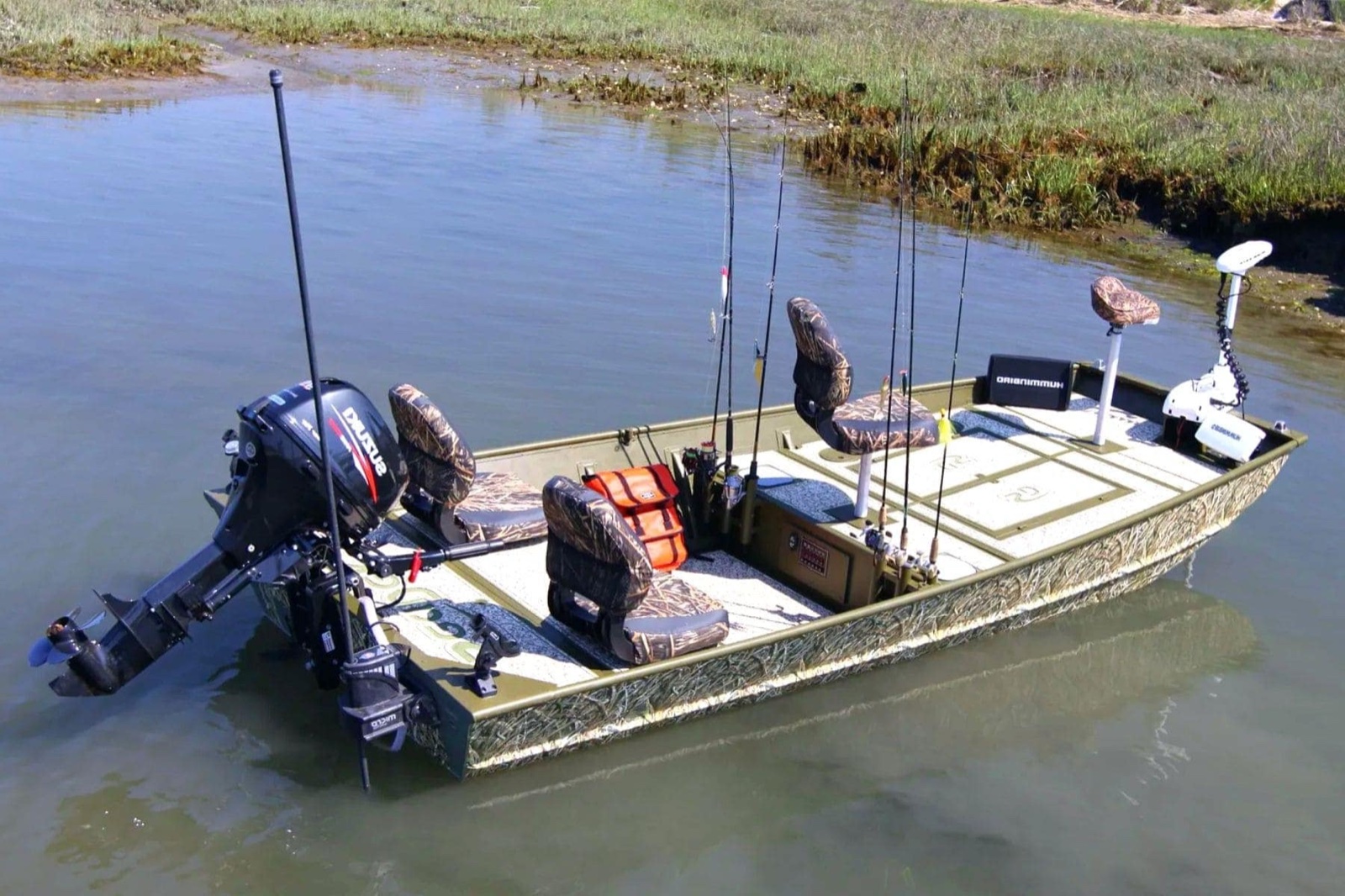
The Tracker Grizzly 1648 Jon is the entry-tier riveted aluminum jon in the Tracker lineup, sold mostly as a Bass Pro Shops package with trailer and basic accessories included. It is the boat a lot of river anglers and duck hunters end up with as their first dedicated rig, and the price point is what makes that happen. It is not the most rugged jon in the segment, but it gets a working boat under a buyer for less money than the welded competition.
What is the Grizzly 1648?
The Grizzly 1648 is a 16-foot aluminum jon with a 48-inch bottom width at the floor, a mod-V bow, and a flat working deck. Beam at the gunwale is 5 feet 10 inches. Dry weight is 395 pounds, which is light enough that two people can manhandle the hull off the trailer at a poor ramp. Hull thickness is .100-gauge aluminum, the entry tier in this segment. Construction is riveted, not welded, which is the cost-driving choice on the build.
Layout is plain. Bench seats run across the hull at three points: forward, mid, and aft. The floor is bare aluminum, sometimes with a sprayed or painted finish. The transom is rated for a small outboard. The Bass Pro package typically pairs the boat with a Mercury 9.9 or 15 horsepower tiller motor, which is enough to push the boat at a working pace on a river or shallow lake. A bow-mount trolling motor pad and a stern jack-plate for a transducer are standard mounts.
The mod-V bow is the meaningful design choice on this generation. A pure flat-bottom jon pounds in any chop. The mod-V softens the entry and lets the boat work small wind chop without shaking out the fillings of the people on board. It is not a deep-V hull and it does not pretend to be. It is a small concession to comfort that still keeps the draft shallow.
Who is it good for?
Weekend anglers and duck hunters running rivers, sloughs, and backwaters are the core buyer. The boat is shallow enough to push up into water where bigger hulls cannot follow, light enough to launch at primitive ramps, and cheap enough to leave at a fish camp without losing sleep. Tracker's Bass Pro package gives buyers everything they need to leave the lot ready to fish.
I spent a frosty December morning on a 1648 working a backwater off the Mississippi Delta with two friends, decoys stacked on the forward deck, the boat tucked into flooded timber where the water was barely deep enough to float the hull. The shallow draft and the light weight are why the boat works for that. A welded heavier jon would have pushed into the bottom and stuck.
Budget-first buyers fit the second profile. The Grizzly is one of the cheapest ways to get into a 16-foot aluminum jon with a trailer included. For a buyer who fishes 20 days a year and does not need a hull that will outlast them, the package math is right.
Who is it not good for?
Big-water owners should walk past. The 1648 is not built for open lakes with serious wind chop or coastal use. The freeboard is short, the hull is light, and the boat will be unhappy in a real two-foot sea.
Owners who plan to use the boat hard over a decade are the second wrong fit. Riveted construction works fine for years of moderate use, but a welded G3 or War Eagle will outlast a riveted Grizzly under hard service. Pull a heavy boat hard onto a rocky bar a hundred times and the welded hull is the one that takes it without loosening rivets.
Buyers planning to mount a heavier outboard are the third exclusion. The transom rating limits the motor choice. Anyone wanting to hang a 25 to 40 horsepower outboard on a 16-foot jon should look at a wider-transom, heavier-gauge welded competitor.
Pricing
New 2026 pricing on the Grizzly 1648 hull-and-trailer package through Bass Pro typically lands $4,500 to $7,200 before the outboard. Adding a Mercury 9.9 or 15 horsepower tiller and a basic accessory bundle pushes the out-the-door number to $7,500 to $11,500 depending on the package and the dealer.
The used market is broad and active. Clean hulls with motor and trailer range $2,200 to $5,800 depending on year, hours, and rivet condition. Older painted hulls with rivet-seam wear and trailer rust live at the bottom of that range. Late-model packages with low hours sit at the top. Depreciation is steeper than welded competitors, but the entry price is lower, so the dollar loss over five years is roughly comparable on a percentage basis.
What works
- Bass Pro package pricing is the lowest entry point in the segment.
- Mod-V bow handles small chop better than a pure flat-bottom.
- .100-gauge aluminum is adequate for the recreational use case.
- Wide bench seating and an open deck work for two-angler fishing or duck-hunting setups.
- Trailer is included in the package, which is not standard with most welded competitors.
- Dealer footprint through Bass Pro and Cabela's is wide and parts are easy to source.
What doesn't
- Riveted construction loosens over a decade of hard use. Welded outlasts.
- .100-gauge is the entry-tier hull thickness, not the heavy-duty spec.
- Painted finish chips and shows wear faster than bare-aluminum welded hulls.
- Transom rating limits the outboard options to small motors.
- Resale lags welded competitors at year five and beyond.
- Cleats, rod holders, and small hardware are functional, not premium.
Year-by-year notes
The Grizzly 1648 has been in the Tracker lineup since the early 2010s on broadly the same hull. Tracker has refined the rivet pattern, the bench-seat construction, and the trailer spec across the production run, but the basic boat has not changed substantially. Buyers shopping used will find that hulls from 2018 onward have the current rivet pattern and a slightly heavier transom. Pre-2015 hulls are still useful boats but show their age on the rivet seams first. The painted finish on early hulls has been the most common wear point.
Cost of ownership
Annual recurring costs are low. A small outboard wants oil change and lower-unit gear oil at the end of the season. Bottom finish on a trailered hull does not need annual antifouling. Trailer bearings want a season-end repack. Insurance on a $6,000 package in most markets runs $200 to $400 a year. The recurring cost picture on a jon boat is dominated by the trailer and the outboard, not the hull.
A five-year hold on a 2024 Grizzly 1648 package bought at $9,500 with a 15 horsepower outboard, used 25 days a year on the Mississippi backwaters, lands at roughly $1,200 to $1,800 a year all-in including fuel, insurance, oil, and amortized capital cost. That is the appeal of an aluminum jon. The math is low everywhere.
Best year and trim to buy
2018-onward hulls with the current rivet pattern, the heavier transom, and a trailer in usable condition are the right buy in 2026. Verify three things before signing. First, the rivets along the chine and the keel show no signs of loosening or weeping. Run a finger along the seam and look for stains. Second, the hull sides have no hard dents that suggest the boat has been bottomed out at speed. Third, the trailer bunks, bearings, and lights are in working order. A trailer in poor shape is a several-hundred-dollar fix that buyers sometimes overlook.
Sea trial notes
A jon-boat sea trial is shorter and simpler than a fiberglass cruiser walk-around, but the basics still matter. First, launch and load the boat from the trailer. The Grizzly is light enough that it should slide off the bunks cleanly and load back up without fighting. Second, run the boat at cruise on whatever water is available. The mod-V should soften small chop and the boat should track straight without significant rudder input. Third, watch the bilge for any seepage at the rivet seams under load. A small amount of water is normal on a riveted aluminum jon, but standing water in the bilge after a short run is a flag. Fourth, listen to the rivet seams for any creaking or pop under load. Loose rivets can sometimes be heard before they can be seen.
A morning on the lower Mississippi backwaters near Vicksburg is a typical environment for this boat. Cold air, fog rising off the slack water, a pair of hunters running out to set decoys, and a hull that takes the trip without complaint. That is the brief the Grizzly was built for, and it is what owners actually do with the boat.
A second walk-around on a used hull should check the rivet pattern along the chine, the keel, and the gunwale-to-hull joints. Look for any rivets that show a halo of dried water around the head, which is the sign of a weeping seam. Check the painted finish for chips that have exposed bare aluminum, because corrosion at chip points is the most common long-term wear story on these hulls. Inspect the transom for any flex under hand pressure with a motor mounted.
Alternatives
The closest riveted cross-shop is the Lowe Jon 1652 MT, which gives a step up in length and freeboard at a similar price tier. For a smaller riveted jon at a lower price, the Alumacraft 1448 Jon is the entry-tier cross-shop. Buyers wanting to step up to welded construction should compare the G3 Jon 1860 CCJ, which is an all-welded hull at materially more money.