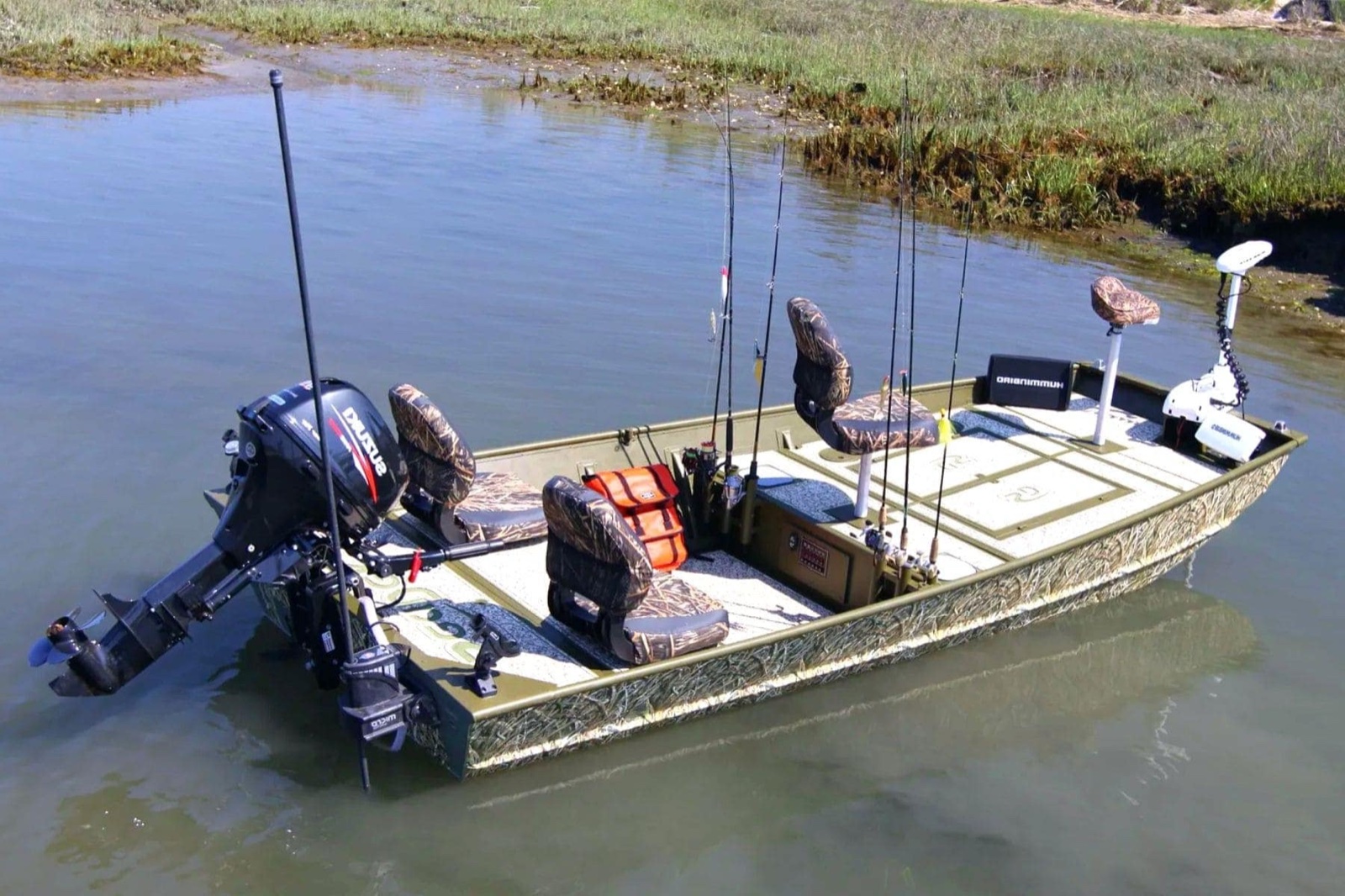
The Lowe Roughneck 1860 sits at a useful place in the aluminum jon market. It is welded, not riveted, which is the durability story most serious users care about. It is wide enough to fish two anglers or set up a duck-hunting layout without crowding. And it is priced below the top-tier mud-motor competition, which makes it a real option for buyers who want welded construction without going all the way up the cost ladder.
What is the Roughneck 1860?
The Roughneck 1860 is an 18-foot 6-inch all-welded aluminum jon with a 60-inch bottom width and a mod-V bow. Beam at the gunwale is 7 feet 4 inches. Dry weight sits around 650 pounds. Hull thickness is .100-gauge aluminum, with a heavier .125-gauge option available on some builds for buyers who want extra durability for rocky river work. The seam pattern is clean welded construction throughout, with no rivets in the structural hull.
The mod-V bow is one of the design decisions that matters most in real use. It softens the ride in wind chop without giving up the shallow-water capability of a jon. The boat will float in a foot of water comfortably, and it will run on plane through small chop without pounding the way a pure flat-bottom does.
Transom and floor options drive the build cost. The base boat has a small transom rating and a bare-aluminum floor. The heavy-duty transom option pushes the outboard rating to a real working horsepower, in the 60 to 90 range depending on the year and the build. The finished-floor option adds a marine-grade plywood or composite floor with a sprayed coating, plus optional casting platforms forward and aft. A buyer can leave the dealer with a bare hull to build out themselves, or with a finished boat ready to fish.
Mounting points are well thought out. Bow trolling-motor pad, stern jack-plate for transducers, gunwale rod holders on the finished builds, and a clean stern for a tiller or remote-controlled outboard.
Who is it good for?
Serious duck hunters and waterfowl owners are the core buyer. The 60-inch floor takes a blind setup, two hunters, gear, and a dog without crowding. The welded construction handles the abuse of crossing flooded fields and the kind of submerged debris hunters drag a jon across without thinking.
River anglers fishing the Tennessee River and the larger tributary systems are the second profile. I spent a long October day on a Roughneck 1860 working a stretch of the Tennessee River below one of the dams, two of us throwing crankbaits and topwaters from the casting platforms, the boat sitting steady against the current with the trolling motor holding position. That is the brief the boat was built for. A riveted entry-tier jon could do the same trip, but the welded hull will still be doing it in fifteen years.
Bowfishing owners are the third profile. The wide working floor, the welded construction, the option of a finished casting deck, and the heavy-duty transom that takes a generator-equipped lighting rig all line up. The boat ends up as a common bowfishing platform at the upper end of the budget range.
Who is it not good for?
Buyers shopping on entry price. The Roughneck costs meaningfully more than a riveted Tracker Grizzly or an Alumacraft 1448, and for owners who fish 20 days a year on calm water, the riveted competitor is the right tool at the right money.
Hard-core mud-motor users who push a jon into water that would damage an outboard are the second wrong fit. The Roughneck handles a lot, but the dedicated mud-motor hulls from War Eagle and Weldbilt use heavier-gauge aluminum and reinforced transoms that take the kind of abuse that the Roughneck would eventually feel. If you run a Pro Drive or Gator Tail on a mile of mud at full throttle every weekend, look at the heavier hulls.
Buyers who launch at primitive ramps and want a light boat are the third exclusion. At 650 pounds dry, the Roughneck is not the boat to manhandle off a trailer at a poor ramp. A 16-foot riveted jon at 400 pounds is easier on the back.
Pricing
New 2026 pricing on the Roughneck 1860 hull lands roughly $7,500 to $12,400 depending on transom rating, floor option, and seat package. Add an outboard in the 40 to 90 horsepower range, a trailer, and a basic electronics package, and the typical out-the-door build sits $14,000 to $24,000.
The used market is active. Clean hulls with outboard and trailer range $5,500 to $11,000 depending on year, condition, and build spec. Welded Lowe jons hold value better than riveted Tracker equivalents, and the resale picture at year five is one of the reasons to step up to this tier. Owners who fish hard for five years and trade have historically gotten back a meaningful share of what they paid.
What works
- All-welded .100-gauge hull. More durable than riveted competitors.
- 60-inch floor width gives a real working platform for two anglers or a duck setup.
- Mod-V bow handles wind chop better than a pure flat-bottom jon.
- Transom rating takes a real outboard, up to 60 to 90 horsepower on the heavy-duty option.
- Finished-floor option saves the buyer the cost of building out the deck after purchase.
- Resale on Lowe welded jons is stronger than riveted alternatives at the same length.
What doesn't
- Hull weight at 650 pounds is significant for a primitive launch.
- Trailer is not included in the hull price.
- Bare-aluminum finish is the right choice for durability but shows scuffs and stains.
- Bench seating in the base build is functional, not comfortable on a long day.
- Hardware spec is mid-tier, not premium.
- Top-spec finished builds with the heavy-duty transom and casting platforms get into welded bass-boat money.
Year-by-year notes
The Roughneck 1860 has been in production since the early 2010s on broadly the same hull. Lowe has refined the welded seam pattern, the transom construction, and the floor options across the years. The 2018-onward hulls carry the current welding spec and the heavier transom option. Buyers shopping used should verify which floor and transom build is on the boat, because the spread in spec between a base bare-floor build and a finished heavy-duty build is wide, and the two boats live very different lives.
Cost of ownership
Annual costs are modest. A 60 to 90 horsepower outboard wants 100-hour service intervals, which run $200 to $400 in parts and labor at a dealer. Trailer bearings repack annually, bunks replace every four to six years depending on use. The bare-aluminum hull does not need antifouling. Insurance on a $15,000 package in a typical inland market runs $300 to $550 a year.
A five-year hold on a 2022 Roughneck 1860 with a 60 horsepower outboard, used 35 days a year on a Tennessee River system, lands at roughly $2,000 to $3,200 a year all-in over the hold. The capital cost is the biggest line, and most of that comes back at resale.
Best year and trim to buy
2018-onward Roughnecks with the heavy-duty transom, the finished-floor option, and the welded seams clean and continuous are the right buy in 2026. Verify five things before signing. First, the welds along the chine and at the transom-to-side joints are clean and continuous, with no signs of repair work. Second, the transom rating matches what is hanging on the back. Third, the floor coating, if there is one, has no large delamination patches. Fourth, the trailer bunks and bearings are in working order. Fifth, the outboard has a current service file.
Sea trial notes
A sea trial on a Roughneck is short and direct. First, launch and load the boat from the trailer. At 650 pounds dry, the boat needs a working trailer with bunks in good shape, and the launch should be clean. Second, run the boat at cruise on whatever water is available. The mod-V should soften small chop and the hull should track straight under power. Third, watch the bilge under load. A welded aluminum hull should not be taking on water at the seams. Any water in the bilge after a short run is a flag worth investigating. Fourth, listen to the welded seams under load and inspect the transom for any flex with a motor mounted at the rated horsepower.
A morning on the Tennessee River just below one of the upstream dams is a typical environment for this boat. Cool air, slack water, a pair of anglers throwing crankbaits along the bank, and a hull that holds position under a bow trolling motor with the side-console controls within easy reach. That is the brief the Roughneck was built for.
A second walk-around on a used hull should focus on the welds. Look for continuous, clean weld lines along the chine, the keel, and where the transom meets the hull sides. Any sign of repair work, especially at the transom, is worth a deeper look. Check the floor coating, if equipped, for delamination patches. Inspect the bench seats for any cracking at the mounting points. Verify the trailer bunks, bearings, and lights are in working order, because a trailer in poor shape is a several-hundred-dollar fix that buyers sometimes overlook in the moment.
Alternatives
For buyers stepping down to riveted construction at a lower price, the Tracker Grizzly 1648 Jon is the entry-tier cross-shop. At the same welded tier, the G3 Jon 1860 CCJ is the Yamaha-owned alternative with a slightly different floor option list. For buyers wanting to step up to a heavier-gauge mud-motor hull, the War Eagle 754 VS is the next tier up.