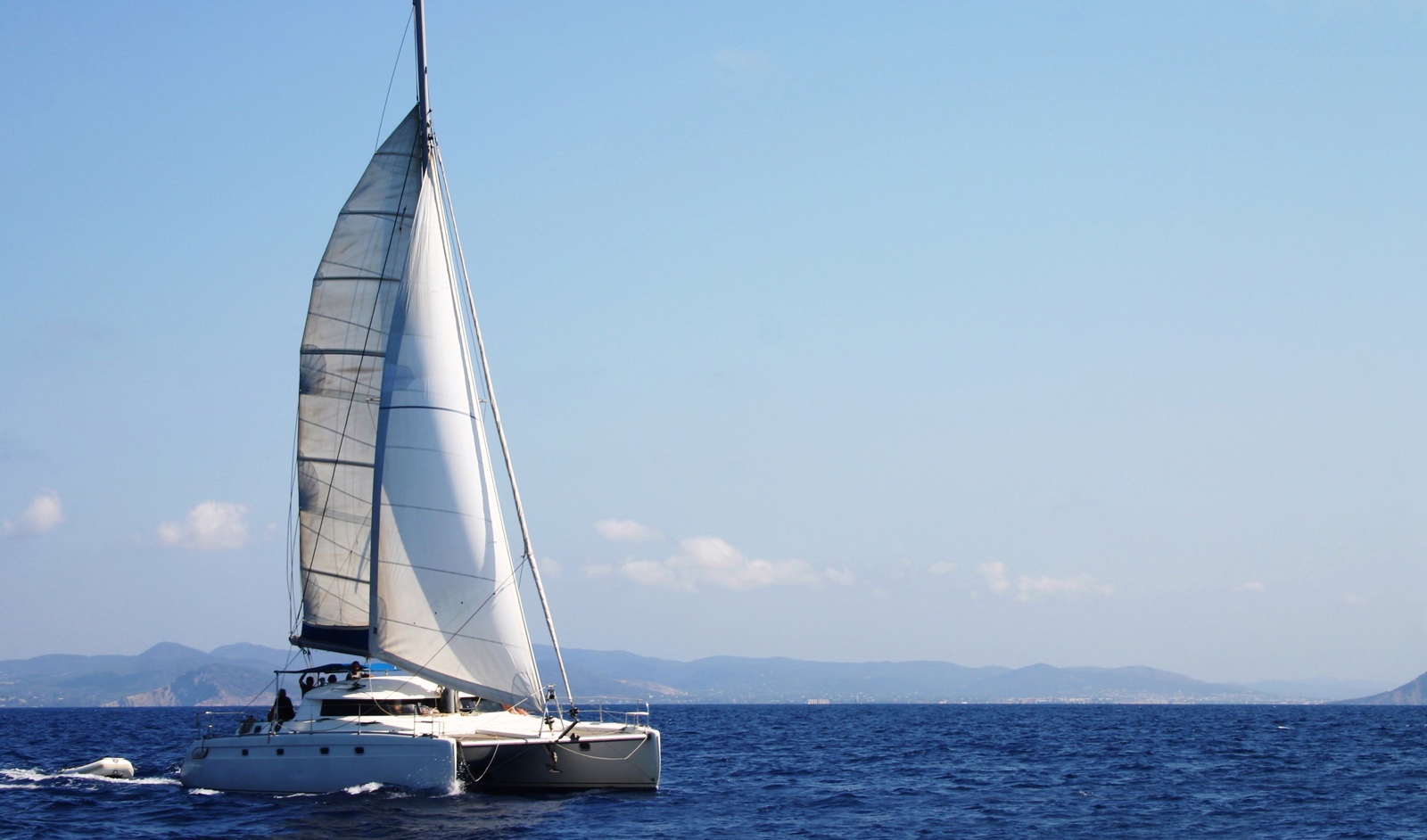
The Gemini 105Mc is one of the rare cruising catamarans that fits in a monohull slip. Gemini Catamarans built the 105Mc and predecessors from a yard in Pennsylvania for decades, founded by Tony Smith, the designer who shaped the boat. The 105Mc ran from 1993 to 2011 as the company's mid-range cruiser, and the boats are still common on East Coast docks, in Florida, the Bahamas, and the Chesapeake. The narrow beam is the boat's defining feature, and it is what makes the 105Mc work in a market where wide cat slips are scarce or expensive.
What is the Gemini 105Mc?
The 105Mc is a 33-foot 6-inch fiberglass cruising catamaran with a 14-foot beam, a draft of around 1 foot 6 inches with centerboards up and 5 feet with them down, and a displacement around 9,300 pounds. The 14-foot beam is narrow for a cat of this length. A typical Lagoon or Leopard in similar length carries a 22 to 25-foot beam, so the Gemini's footprint is materially smaller. That narrower footprint is what lets the boat fit in a slip designed for a 36-foot monohull, and it is the spec line that justifies the boat for owners in slip-constrained markets.
Power comes from a single Westerbeke diesel in the 27 to 30-horsepower range, driving twin sail-drives on later production or a single sail-drive on earlier hulls. The single-engine layout is simpler and cheaper to maintain than twin-engine cats, but it gives up the redundancy that twin-diesel boats carry. Fuel capacity sits at around 30 gallons. The diesel handles the displacement at six and a half knots under power and burns about half a gallon per hour at cruise.
Below decks is where the boat earns its place. Three cabins (one in each hull plus a forward double in the bridge), a head with shower, and a galley along the back wall of the saloon that connects directly to the aft cockpit. Standing headroom is six feet in most of the cabin. We rode aboard a 2007 105Mc tied alongside the dock at a Mediterranean charter base near Athens one early-summer morning, and the volume below decks for a 33-foot boat was the surprise. The cabin felt like a 36 to 38-foot monohull, with the cat layout giving private sleeping quarters that a monohull at the same length cannot offer.
Who is it good for?
Liveaboard couples cruising the East Coast, Florida, the Bahamas, or the Chesapeake on a budget are the core buyer. The 105Mc covers the case where you want a cat for the cabin volume, the shoal-draft cruising, and the private sleeping quarters, but you do not want to spend a half-million dollars on a Lagoon 42. A clean Gemini in the $85,000 to $100,000 band gives you most of what makes a cat appealing.
Coastal cruisers who want the cat layout in a slip-constrained market are the second profile. Many marinas on the East Coast and in Florida do not have wide cat slips, or they charge a wide-slip premium. The Gemini fits in a monohull slip at monohull cost, which is part of why the boats are still in active use decades after the production ended.
The third buyer is the shoal-draft cruiser. Centerboards up at 1 foot 6 inches of draft opens up cruising grounds in the Bahamas, the Florida Gulf coast, and the Chesapeake shallows that a 4 to 5-foot fixed-keel monohull cannot reach. People who want to anchor close to a beach or work shallow flats appreciate the spec.
Who is it not good for?
Offshore cruisers planning ocean passages should walk past the 105Mc. The boat is a coastal cruiser, built for protected water and short-hop offshore work. The build is sized for that, not for a transatlantic, and the bridgedeck clearance plus the narrow beam plus the modest rig all make the boat the wrong tool for a long bluewater passage.
Performance sailors should also skip. The 105Mc is slow. The narrow beam limits stability under sail, the rig is sized for cruising rather than for performance, and light-air pace is below what a comparable monohull at the same length would deliver.
The third anti-profile is the buyer who wants a stand-up engine room, a watermaker as standard, generator power, and the systems redundancy of a 45-foot Lagoon or Leopard. The 105Mc is a smaller, simpler, less-built boat, and buyers who want the premium-cat feel are looking at a Lagoon 380 or a Leopard 40 at materially more money.
Pricing
The Gemini 105Mc is no longer in current production. The Gemini brand was succeeded by the Legacy 35 and newer models. On the used market, 2003 to 2010 hulls in clean condition sit in the $58,000 to $115,000 band depending on year, engine condition, sail age, electronics, and rigging history. The broader market runs from about $38,000 for older or higher-hour boats up to $145,000 for low-hour examples with recent re-rigs and updated electronics.
Depreciation has flattened. A 2008 105Mc that sold new for around $145,000 sits in the $80,000 to $95,000 band, which is close to where it has been sitting for the last several seasons. The cat segment in general holds value reasonably and the Gemini at the entry-level price point continues to find buyers.
What works
- 14-foot beam fits in monohull slips at monohull cost
- Twin shoal-draft hulls with centerboards. Draft drops under 2 feet
- Cabin volume is generous for a 33-foot boat. Three cabins, head with shower, working galley
- Single Westerbeke diesel is simpler and cheaper than twin-engine cats
- Hull weight at 9,300 pounds means the boat is trailerable on a heavy-duty rig
- Entry-level cat pricing. A clean 105Mc costs a third of a comparable Lagoon
- Tony Smith design heritage. Long-tested hull form with a known service profile
What doesn't
- Sailing performance is modest
- Build sits a tier below Lagoon or Leopard
- Standing rigging on older hulls is past replacement age
- Centerboard mechanism asks for service every 5-8 years
- Single-engine layout on earlier production reduces redundancy
- Used-market resale is softer than for premium cats
Year-by-year notes
The 105Mc ran from 1993 to 2011. Earlier production used a single sail-drive driven by the Westerbeke diesel, with later production moving to twin sail-drives for improved maneuverability. Electronics shifted from older monochrome plotters to color Raymarine and Garmin units across the production. The hull form did not change meaningfully across the run. Interior finish and hardware got incremental updates. On any 105Mc over 15 years old, the standing rigging, the sail-drive seals, the centerboard mechanism, and the bridgedeck through-hulls all want a careful look at survey. There is no defect cutover year, but the older the boat, the more accumulated service tasks come with the buy.
Cost of ownership
A 105Mc kept in a Florida or Bahamas slip at 100 sailing days a season costs roughly $9,000 to $14,000 a year all-in once you spread the recurring lines across an ownership year. The single-engine layout and the smaller footprint keep costs below what a comparable Lagoon or Leopard would carry. Annual haul-out and bottom paint runs $1,200 to $2,200 because the cat still has two hulls, even if the beam is narrow.
The Westerbeke diesel wants oil and impeller service every 100 hours or annually, at $250 to $400 in parts. Sail-drive service every 200 hours runs $500 to $900. Standing rigging replacement comes due every 10 to 15 years and costs $6,500 to $11,000 on a 33-footer. Sail life on the original main and jib is 5 to 7 seasons of regular use, with replacement at $4,500 to $8,000 for the package in cruising fabric. Insurance on a $90,000 hull value is $1,200 to $2,200 a year depending on cruising area and named-storm exposure.
Best year and trim to buy
A 2005 to 2010 Gemini 105Mc with the Westerbeke diesel, twin sail-drives if you can find a later-production hull, a B&G or Raymarine plotter at the helm, and a recent rigging inspection is the right buy in 2026. Look for a boat with a clear service history on the centerboard mechanism and the sail-drive seals, and a clean engine log.
Check five things before buying. First, the standing rigging age and condition. Anything over 12 years old is on borrowed time. Second, the sail-drive seals and the lower-unit service log. Failure here is the cat-specific repair line. Third, the centerboard mechanism on the shoal-draft option. The wire and the pivot pin both wear with use. Fourth, the bridgedeck through-hulls and seacock service. Fifth, the Westerbeke engine log. Older Westerbekes are durable but they want regular service.
Alternatives
The premium cross-shop at slightly more length is the Lagoon 380, a real step up in build, volume, and ownership cost. The Robertson and Caine cross-shop is the Leopard 40, a wider, better-built cat at materially more money. The monohull alternative at similar interior volume is the Catalina 355, which trades the cat layout for monohull simplicity at similar price.