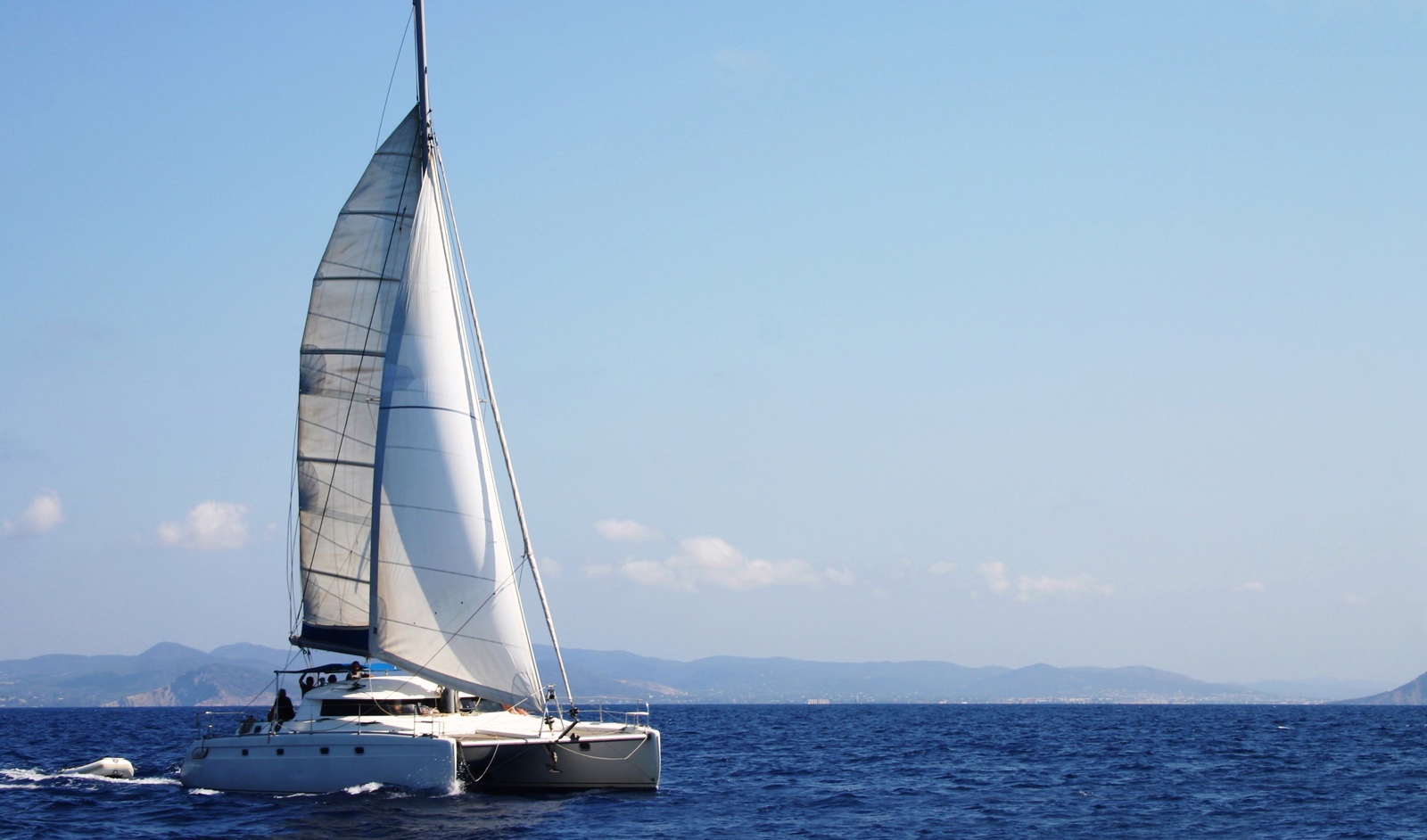
The Hunter 33 is the value pick in the under-$50k first-cruiser segment. Hunter Marine started building boats in Alachua, Florida in the 1970s, and by the mid-1980s the company had a production model that emphasized interior volume, easy systems, and a price that brought sailboat ownership down to a number first-time buyers could actually swing. The 33 went through several revisions between 1980 and 1998, but the through-line is consistent. More boat for less money than the equivalent Catalina or Pearson, and a build that reflects the price.
What is the Hunter 33?
The 33 is a 33-foot fiberglass sloop with a beam of 11 feet 6 inches, which is the widest beam at the length in this segment. Draft is 4 feet 6 inches on the shoal-keel version and 5 feet 6 inches on the deep-keel. Displacement is around 11,500 pounds, lighter than a comparable Catalina 30 and noticeably lighter than the Pearson 323. Auxiliary power is almost always a Yanmar 2GM20F or 3GM30F. Hunter wasn't shy about repowering at the factory through the production run.
The B&R rig is the design choice that defines the boat. There's no backstay. The shrouds sweep aft to handle the rig load, which means the boom can carry a big square-cut main without interfering with the standing rigging. The cost is mast-bend control. With no backstay to play with, you can't flatten the main the way you would on a more conventional rig. For coastal cruising, this is a non-issue. For owners who want to push the boat hard upwind, the rig sets a ceiling on what's possible.
The interior is what makes this boat different. A U-dinette to port that converts to a double, a settee to starboard, a forward V-berth that fits two adults, and a quarter berth that doubles as storage. Sleeps four comfortably with two more in a pinch. Headroom is 6 feet 3 inches in the saloon, tallest in this segment. The galley sits to port at the foot of the companionway with a two-burner alcohol or propane stove (depending on year), an icebox, and a stainless sink. The head is to starboard with a wet shower. Build quality inside the boat is honest. The vinyl headliner is replaceable, the cabinetry is plywood with vinyl or veneer surfaces, and the joinery is functional rather than showpiece.
The deck is balsa-cored on most hulls, which drives the survey priority. Hardware bedding leaks, and over forty years the deck core around stanchions, the mast step, and the deck-stepped hardware can soften. A moisture meter is the right tool, and a clean reading is the buy signal. A soft deck is a project that runs into five figures fast.
Who is it good for?
First-time cruisers who want the most interior space their money will buy are the right buyer. The Hunter 33 sleeps four for real, has a saloon you can host four guests in without anyone climbing over a knee, and has a galley that handles real meals. If your weekending plan involves family or friends aboard, the Hunter beats the Catalina and the Pearson on interior volume by a wide margin.
Families with kids are the second profile. The U-dinette converts to a kid's bunk, the V-berth holds two adults, the quarter berth handles a third kid or a long bag of gear. The cockpit is wide and the side decks are walkable. We chartered a 1992 Hunter 33 out of a Chesapeake yard one August for a long weekend with two adults and two kids, and the interior volume was the thing that turned the trip from a camping experience into a comfortable one. The wide beam aft means the cockpit holds five for dinner under the bimini, which is where most of the actual living happens on a coastal cruise.
Sailors who keep the boat in protected water and put 50 to 100 hours a season on the boat are the third profile. The B&R rig and the moderate displacement work fine in 12 to 18 knots on a bay or a sound. The boat sails best on a reach, makes reasonable speed downwind under a 130 or 150 percent genoa, and is honest upwind without setting any records. Coastal sailing is what Hunter designed the boat for, and that's where it earns its money.
Who is it not good for?
Sailors planning a fifteen-plus-year hold should buy a different boat. The Hunter 33 is a five-to-ten-year boat for most owners. The build, the hardware, and the deck core all set a ceiling on how long the boat can be sailed hard without major reinvestment. If you want a hull that will still be tight in 2050, the Pearson 323 is the better choice.
Sailors who want to race or push the rig hard should also look elsewhere. The B&R rig is the wrong tool for that work. Headsail-trim options on a beam reach are limited, mast-bend control is fixed, and the hull form doesn't reward the kind of trim adjustments a more performance-oriented design would. The boat will get you to the next harbor. It won't get you there fastest.
Buyers who need the boat to hold its price on a three-year flip should pass too. Hunter depreciation has been steady for two decades, and it's not kind to the older hulls. A 1988 Hunter 33 that sells today at $22,000 will probably sell in three years at $19,000 or $20,000. Not catastrophic. Not flat either. The Catalina 30 holds its number a little better and the Pearson 323 holds it noticeably better at the same length.
Pricing
The Hunter 33 was discontinued in 1998 after multiple revisions, so new-boat pricing doesn't apply. The used market in 2026 spans roughly $12,000 at the bottom (rough 1985-1988 hulls with engine issues and deferred yard work) up to $38,000 at the top (a well-kept 1995-1998 hull with a recent Yanmar, current rigging, and updated electronics).
The sweet spot is the $22,000 to $32,000 band. A 1989-1995 hull with a Yanmar 2GM20F or 3GM30F in the engine bay, standing rigging replaced within the last decade, and a deck-core moisture survey that came back clean. That's the configuration that gives you ten years of coastal cruising without writing a five-figure check for a major project.
Below $18,000 you're usually looking at a boat with deck-core issues, an engine that needs work, or both. The math on those boats is rarely favorable for a first-time owner. Survey is non-negotiable, and the moisture meter is the most important tool the surveyor will use.
What works
- Widest saloon at the length in this segment. Interior volume is the differentiator
- Sleeps four for real with a U-dinette that converts and a V-berth that fits two adults
- Headroom 6 feet 3 in the saloon. Tall sailors notice it on a walkthrough
- Pricing 15 to 20 percent under the Catalina 30 of equivalent age
- Yanmar 2GM20F and 3GM30F engines in most hulls. Any yard can service them
- B&R rig keeps the cockpit clean. No backstay to duck around at the helm
What doesn't
- Build is entry-tier. Hardware grade, gel quality, and joinery sit below Pearson and Catalina level
- Balsa-cored deck on most hulls. Moisture readings around hardware are the survey priority
- B&R rig limits headsail-trim flexibility on a beam reach. Mast bend is fixed
- Three-year depreciation 10 to 15 percent. Exit value the weakest in this segment
- Standing rigging on most older boats needs replacement. Budget $4,000 to $6,000
- Cockpit drainage is slow on older boats. The scupper layout backs up in a hard rain
Year-by-year notes
Hunter built variants of the 33 across nearly two decades, and the boats are not all the same. The early 1980s Cherubini-designed Hunter 33 (1980-1983) is a different boat from the later production. The mid-production Hunter 33 (1986-1990) is the one most buyers think of, with the B&R rig fully implemented and the wider beam. Late production (1994-1998) added the Hunter 33.5 and 336 variants with refinements to the deck layout, the cockpit drainage, and the chainplate hardware. The 336 in particular is a noticeably better boat than the earlier 33 in cockpit ergonomics and deck-hardware bedding. If you can find a clean 336 from 1995-1998 in the budget, take it over a 1988-1990 hull at the same money.
Cost of ownership
Annual costs on a Hunter 33 line up with other 30-foot to 33-foot coastal cruisers. Routine maintenance runs $1,800 to $3,500 a year if you're handy. Slip rental in protected water is $3,000 to $9,000 depending on market. Insurance is $500 to $1,000. Bottom paint every two to three years is $700 to $1,400.
The periodic lines are the ones that bite. Standing rigging replacement is $4,000 to $6,000 when it's due. A Yanmar repower, if the boat still has its original engine, is $11,000 to $16,000 installed. New sails are $3,500 to $6,000 for a working main and a 130 percent genoa. Deck-core repair, if the moisture survey finds soft spots, is the project that can blow the budget. Anywhere from $4,000 for a single small soft area to $20,000-plus for a full deck recore. This is why the moisture meter matters.
A five-year hold on a 1993 Hunter 33 bought at $26,000 with a clean survey, sailed 80 hours a year on a sound or a bay, with yard storage in winter, comes to roughly $4,500 to $7,500 a year all-in including amortized capital cost.
Best year and trim to buy
A 1989-1995 Hunter 33, or better, a 1995-1998 Hunter 336 with a Yanmar 2GM20F or 3GM30F, standing rigging replaced within the last ten years, and a clean deck-core moisture survey is the right buy in 2026. Either keel version works for most coastal sailing. The shoal keel opens up thin-water cruising in places like the Chesapeake. The deep keel sails closer to the wind for owners who care.
Verify five things before signing. First, the deck core readings around every piece of hardware. Soft spots are the project that wrecks the budget. Second, the chainplate bedding. Hunter glassed the chainplates into the bulkhead structure, and leaks at that joint cause hidden damage. Third, the rudder-post bearing. Some hulls have shown wear there at thirty years. Fourth, the engine service file. Yanmar in regular service is bulletproof. Yanmar sitting unused for a few years isn't. Fifth, the standing rigging swages and toggles. Forty-plus-year-old wire is past its working life regardless of how it looks.
Alternatives
The most-cross-shopped boat at this price is the Catalina 30. Catalina has a deeper owner network, easier parts logistics, and a build that's a half-step above Hunter on hardware and joinery. The cost is interior volume. The Catalina is narrower and the saloon doesn't open up the way the Hunter's does.
The build-quality cross-shop at similar money is the Pearson 323. Pearson gives you solid fiberglass, bonded bulkheads, and a hull designed for the open coast. The cost is interior space and saloon volume. The Pearson is a long-hold boat. The Hunter is the right answer when interior space and entry price matter more than long-term construction.