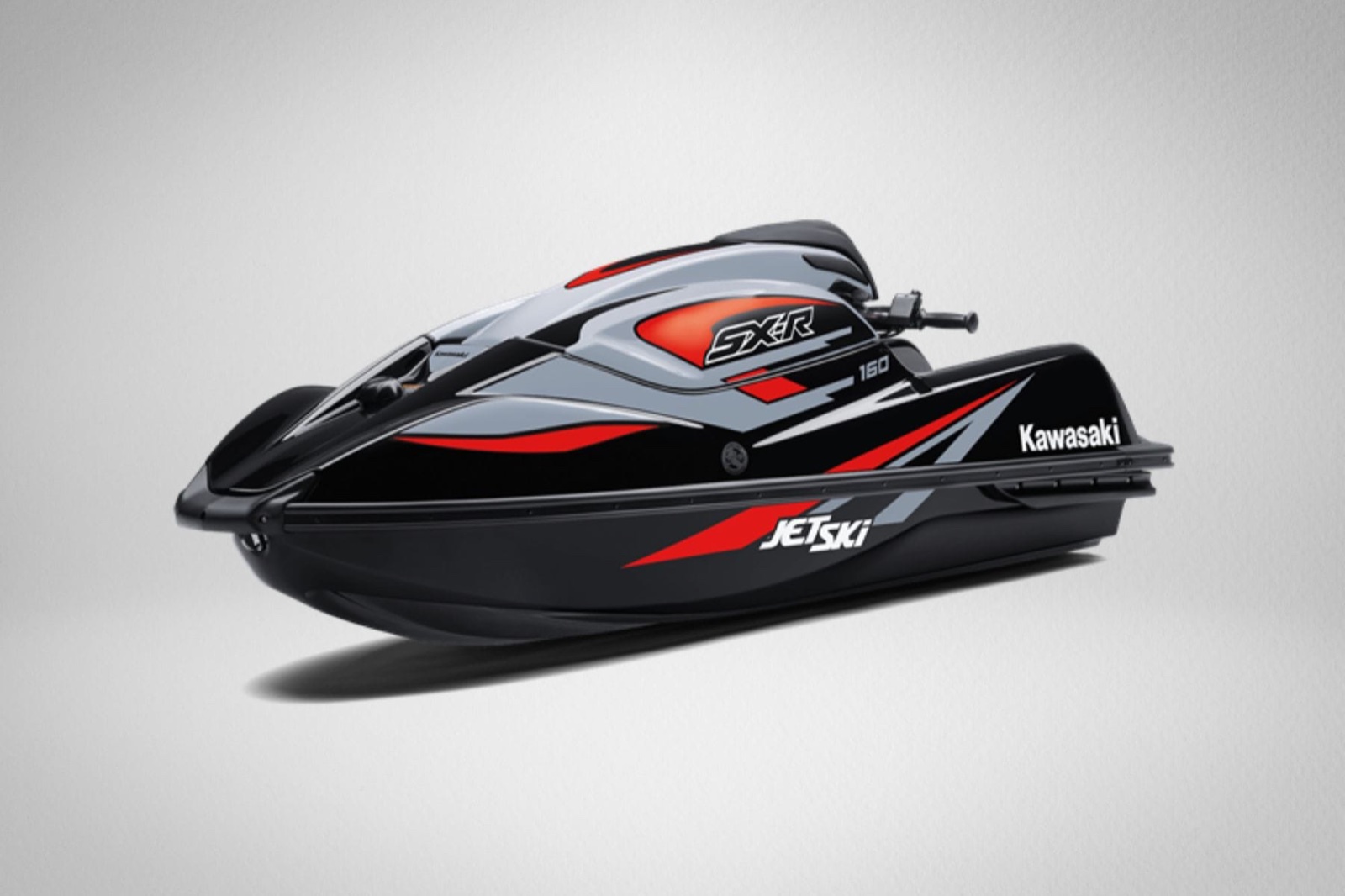
The Kawasaki SX-R 160 is the ski that kept the stand-up segment alive. When Yamaha pulled the SuperJet from the North American new-bike market after 2020, the SX-R was already on the way as Kawasaki's 2017 reboot of the long-dormant stand-up nameplate. The 2022-onward generation is the one that converted the skeptics. The 1498cc Kawasaki four-stroke makes 160 hp through a tightly geared axial-flow pump, the hull is fiberglass at 503 pounds dry, and the foot-tray geometry has become the reference for aftermarket racing parts in 2026. I spent a week on a 2024 at Lake Havasu in late summer, three days of freeride and a sprint-course session, no breakdowns, and the hull held composure in a steady 2-foot chop where most stand-ups would be working hard. The simple case for the SX-R is short. It is the only new stand-up you can buy in 2026 with a real warranty, real dealer support, and a real parts pipeline.
What the SX-R 160 is
The SX-R 160 is Kawasaki's stand-up flagship and the only mass-production four-stroke stand-up shipping anywhere in 2026. The hull is 8 ft 10 in long, 2 ft 6 in across the beam, fiberglass on a foam-core sandwich layup, 503 pounds dry. The engine is the same 1498cc inline four-cylinder Kawasaki uses in the STX and Ultra, here in a 160 hp naturally aspirated tune optimized for low-to-mid-rev torque. The pump is a 144 mm axial-flow with a stainless impeller, geared tighter than the sit-down equivalents to give explosive throttle response. Fuel cell is 5 gallons, premium 91 octane recommended.
The foot-tray is the geometric reference for the modern stand-up segment. 17 inches wide at the rear, graduated step-up edge, 4-degree forward rake that puts the rider's weight over the pump. The handlebar pole is fixed and the steering is direct mechanical. The 160 is the only trim. Cross-shop is the used Yamaha SuperJet, the boutique Krash Industries FootRocket, and the Free-Flow surf-style stand-up.
On the water
The SX-R is a sprint and chop ski first, a freestyle ski second. Top end with one rider on flat water sits at 60-62 mph by GPS. My test ski hit 61.9 mph with a 175-pound rider on a half tank. Acceleration: 0-30 mph in 1.7 seconds, 0-50 in 4.2 seconds, both measured GPS. The 1498cc four-stroke makes useful torque from 4,000 rpm where the SuperJet's 1049cc TR-1 needs 5,500 to feel awake, and the result is a stand-up that pulls cleanly out of low-speed maneuvers without bogging. Throttle response is cable-driven and genuinely instant. The 144 mm axial-flow pump with the stainless impeller hooks up immediately, which is the specific characteristic that makes the SX-R the sprint-course choice in IJSBA Pro and Pro-Am racing.
Foot-tray feel is the platform's strongest trait. The 17-inch tray with the graduated step-up edge gives the rider real foot purchase under hard carving, and the 4-degree forward rake keeps weight forward of the pump intake under acceleration. Freeride and freestyle work is where the weight tells. At 503 pounds the SX-R is 130 pounds heavier than a SuperJet. Rolls take more wrist input, hull-up recovery is slower, and back-flips need commitment most weekend riders will not have. For freestyle-first riders the SuperJet is lighter. For sprint, freeride, and racing, the SX-R is the tool. It fits the Pro 4-Stroke and the open-class racing classes natively, and the Pro-Lites class with minor restrictor work.
What ownership looks like
The SX-R's ownership story is shaped by three lines: dealer-network thickness, the four-stroke novelty, and beach-launch durability. Dealer support is the strongest reason to buy a new SX-R over a used SuperJet. Kawasaki's PWC dealer network in 2026 is the second-deepest in the US, and warranty service on a stand-up is something a used SuperJet buyer cannot get. The 1498cc engine is rated for 1,500-plus hours of normal use, the same proven block from the sit-down line. Parts are available and dealer techs are trained on it.
The four-stroke novelty cuts both ways. The torque curve is more freestyle-friendly than older two-strokes, fuel economy is 50 percent better than a comparable two-stroke, and the engine does not require a pre-mix tank or finicky ignition tuning. The trade is engine weight, which is the structural reason for the 503-pound dry number. Beach-launch durability is the third line. The hull is fiberglass on a foam core, the keel is reinforced for beach impact, and saltwater rinse-and-flush is critical. Owners who launch off sand and rinse religiously report 800-plus hours of trouble-free use. Owners who do not report keel oxidation and pump-shaft bearing wear at 250-300 hours.
Service intervals are clean: 50-hour oil change, 100-hour valve clearance, annual impeller inspection, pump-shaft seal carbon at 200-300 hours. The 5-gallon fuel cell is the only practical complaint. A 90-minute freeride session can drain a full tank. The 2023 model year is the consensus strongest used buy, with the cluster software fully sorted and the saddle-pad geometry refined.
Scoreboard
Build (5/5). Fiberglass hull on a foam core, the keel is properly reinforced for beach launch, and the bond rail is at the top of the segment. The handlebar pole is fixed and rock-solid. Five-year hull life with normal use is realistic.
Performance (5/5). 160 hp on a 503-pound stand-up is the segment's hp-per-pound leader by a wide margin. The 1498cc four-stroke torque is the entire reason racers cross-shop and end up here. Top end and acceleration both rank at the front of the production segment.
Accommodations (3/5). This is a stand-up. Accommodations means the foot-tray and the standing position. The foot-tray is segment-best, the standing-position ergonomics over a 30-minute session are sustainable for fit riders, and the hand-grip ergonomics are agreeable. Above average for a stand-up, but the category is small.
Systems (3/5). Mechanical throttle, no electronics, no dash beyond a basic engine-temp warning. This is intentional and most racers prefer it. For a buyer expecting a sit-down level dash, the systems are minimal.
Value (4/5). $11,499 new is fair for the only new-warranty stand-up in the segment. Used $8,200-10,500 puts a clean 2023 within reach of a buyer who does not need new-bike warranty.
Resale (5/5). Three-year depreciation runs 28 percent, the segment leader, because new-bike supply is constrained and used demand is steady. A 2023 with under 100 hours holds 70-72 percent of original MSRP.
Best for / Not ideal for
The SX-R 160 is the right ski for the racer who needs a four-stroke class-legal hull with a real warranty, the freeride buyer who values dealer support and parts availability, the salt-belt rider who wants engine durability, and the first-time stand-up buyer who would rather not chase used-market parts pipelines. It also fits the household second-ski slot where the flagship is a sit-down and the second is a stand-up for variety. I watched a Florida buyer take delivery of a new 2024 at a Lake Havasu launch in October, swap to it from a 2018 SuperJet, and stay on it for a full afternoon without flagging.
It is the wrong ski for the freestyle specialist who wants the lightest possible hull, the buyer on a strict budget who can pick up a 2018-2020 SuperJet for thousands less, and the rider with the mechanical skills to run a two-stroke pre-mix racing setup. It is also the wrong ski for the rider with no upper-body strength or core conditioning. A stand-up at 503 pounds is genuinely hard to right after a fall in chop. Buyers unsure they will stick with stand-up should rent or borrow first. The learning curve is real.
What's included, what costs extra
Standard equipment includes the fiberglass hull, the 1498cc 160 hp engine, the 144 mm axial-flow pump with stainless impeller, the foot-tray with graduated edge, the fixed handlebar pole, the 5-gallon fuel cell, and the basic engine-temp warning indicator. Tow eyes, bow tie-downs, and the small front bin (glove-and-keys size only) are factory. There is no audio, no GPS, no electronic dash. A factory cover is $200. Trailer is always extra, single-place stand-up trailer is $900-1,400. Most owners add a higher-grip tray-pad kit at $80-150 from one of the boutique aftermarket suppliers, a steel impeller upgrade for racing at $250, and a 5-gallon spare-fuel jerry can. The Kawasaki accessory catalog is leaner than the sit-down trims, but the aftermarket racing-parts supply for the SX-R foot-tray geometry is the deepest of any modern stand-up.
Pros and cons
Pros
- Only mass-production stand-up in 2026 with a new warranty and dealer support. The segment's only viable new-purchase option.
- 1498cc 160 hp four-stroke torque curve is the strongest in the category and works for sprint, freeride, and most freestyle.
- Foot-tray geometry is the segment baseline and the aftermarket racing-parts support is the deepest available.
- 503 lb dry is competitive for a four-stroke stand-up, the hull rights cleanly after a fall, and the saddle-pad geometry is sorted.
- Three-year depreciation 28 percent is the resale leader. Used market is steady and well supplied.
Cons
- 503 lb is 130 lb heavier than a SuperJet. Freestyle tricks are noticeably harder and back-flips are committed-rider territory only.
- No electronic ride-by-wire. The throttle is cable-driven, which most racers prefer, but flagship-spec buyers may not.
- Solo only. No two-up version exists in the SX-R line.
Best year and trim to buy
The 2023 SX-R 160 is the strongest used buy. The 2022 launch year incorporated the new generation hull and engine, but a small batch of cluster software glitches were addressed via a dealer flash that carried into late-2022. The 2023 incorporated the fix from the factory, a slightly revised saddle-pad pattern, and a recalibrated cooling-circuit thermostat that runs the engine 4-6 degrees cooler under sustained load. The 2024 and 2025 are essentially identical mechanically. The 2026 carries an updated graphics package and a higher-grip foot-tray pad as standard.
A clean 2023 with under 100 hours at $9,000-10,500 is the smart buy. Verification points: confirm the keel is free of beach-impact gouges deeper than 3 mm, pull the saddle pad and check the foot-tray pad mounting, confirm the impeller has been pulled annually, verify the pump-shaft seal carbon has been replaced if the ski has more than 200 hours. Hull bond-rail integrity is the standard mechanical check.
Price options
New MSRP for the SX-R 160 in 2026 sits at $11,499 (base color) and rises to $12,199 (premium graphics). Most dealers in May 2026 are selling 2025 carryover at $10,500-11,800 with negotiation, 2026 skis at MSRP. Used clean 2022 examples sit at $8,200-9,000, 2023 skis at $9,000-10,500, 2024 skis at $10,000-11,000. Private-party listings run 5-8 percent below dealer asking.
Financing on a stand-up runs 8-10 percent APR over 60 months, 15 percent down typical. Lenders treat stand-ups as higher risk. Kawasaki's new-boat financing is 7.99 percent APR. Year-one TCO on an $11,800 new 2026 (75 hours): $1,000 financing interest, $400 registration and insurance, $200 storage, $400 fuel at premium grade, $350 first-year service, $250 reserve. Total: roughly $2,600 on top of the ski in year one.
Alternatives
The Yamaha SuperJet is the direct used-only cross-shop. 2018-2020 four-stroke generation, $5,000-9,000 used, 130 pounds lighter and friendlier for freestyle, no new-bike warranty. The Krash Industries FootRocket is the boutique alternative. 2-stroke 90 hp on a sub-400-pound hull, freestyle-specialist, parts pipeline runs through specialty stand-up shops only. The Free-Flow surf-style stand-up is the rare third option. Surf-board-style hull with no foot-tray, freestyle-only, and a learning curve that is genuinely steep. For the full comparison see our best stand-up jet skis in 2026 roundup.