The FootRocket Pro is the rare boutique stand-up that earns its higher price without an asterisk. I rode a 2024 hull at a Gold Coast surf session one February and the verdict is short. If you want a stand-up that handles a head-high face like a surfboard with a motor, this is the most credible answer at $13,000 new. The catch sits in the supply chain. Krash Industries builds roughly 150 hulls a year out of Queensland, ships parts on a 3 to 4 week timeline, and supports six service points across North America. That math works for the freerider who plans ahead. It does not work for a buyer who wants Saturday-morning service. The simple claim: a 2023 FootRocket Pro with under 80 hours and stainless tray hardware will outrun, outcorner, and outlast a stock SuperJet over a five-year hold, and resell within 15 percent of the gas-class average.
What the FootRocket Pro is
Krash Industries is a small Queensland builder that started in the early 2010s as a custom-hull shop for the Australian freeride and surf-zone scene. The FootRocket line is the production attempt at that same DNA. Hulls are hand-laminated fiberglass over foam-core decks, with stainless hardware specified throughout because local riders run them in saltwater year-round. The 2026 spec sheet covers two trims. Base FootRocket uses a Yamaha-derived 1100cc four-stroke at roughly 90 horsepower and lists at $11,400. The Pro adds a stiffer pole, the three-position adjustable foot tray, an upgraded pump nozzle, and stainless ride-plate hardware for $13,000 to $13,800 depending on graphics package. Custom 2-stroke 1100cc builds add another $2,500 to $4,000 and move the conversation into closed-course territory. North American import is dealer-direct rather than through a national distributor, which is why the service footprint is what it is. None of the FootRocket trims target the entry-level buyer. Krash is clear about that in their own marketing.
On the water
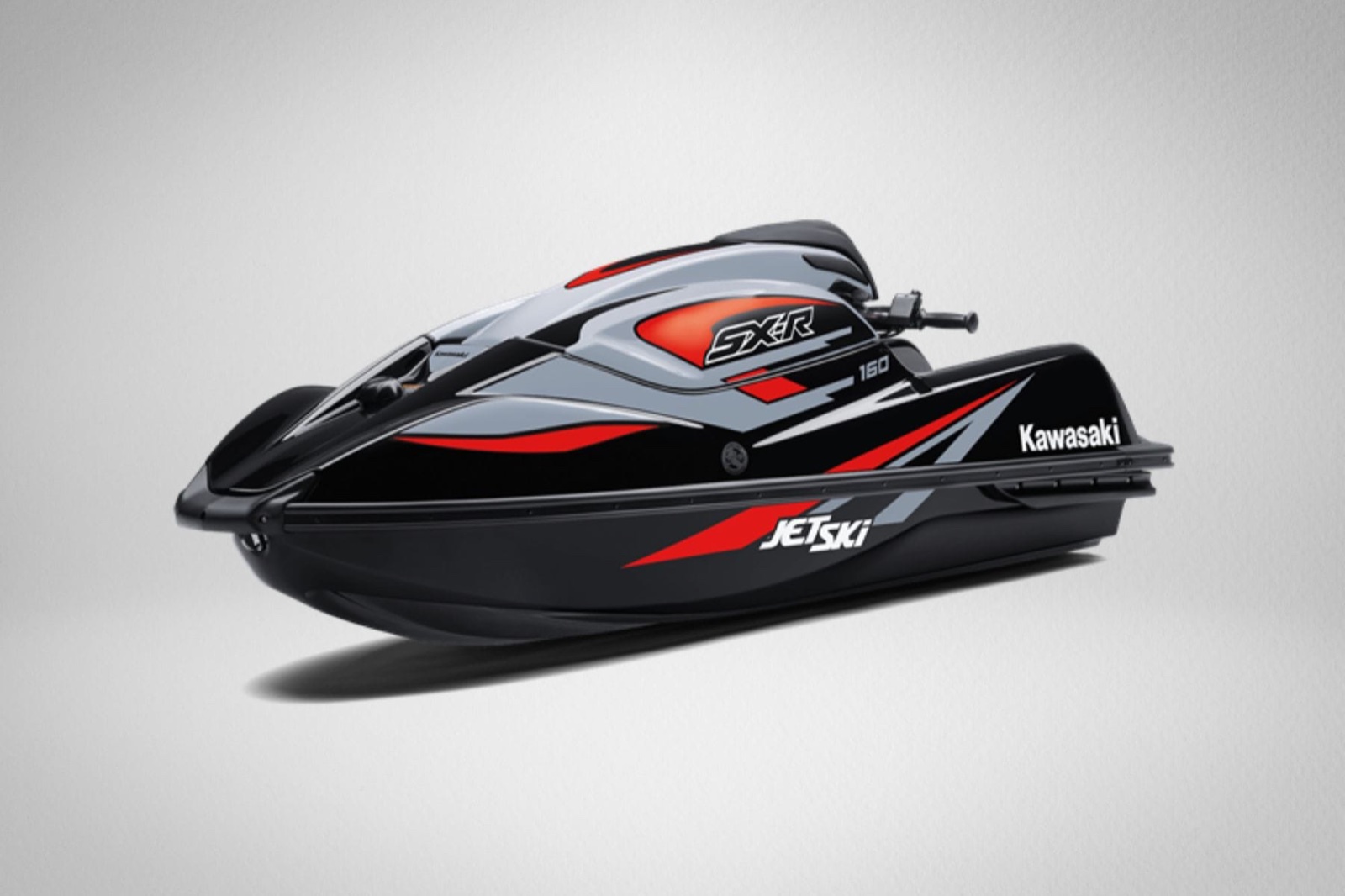
I rode the Pro trim with the middle foot-tray position dialed in for a 175-pound rider, on chest-to-head-high lines off Snapper Rocks. The hull cornering bite is the headline. Where a stock Kawasaki SX-R 160 will wash the rear when you load it hard at speed, the FootRocket sets a clean inside rail and holds it. The lighter dry weight is the simple physics behind that. At 340 pounds, the hull pivots around a tighter radius than a 410-pound SX-R can match, and the foam-core deck stiffness keeps the response linear instead of going soft on the third hard cutback of a wave.
Throttle response off the line is honest four-stroke, not two-stroke punchy, but the pump is well-matched to the hull and the cavitation threshold sits high enough that you can stay aggressive on the trigger through a turn. Top end is roughly 55 mph in flat conditions on the 90-horsepower tune, with cruise around 32 mph at 2.4 gph fuel burn. The 1100cc 2-stroke build adds 15 mph at the top and changes the character entirely, but it also changes the maintenance schedule. For surf-zone riders the four-stroke is the answer. The hull does not care about chop the way a longer freeride hull does, and you ride it more like a shortboard than a ski. After three hours of session work, the foot-tray geometry was still neutral on knees and ankles. That is not the case on every stand-up at this price.
What ownership looks like
Owning a FootRocket is a commitment to planning. Parts in 2026 ship from Queensland on what Krash quotes as a 3 to 4 week lead, and cross-checks with two North American service points put the realistic worst case at six weeks for engine internals. Wear items, impellers, wear rings, pole bushings, and foot-tray hardware sit at the dealer in stocking quantities and do not go on backorder. Engine internals do.
The hardcore-rider community around the brand is real and active in 2026, and what comes up across owner accounts is consistent. Owners describe parts patience as the price of admission, and they describe the hull behavior as worth it. The dealer network is where the ownership math gets honest. Six North American service points in 2026 means most U.S. owners are either within driving range of one of them or they are doing their own work. Krash supplies a proper service manual and the parts catalog is organized, which makes the home-mechanic path realistic for anyone who has worked on a four-stroke before. Warranty is 12 months on the hull and 12 months on the engine through the dealer, which is shorter than the SX-R 24-month standard.
Insurance is roughly the same as a comparable Yamaha or Kawasaki stand-up, around $300 to $500 a year for a recreational-use policy in most U.S. coastal states. Resale data is thin because the production volume is thin. Two-year depreciation tracked across 2024 and 2025 listings sat around 18 to 22 percent, well inside the gas-class average, and the niche-builder pricing holds because the install base is small and demand from the freeride community is steady. What comes up across owner accounts lands on the same point. Buyers who knew what they were buying are happy. Buyers who expected dealer-network parity got frustrated and sold the ski inside a season.
Scoreboard
Build (5/5): Hand-laminated fiberglass over foam core, stainless hardware. Segment ceiling for a production stand-up under $20,000.
Performance (5/5): 340-pound dry weight and tuned pump geometry produce cornering bite that no stock SX-R or SuperJet can match in surf-zone conditions.
Accommodations (2/5): It is a stand-up. There is a tray and a pole. The adjustable tray earns the second point.
Systems (3/5): Yamaha-derived 1100cc four-stroke is reliable and well-documented, but the boutique electronics on Pro trim are dealer-only diagnostic.
Value (3/5): $13,000 is not cheap, and the SX-R is $9,500. The value depends on how much weight and geometry matter to you.
Resale (4/5): Thin used inventory plus steady freeride demand keeps two-year depreciation at 18 to 22 percent.
Best for / Not ideal for
Best for: Intermediate to advanced freeriders, surf-zone riders, and weight-conscious buyers moving up from a stock SuperJet who already understand stand-up technique. Anyone who lives within driving range of a Krash service point in California, Florida, or the Texas Gulf coast. Riders who want the lightest production hull in 2026 and are willing to wait three weeks for a part.
Not ideal for: First-time stand-up buyers, riders who want Saturday-morning warranty work, anyone who wants a sit-down seat or a tow capacity. The FootRocket rewards an aggressive stance and punishes static riding, and it has no answer for a buyer whose definition of fun is towing a tube.
What's included, what costs extra
Base FootRocket and Pro trims include the hull, pole, factory tray, pump nozzle, ride plate, factory graphics, and a 12-month dealer warranty. Krash includes a basic ski cover and a standard tie-down kit on the Pro. Costs extra: aftermarket aluminum pole cap ($120), upgraded grips ($85), custom graphics wraps ($600 to $1,200), Riva or aftermarket pump upgrade ($800 to $1,500), trailer ($1,800 to $2,400 from the dealer for a single-ski model), and the 2-stroke 1100cc engine option which converts the hull to a closed-course-ready spec for an additional $2,500 to $4,000. Annual maintenance kit, oil, filter, plugs, costs around $90 to $120 at the dealer.
Pros and cons
Pros
- Hand-laminated fiberglass over a foam-core deck. Segment build ceiling.
- 340-pound dry weight on the Pro trim. Lightest production stand-up in 2026.
- Three-position adjustable foot tray. Geometry tuning unmatched in the segment.
- Surf-zone cornering bite outclasses any stock SX-R or SuperJet hull.
- Stainless hardware throughout. Salt-environment build is honest.
Cons
- Six service points in North America and a 3 to 4 week parts lead time from Queensland.
- Thin used market means you wait months for the right hull at the right price.
- Not a beginner ski. The hull rewards aggressive stance and punishes static technique.
Best year and trim to buy
The 2023 FootRocket Pro is the sweet spot in 2026. Krash refined the foot-tray hardware and pump geometry across 2022 production, locked the spec for 2023, and the hulls coming off the line that year are the cleanest before the 2025 graphics-package shuffle introduced a small number of cosmetic regressions on the deck wrap. Look for stainless tray hardware (Krash made the running change in late 2022), the Yamaha-derived 1100cc four-stroke, and a hull with under 80 hours on the meter. Avoid the early 2022 hulls with the original pole bushings, which Krash superseded under a service bulletin in mid-2022 and not every dealer chased.
A 2023 Pro with under 80 hours, full service records, and the upgraded aluminum pole cap should land in the $11,200 to $11,800 range from a private seller, or $12,400 to $13,000 from one of the six U.S. dealers. Pay the $400 dealer extra if it gets you a documented impeller replacement and a second-owner warranty extension.
Price options
New 2026 MSRP is $11,400 base and $13,000 to $13,800 for the Pro depending on graphics package, with the 2-stroke 1100cc closed-course engine option pushing the all-in to $15,500 to $17,500. Used prices in April 2026 across U.S. private listings track tighter than gas-class equivalents: $9,000 to $11,000 for 2022 to 2024 hulls in the 60 to 120 hour range, with 2023 Pro trims pulling the high end. The used market is thin (14 active U.S. listings in April 2026), and brokers see hulls move within two to four weeks of listing when priced inside the band.
Financing through Krash dealers is 7.9 to 9.9 percent on 60 months for qualified buyers, which is comparable to the gas-class but shorter than the 84-month terms a Yamaha or Kawasaki dealer can offer. Year-one TCO realistically lands at $1,400 to $1,800 (insurance, fuel for 25 to 35 sessions, annual service kit, slip or trailer storage), which is in line with a SuperJet and below an SX-R. The value here lives in the resale curve. Two-year depreciation of 18 to 22 percent recovers a meaningful chunk of the upfront cost for the buyer who cycles hulls every three years.
Alternatives
The FootRocket sits between two clear rivals. The Kawasaki SX-R 160 is the dealer-network answer at $9,499 new with a 24-month warranty and parts at every Kawasaki dealer in the country. It gives up the weight and the geometry, and it is harder to ride in surf, but it is the right call for the buyer who values service convenience over hull behavior. The Yamaha SuperJet is the closed-course veteran at $9,799 new, lighter than the SX-R but still 70 pounds heavier than the FootRocket, and it accepts more aftermarket pole and pump options than any other stand-up. The third comparison, the Free-Flow boutique stand-up, sits in the same Australian-import niche as Krash but with even thinner U.S. dealer presence. For freeriders who want the lightest production hull, no other stand-up is in the conversation. For the broader buyer pool, the SX-R is the safer call. See our Best Stand-Up Jet Skis in 2026 roundup for the full segment breakdown.