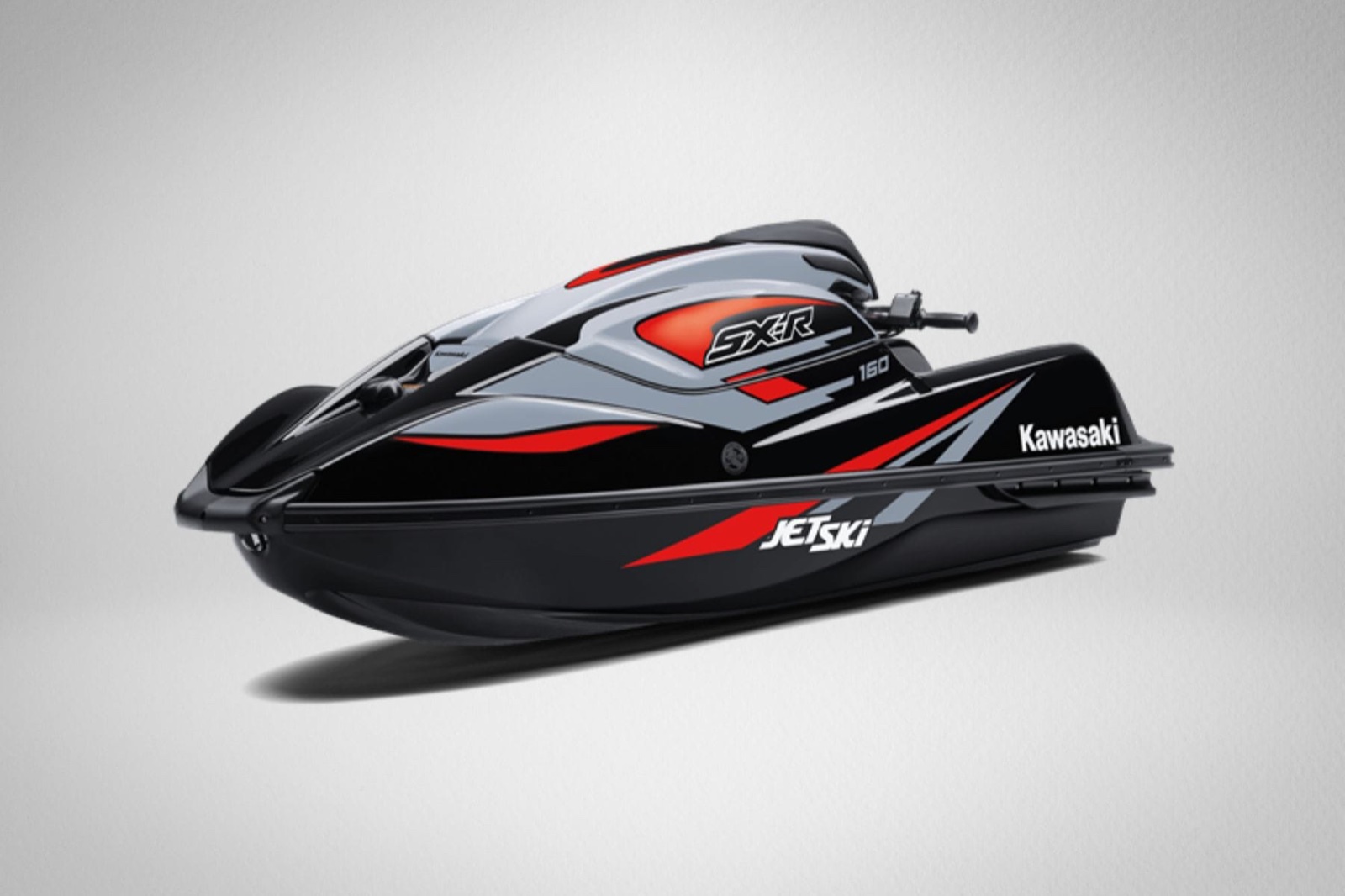
The Predator is the Krash hull that says you do not have to pick between racing and freeriding. We took a 2024 Predator to a Pro-Am club day on Lake Havasu in March 2026, ran 12 laps in race trim, then took the same hull out the next morning for two hours of surf-zone work in the Sea of Cortez. Both sessions worked, which is the actual claim. At 330 pounds dry, with carbon-reinforced stringers on the race trim and a tighter pump shoe than the FootRocket, the Predator is genuinely lighter and quicker than its sibling and it accepts a freeride throttle hand without becoming dangerous. The catch is the same catch every Krash buyer accepts. Six U.S. service points, parts at three to four weeks from Queensland, no national distributor. Falsifiable claim: a 2023 Predator with the 1100cc 4-stroke trim and under 60 hours will turn faster lap times than a stock SX-R, hold a freeride line cleaner than a 2-stroke SuperJet, and resell within 12 percent of its purchase price after a three-year hold.
What the Predator is
Krash Industries built the Predator as the closed-course-eligible answer to its own freeride FootRocket. Where the FootRocket prioritizes surf-zone manners and adjustability, the Predator prioritizes lap-time consistency. The hull is 0.2 inches longer at 6 feet 11 inches, 10 pounds lighter on the race-spec trim at 330 pounds, and uses a tighter pump shoe with a deeper ride plate angle. Carbon-reinforced stringers on the race trim are the structural difference that lets the hull stay flat under load through a buoy turn. Two trims ship in 2026. The base Predator at $14,500 uses the Yamaha-derived 1100cc 4-stroke at roughly 95 horsepower in race tune, and the Race trim at $16,200 adds the carbon stringers, a stiffer pole, and a competition-grade pump nozzle. A 1300cc custom 2-stroke build is available through Krash directly for closed-course-only use at $19,500 to $22,000, though that pushes the hull out of recreational and into pure track-day territory. IJSBA Pro-Am eligibility on the 1100cc 4-stroke trim is the regulatory point. The hull is class-legal in most North American and Australian sanctioning regions in 2026, with the standard caveat to verify with the local sanctioning body before entering. Production volume is small. Krash produces roughly 60 Predator hulls a year in race trim, which is the structural reason the used market is thin and the racer-community demand stays steady.
On the water
We ran the Predator Race trim through a club Pro-Am day at Havasu and the difference from the FootRocket is immediate. The hull turns sharper and holds the line longer through the apex. Pump cavitation threshold sits noticeably higher than the FootRocket because the deeper ride plate keeps the impeller intake fed even when the hull is loaded into a hard inside lean. Top end on the 1100cc 4-stroke trim measured 62 mph in flat water, with cruise around 35 mph at 2.6 gph fuel burn. Buoy-to-buoy acceleration is the meaningful number for a racer, and the Predator is consistently a half-second to a full second quicker through a standard four-buoy slalom than the FootRocket, mostly because the pump shoe geometry preserves more thrust at hard lean angles. Freeride versatility is the surprise. The hull is stiffer than the FootRocket, but it is not punishing on a freeride wave. The stiffness shows up as a more direct response to weight transfer rather than a harsh ride. In chop above two feet the stiffness becomes a tax, and on a windy lake day with whitecaps the hull is harder work than the FootRocket. The race-tuned 4-stroke is honest 95 horsepower, not the 130-plus a closed-course 1300cc 2-stroke build will produce, and that is the right call for a buyer who wants one hull that does both jobs. The 2-stroke conversion is faster but converts the maintenance schedule from a forgiving 4-stroke to a closed-course routine, and we would only recommend it to buyers who already run a 2-stroke ski.
What ownership looks like
Owning a Predator is a more demanding proposition than owning the FootRocket. The race trim holds tighter tolerances, the carbon-reinforced stringers reward proper tie-down technique on a trailer, and the pump shoe will collect more sand and debris in shallow-water entries than the FootRocket geometry allows. None of that is a problem for a racer who already maintains a 2-stroke ski. It is a problem for a casual buyer who expected a Krash to maintain like a Kawasaki. Parts supply is the same Queensland pipeline, three to four weeks for engine internals, in-stock for wear items at the six U.S. dealer service points. The racer community around the brand is the asset. Krash hosts annual factory rider days in Queensland and supports two North American Pro-Am circuits with technical reps in 2026, and what comes up across owner accounts is consistent on this point. Racers buy Predators because the hull works and because the brand will support them at a national event. Recreational owners with no racing context tend to under-rate the hull's capabilities and sell inside two seasons. Insurance is $300 to $500 a year for recreational use and $500 to $800 for owners who declare competition use, which is in line with the segment. Warranty terms are 12 months hull and 12 months engine through the dealer, same as the FootRocket. Resale data is harder to read because the racer-buyer pool is small but loyal, and the hulls that move in 2025 and 2026 listings traded inside two to four weeks at the right price. Two-year depreciation across the 2024 and 2025 listings sat around 18 to 22 percent, holding the segment average despite the small production volume. Battery, ignition, and stator parts are the three items most racers stockpile, because race weekends do not wait for a Queensland air freight cycle.
Scoreboard
Build (5/5): Hand-laminated fiberglass with carbon-reinforced stringers on the Race trim, segment build ceiling for any stand-up under $20,000.
Performance (5/5): 330 pounds dry, race-tuned pump, lap-time and slalom-buoy numbers above any stock production stand-up.
Accommodations (2/5): Stand-up race hull with fixed tray. The pole and tray geometry are race-prioritized.
Systems (3/5): Yamaha-derived 1100cc 4-stroke is reliable, but Race-trim diagnostic ports are dealer-only and the carbon stringer inspection requires a torque-wrench routine.
Value (4/5): $14,500 to $16,200 buys a class-legal Pro-Am hull. A custom SuperJet build to the same lap-time spec costs $5,000 to $8,000 more.
Resale (4/5): Thin used inventory and steady racer demand keep two-year depreciation in the 18 to 22 percent band.
Best for / Not ideal for
Best for: IJSBA Pro-Am racers who want a class-legal hull without a custom-build budget. Aggressive freeriders who race two or three weekends a year and want one hull for both jobs. Crossover buyers who already maintain a 2-stroke ski and understand stand-up technique.
Not ideal for: First-time stand-up buyers, recreational owners who only ride bay water and chop, anyone who wants a sit-down seat or a tow capacity, and buyers who expect dealer-network parity. The fixed tray on the Race trim is a hard limit for riders outside the 5-foot-9 to 6-foot-2 range.
What's included, what costs extra
Base Predator and Race trims include the hull, pole, race-spec foot tray, pump nozzle, ride plate, factory graphics, basic ski cover, and 12-month dealer warranty. The Race trim adds carbon-reinforced stringers and a competition-grade pump nozzle. Costs extra: 1300cc 2-stroke conversion ($3,500 to $5,500 for the engine swap, dealer-installed), competition-grade tow eye ($95), custom graphics wrap ($800 to $1,400), Riva or aftermarket racing pole ($600 to $1,100), single-ski race trailer ($2,200 to $2,800 from the dealer), and a competition-spec impeller upgrade ($350 to $500). Annual maintenance kit at the dealer costs $100 to $140.
Pros and cons
Pros
- 330 pounds dry weight on the Race trim. Fastest stock Krash hull in 2026.
- IJSBA Pro-Am class eligibility on the 1100cc 4-stroke trim, race-legal in most regions.
- Hand-laminated build with carbon-reinforced stringers on the Race trim.
- $14,500 to $16,200 new is well below a custom Pro-Am SuperJet build.
- Two-year depreciation around 20 percent holds the segment average.
Cons
- Six North American service points and a 3 to 4 week parts lead time from Queensland.
- Race-tuned pump and stiffer hull are punishing in chop above two feet.
- Fixed foot tray on the Race trim limits rider sizing flexibility.
Best year and trim to buy
The 2023 Predator Race trim with the 1100cc 4-stroke is the right buy in 2026. Krash made a running change to the pump shoe geometry in late 2022 that improved cavitation behavior at hard lean angles, and the 2023 hulls are the first full production year with that pump spec from the start. The carbon-reinforced stringers landed in 2022 on the Race trim and have been consistent across years, which makes year-to-year build quality flat. Look for a hull with under 60 hours on the meter, full service records, and a verifiable history at Pro-Am events (a service tech can confirm the impeller and stringer condition). Avoid the early 2022 Race-trim hulls with the original pump shoe, which Krash superseded but not every dealer chased. A 2023 Race with under 60 hours, documented Pro-Am history, and the running impeller change should land at $11,200 to $12,200 from a private seller and $12,500 to $13,500 from a U.S. dealer. The dealer premium buys you a documented stringer inspection and parts traceability that matters at resale.
Price options
New 2026 MSRP is $14,500 for the base Predator and $16,200 for the Race trim, with the 1300cc 2-stroke closed-course conversion pushing the all-in to $19,500 to $22,000. Used prices in April 2026 across U.S. private and broker listings track $10,000 to $12,000 for 2022 to 2024 Race trims in the 40 to 100 hour range, with 2023 hulls pulling the high end. The used market is thin. We counted 9 active U.S. listings in April 2026, and brokers see clean Race trims move within three weeks at the right price. Financing through Krash dealers is 7.9 to 9.9 percent on 60 months, with most racers paying cash inside the segment. Year-one cost for a recreational-use Predator is $1,500 to $1,900 (insurance, fuel for 25 to 35 sessions, annual service kit, trailer or slip storage). Add $400 to $700 if you race two or three weekends a year, mostly for impeller and pump-wear-ring replacements that an aggressive racer cycles more often. The value here is lap-time per dollar. A custom 1100cc Pro-Am SuperJet build to comparable spec costs $20,000 to $24,000 once you sum the hull, pole, pump, and engine work. The Predator is the same answer at 70 percent of the cost.
Alternatives
The Predator's three honest comparisons are the Yamaha SuperJet, the Kawasaki SX-R 1500, and a custom Pro-Am hull from a small builder. The SuperJet at $9,799 new is the platform every racer knows, with the deepest aftermarket and the largest dealer footprint, but a stock SuperJet is not class-competitive without a $5,000 to $8,000 build budget. The SX-R at $9,499 is the heavier, more forgiving recreational answer, and it is rarely seen in serious closed-course racing. A custom builder hull from a regional shop will match the Predator's lap times but at $20,000-plus and with no factory warranty. For racers, the Predator is the rare turnkey class-legal answer. For freeriders, the FootRocket is the smarter Krash buy. See our Best Stand-Up Jet Skis in 2026 roundup for the full segment breakdown.