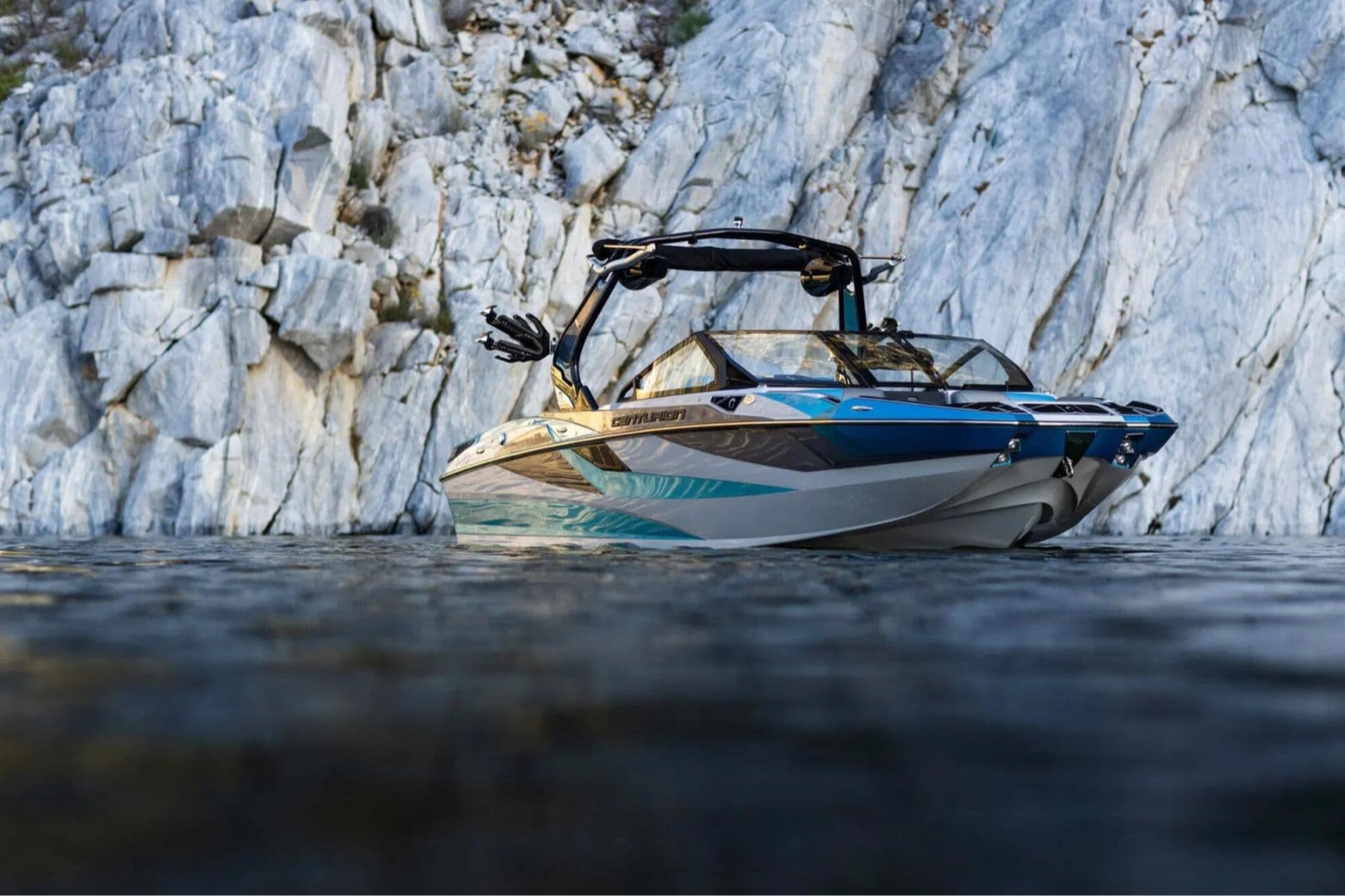
The Ski Nautique 200 is a slalom tournament boat. Nautique has been building ski boats in Orlando, Florida since the late 1950s, and the Ski 200 sits in that history as one of the cleanest expressions of a direct-drive three-event hull the company ever built. Production ran from 2005 through 2018, and on the 2026 used market the 200 is still the reference boat tournament skiers and ski-club families point at when they want the smallest possible wake at 36 mph.
What is the Nautique Ski 200?
The Ski 200 is a 20-foot 2-inch fiberglass direct-drive inboard. Beam is 7 feet 9 inches, dry weight is 2,950 pounds, fuel capacity is 27 gallons. The drivetrain is a PCM 6.0L gas inboard turning a prop that sits in a pocket directly below the cockpit floor. That layout is the whole point of the boat. Direct-drive means the engine sits roughly amidships, weight is centered, and the prop turns through clean water under the hull rather than behind it. The wake that comes off the transom at slalom speed is the smallest, cleanest, most predictable wake in the segment, and that is what tournament skiing pays for.
The cockpit is small. There is an open bow on most builds, a walk-through windshield, a single bench across the transom that doubles as the engine cover, and a driver and observer position forward. Four people is the comfortable capacity, five is tight. There is no real swim platform party space, no surf gates, no plug-and-play ballast bags, no tower with surf-board racks. The boat is a tool with a specific job, and the cabin and cockpit volume reflect that job.
Speed control on 2010-onward boats is Zero Off, the GPS-based system that holds tournament-spec speeds within a tenth of a mile per hour. Pylon is a fixed center pylon, not a tower. Mirror is an over-the-windshield ski mirror. There is no surf-mode helm screen, no shaping app, no live ballast read-out. The helm is built for the job and nothing else.
Who is it good for?
Tournament three-event skiers are the core buyer. Slalom passes at 34 and 36 mph, trick at 18 to 21 mph, jump at 32 to 36 mph. The hull holds each of those speeds with a wake that does the right thing for each event, which is what a tournament boat is supposed to do. Club-ski families who run their kids through summer ski programs are the second profile. The 200 pulls four passes with the engine at cruise and asks for very little in return.
Households trading up from an older Ski Nautique 196 or a Malibu Response are the third. Same direct-drive philosophy, a generation cleaner on the wake and the electronics. Last fall I watched a club-ski instructor on a Texas Hill Country lake start a Saturday morning at 7 a.m. with the water still glass, run three skiers through twelve passes each before the wind came up at 10:30, and shut the boat down with the fuel gauge still showing half. That is the use case the 200 was designed around, and it does the job without complaint.
Who is it not good for?
Wakeboarders should not buy a 200. There is no ballast to shape a real wakeboarding wake, the tower is not a real wakeboarding tower, and the speed range the hull likes is below where a serious wakeboarder wants to be pulled. Wakesurfers are even less of a fit. The direct-drive prop sits where the surfer wants to ride, which is the safety reason direct-drives do not get used for surf even on boats that could theoretically shape a wave.
Families who want one boat for tubing, swimming, and a sundown drink should also walk past. The cockpit volume is sized for skiers, the swim platform is a step rather than a deck, and the 27-gallon fuel tank means a full afternoon of running between coves is going to end at the pump. A Malibu 22 LSV or an Axis A22 covers a broader brief and gives up the slalom-purity in exchange.
Buyers who want a current-production boat with current-spec electronics and warranty coverage should also pause. The Ski 200 ended production in 2018. Parts come through the Nautique dealer network and the wait varies. The newer Nautique tournament platforms cost materially more.
Pricing
The Ski 200 is out of production. Last new-MSRP windows on late builds landed near $75,000 to $90,000 depending on options. The used market in 2026 spans roughly $28,000 at the bottom (2005-2008 hulls with high hours and tired upholstery) to $65,000 at the top (clean 2016-2017 boats with current Zero Off and low hours).
The sweet spot for buyers is a 2014-2017 hull with 400 to 700 hours, the PCM 6.0L in good shape, and the file showing regular service. Those land in the $42,000 to $58,000 band on the open market. Resale depreciation from year ten onward is essentially flat. Clean tournament boats hold their price the way a quality fishing reel does. The boat is no longer being built, the demand from ski clubs and tournament skiers stays steady, and the supply is what it is.
What works
- Direct-drive prop placement gives the cleanest slalom wake at 36 mph available on the used market in 2026.
- PCM 6.0L gas inboard is reliable, parts are still in supply through the dealer network, and owners keep these engines running fifteen-plus years.
- Zero Off GPS speed control from 2010 onward holds tournament speeds with no helm input from the driver.
- Holds its price on resale better than almost anything in the ski-wake category.
- Trailer-friendly at 20 ft 2 in and 2,950 lb. A half-ton truck pulls it without complaint.
- Build is straightforward and easy to service. Most ski-club mechanics know the boat inside out.
What doesn't
- Cockpit is small. Four people is comfortable, five is tight, six is not happening.
- 27-gallon fuel tank limits the boat to short days. Plan on a refuel between the morning and afternoon sessions on busy days.
- No wake-shaping ballast, no surf gates, no real tower. The 200 is not a do-everything water-sports boat.
- Out of production since 2018. Some interior trim and helm-electronics parts have longer lead times than current-model boats.
- Direct-drive layout puts the engine box in the back of the cockpit. The bench seat across the transom is also the engine cover.
- Resale strength is good for sellers and rough on first-time buyers. Entry cost is high relative to a v-drive used wakeboat at similar money.
Year-by-year notes
The Ski Nautique 200 launched as the open-bow follow-on to the long-running Ski Nautique 196. The 2010 model year added Zero Off GPS speed control as standard, which is the cutover most tournament buyers screen for. The 2013 and 2014 builds carry refinements to the helm and the Zero Off interface. The 2015-2017 boats have the cleanest interior trim and the most recent generation of dash electronics. Production ended after the 2018 model year as Nautique reshuffled the tournament platform mix. There is no defect cutover year. Buyers should focus on engine hours, service file, and prop strut condition rather than chasing a specific year.
Cost of ownership
A direct-drive PCM 6.0L is one of the cheaper inboards in the segment to maintain. Annual service is roughly $400 to $700 in parts and labor for an oil change, impeller, and basic checks. The 300-hour valve adjustment and longer-interval items add a few hundred to that. Insurance on a $50,000 hull value is $700 to $1,200 a year depending on state. Slip rental rarely applies because most owners trailer the boat and store it under cover.
A five-year hold on a 2016 used Ski 200 bought at $48,000 with 350 hours, used 80 hours a season for club skiing on a Texas Hill Country lake with trailer storage, lands at roughly $4,500 to $7,500 a year all-in including insurance, fuel, service, and amortized capital. The amortized capital cost is the smallest line because the boat sells for close to what you paid five years on. On a Lake Powell trip a few summers ago I watched a 2012 200 owner load his boat back onto the trailer after a long weekend, hose the salt and silt off, and wave it down the road behind a half-ton pickup. The simplicity of the package is part of the appeal.
Best year and trim to buy
The 2014-2017 Ski Nautique 200 with the PCM 6.0L, Zero Off speed control, and a clean upholstery and gel coat is the right buy in 2026. Four hundred to seven hundred hours is the normal range and not a red flag if the file is in order. Look hard at the prop strut and rudder for groundings, the gel coat at the chines and the keel for repair work, and the engine for any sign of saltwater use (the boat was built for freshwater).
Verify five things pre-purchase. First, the engine hours match the file and the helm hour-meter. Second, the impeller and oil are on a current schedule. Third, the upholstery is not cracked at the seams from sun exposure. Fourth, the Zero Off interface boots cleanly and reads a GPS lock at the dealer. Fifth, the trailer is in shape, the trailer brakes work, and the bunks are not crushed flat.
Alternatives
The closest cross-shop on intent is the MasterCraft X24 for households that want a surf wave instead of a slalom wake. Different boat, different job, but the same family of decision. For broader water-sports use the Malibu 22 LSV is the all-around v-drive wakeboat the Ski 200 was never trying to be. The Axis A22 is the value-tier alternative built on the Malibu platform, a step down in materials but a step up in cockpit volume.