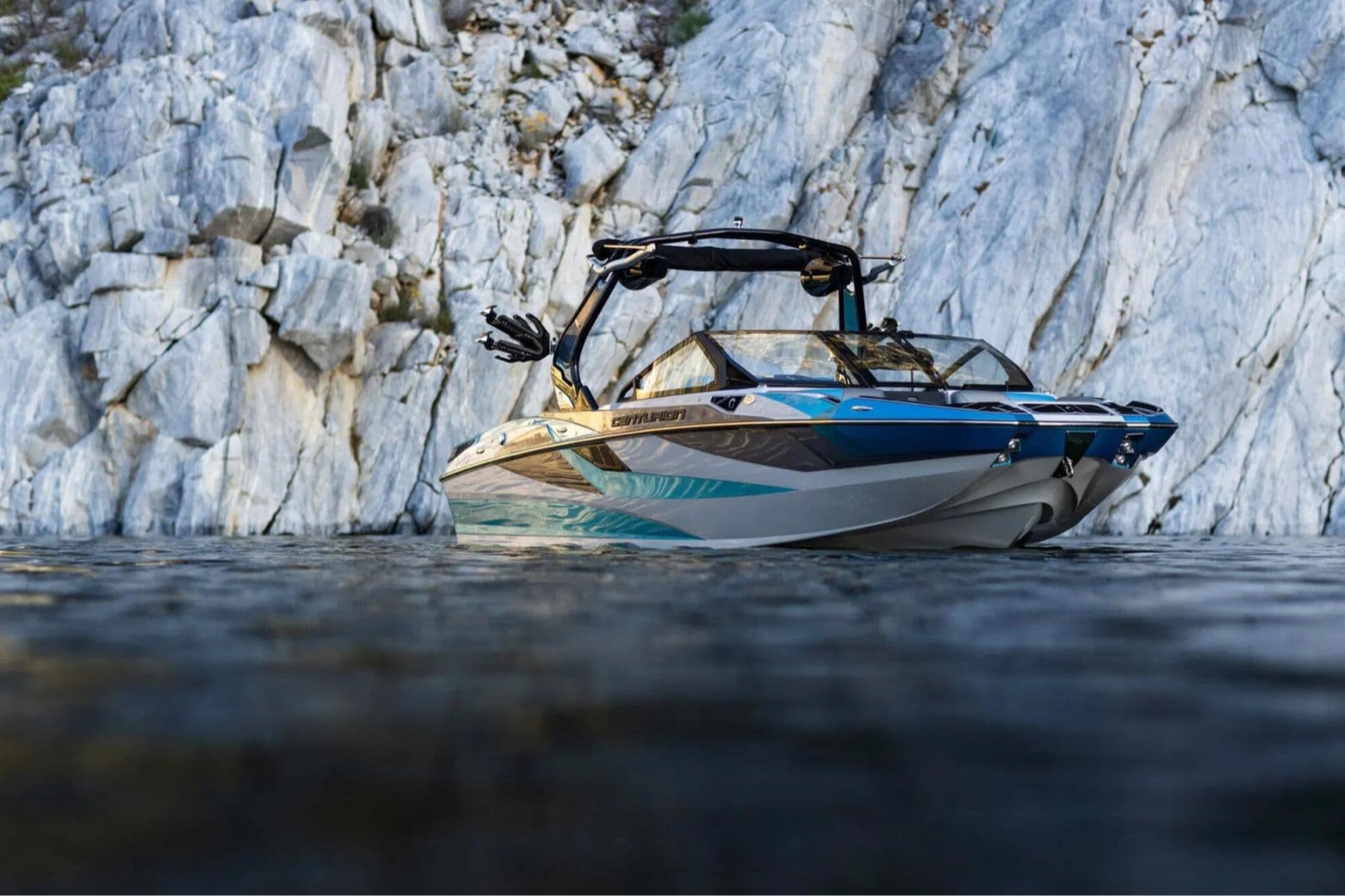
The MasterCraft X24 is the wakeboat the segment cross-shops everything else against. MasterCraft has been building tournament-tow inboards out of Vonore, Tennessee since 1968, and the current X24 generation is the model that has held the rank-one position in our 2026 ski-and-wake-boats guide because the wake quality, the brand demand, and how it holds its price all line up against the segment.
What is the MasterCraft X24?
The X24 is a 24-foot 2-inch dedicated wakesurf inboard with a 102-inch beam, 6,100 pounds dry, an 85-gallon fuel tank, and a manufacturer-rated 18-person capacity. The drivetrain is the Ilmor 6.2L marine V8, available naturally aspirated as the standard option and supercharged to roughly 630 horsepower and 665 pound-feet of torque on the upper trim. Ilmor took over MasterCraft's primary engine partner role at the end of the Indmar era. Any 2020-onward X24 uses an Ilmor block, not an Indmar one. The hull is a surf-specific V design tuned around the Gen 2 Surf System.
The Gen 2 Surf System is what makes this boat different. Three electrically-actuated Lenco transom plates produce the wave shape. The center plate controls bow rise and overall hull attitude, and the two outer plates shape the wave on each side. The system is paired with a 4,300-pound integrated ballast capability across the bow, mid-cabin, and rear lockers, and the controls are surfaced through a 12-inch touch display at the helm. Some build configurations use the newer SurfStar implementation with redesigned plates and heavy-duty hydraulic actuators with position sensors, which is the more accurate but more expensive setup. Ten board racks split between the bimini and the rear compartments handle storage cleanly without crowding the cockpit.
Who is it good for?
Wakesurf-tournament households running 100-plus hours a season are the core buyer. The Gen 2 Surf System earns the extra money for owners who care about wave shape on a discriminating eye, where a half-inch of bow rise and a foot of wave length actually matter. Households with multiple riders working through different sets in one outing get the most out of the side-to-side shaping speed and the saved ballast presets. Cross-shoppers from Malibu 22 LSV and Tige who want the brand cachet and the firmer resale price are the second profile, and the X24 typically wins those cross-shops on resale alone over a five-year hold.
We spent a Saturday on Lake Travis in October behind a 2022 X24 with a six-rider rotation. The thing that stood out was how fast you could switch from a goofy rider's wave shape to a regular rider's between sets. Plate presets, two-button recall, and the cockpit lighting is already cued for the next surfer.
Saltwater coastal owners who specced the corrosion-resistant drivetrain package can run the X24 in salt, but the use case is unusual. Most X24 owners are inland-lake households with multi-boat docks and dedicated wakesurf time blocks.
Who is it not good for?
Pure-cruising households where the surf system is rarely used should not pay for an X24. The extra money lives in the surf hardware and the brand cachet, neither of which earns its keep on a boat that mostly runs sundown cruises and family swim runs. A used Cobalt 336 or Sea Ray Sundancer 320 at the same price covers that brief better.
Buyers cross-shopping a wake-capable bowrider should also walk away. The X24 is a dedicated-wakeboat-first design with the cockpit, the swim platform, and the storage tuned around towed sports rather than seat plan or open cruising. A bowrider with a wakeboard tower will surprise no one with the wake quality the X24 produces, but it will also cost a fraction.
The third exclusion is owners who anchor heavily for cove parties and relied on the low-power-accessory mode that earlier MasterCraft hulls offered. The 2025 model year removed that feature, and current owners have flagged it as a real regression. Stereo, interior and exterior lighting, three depth finders, engine displays, and the fridge stay online during anchored use, which loads the main battery faster than older boats. Households who run six-hour cove anchorages should plan around that or shop a 2024 or earlier hull.
Pricing
New 2026 X24 pricing is roughly $182,000 to $228,000 in standard Ilmor naturally-aspirated build configurations with a tower, the Gen 2 Surf System, twin Garmin GPSMap helm screens, JL Audio premium with tower speakers, the 12-inch touch display, and a basic trailer. Stepping up to the Ilmor Supercharged trim with a tri-axle trailer, the hardtop option, surf-platform lighting, and a fully optioned audio package can push the build close to or past $260,000. A 2024 hull with the Ilmor Supercharged option has been listed by dealers around $265,000 in the current market, which is a useful anchor for what a fully optioned new boat costs.
The used market spans $111,000 at the bottom (older hulls in the 400-plus-hour range) to north of $400,000 on a current-year demonstrator with a fully loaded Ilmor Supercharged spec, with the average market price across the production run sitting near $180,000. The sweet spot for buyers in 2026 is the 2021-to-2023 hull with the Gen 2 Surf System, the 12-inch touch display, and 100 to 250 hours, which lands in the $112,000 to $162,000 band. Five-year depreciation is about 22 to 26 percent off new MSRP, well below the segment average and a meaningful share of the X24's value case over a multi-year hold.
What works
- Gen 2 Surf System with three electrically-actuated Lenco transom plates produces a wave widely considered segment-best at 11.5 miles per hour cruise.
- Up to 4,300 pounds of integrated Gen 2 ballast capability. Real surf-tournament-ready setup out of the dealer.
- Wraparound rear lounge plus bow lounge plus twin captain seats fit 18 by the rating and eight in the rear lounge in real use.
- Ilmor 6.2L (NA or Supercharged) pulls the boat to 41 miles per hour-plus top end loaded, and the Supercharged option adds genuine spool-up at slalom hand-offs.
- Brand demand on the wakesurf-tournament market keeps used inventory moving fast and the resale price firm.
- Storage runs deeper than most competitors, and the 10-board capacity between the bimini and rear compartments handles a multi-rider load without crowding the cockpit.
- Powder-coated tower with welded crossbars and stitched-vinyl upholstery throughout. The build is flagship-tier rather than premium-mass.
What doesn't
- The 2025 model removed the low-power-accessory cove mode that earlier MasterCraft owners relied on for anchored use, leaving stereo, lighting, and displays online during a cove day.
- SurfStar and Gen 2 actuators cost roughly $5,000 each in three-per-boat configuration. A long-term ownership cost line that hits hardest at the year-six-to-eight mark when warranty has rolled off.
- Inboard maintenance cycle (impeller, transmission fluid, V-drive, prop shaft alignment) adds 4 to 6 hours of annual service that outboard wakeboats avoid.
- Tower clearance complicates marina-slip entry on covered piers and trailer storage in standard residential garages.
- Walk-through to swim deck has a notable step-down that owners flag as a real ergonomic problem with kids and older guests.
- Entry point pushes used 2021 hulls past $130,000 in the typical dealer-floor configuration, which is a hard line for first-time wakeboat buyers.
Year-by-year notes
The current X24 generation launched for the 2020 model year on the surf-specific V hull and the Gen 2 Surf System. The 2020 and early-2021 hulls had the smaller original rudder that some owners flagged as undersized for the boat's mass. The rudder was upsized in a running production change and the post-update spec drives noticeably better. SurfStar (the hydraulic-actuator version of the surf-plate system) entered the lineup as an upper-trim option mid-cycle. The 12-inch helm touch display became standard on 2021-onward hulls. The Ilmor Supercharged 6.2L moved to a more prominent catalog position in the 2023 model year. The 2025 model year removed the low-power-accessory cove mode, which is the recurring complaint flagged by current X24 owners. The 2026 boats carry the same drivetrain and surf-system architecture as the 2025 hulls. Buyers screening for the cove-mode feature should target 2024 or earlier production.
Cost of ownership
Annual recurring costs are higher than an outboard wakeboat at the same price tier. The Ilmor 6.2L service interval is a 50-hour first oil and filter change, then 100-hour intervals, with annual service mandatory regardless of hour count. A 100-hour service costs $400 to $700 in parts and $400 to $600 in dealer labor at a MasterCraft-experienced shop. Transmission fluid and V-drive service step that number up at the 200-hour mark. Impeller replacement costs $200 to $350 in parts plus 1.5 to 2 hours of labor.
The surf-actuator question is the line that owners outside warranty should price honestly. A single SurfStar or Gen 2 actuator costs roughly $5,000 in parts, three per boat, and a typical first failure shows up at the year-five-to-seven mark on heavy-use hulls. We watched a 2020 X24 owner pull into a Lake of the Ozarks yard last summer with a faulted center actuator. The boat went on the lift the next morning. The bill was the conversation he avoided having with his wife on the way home.
Insurance on a $140,000 X24 hull value is $1,400 to $2,400 a year on inland lakes. Slip rental and winter storage drive the larger variable.
A five-year hold on a 2021 used X24 bought at $135,000 with 120 hours, run at 100 hours a season on an inland lake with trailer storage, lands at roughly $11,000 to $16,000 a year all-in including insurance, fuel, service, and amortized capital cost. Owners running fewer hours per season see the maintenance number drop modestly but the capital amortization stays the same.
Best year and trim to buy
The 2021-to-2023 X24 with the Gen 2 Surf System, the post-update larger rudder, the 12-inch helm touch display, and the Ilmor 6.2L (naturally aspirated for most owners, Supercharged for the speed-sensitive minority) is the right buy in 2026. The 2024 hulls add modest refinements but the depreciation cost over the next two years weighs against the new-or-near-new buy unless the buyer wants a specific recent configuration. The 2025-onward boats remove the low-power-accessory cove mode, which is the reason to skip the current model year if you anchor a lot.
Verify three things pre-purchase. First, the SurfStar or Gen 2 actuators move under power and the surf-plate position sensors track without faulting. Second, the rudder is the post-update larger spec, not the early-launch smaller one. Third, the maintenance file shows current 100-hour service work plus impeller and V-drive service at the appropriate hour mark. A clean 2022 with Gen 2 Surf System, the larger rudder, the 12-inch display, and 150 hours should land between $128,000 and $148,000 at a MasterCraft-experienced dealer with a remaining factory warranty window.
Alternatives
The closest cross-shop is the Malibu 22 LSV, the long-running segment-standard surf boat that competes directly on wave quality and brand cachet, with a resale gap to the X24 that has narrowed in recent model years. The value alternative is the Axis A22, Malibu's value brand, which carries the same hull-design DNA at a materially lower price with simpler ballast and surf controls. For buyers who want a different build philosophy entirely, the Pavati AL26 is the premium aluminum-hull alternative that solves the same wakesurf brief at a higher price with materially different long-term ownership math.