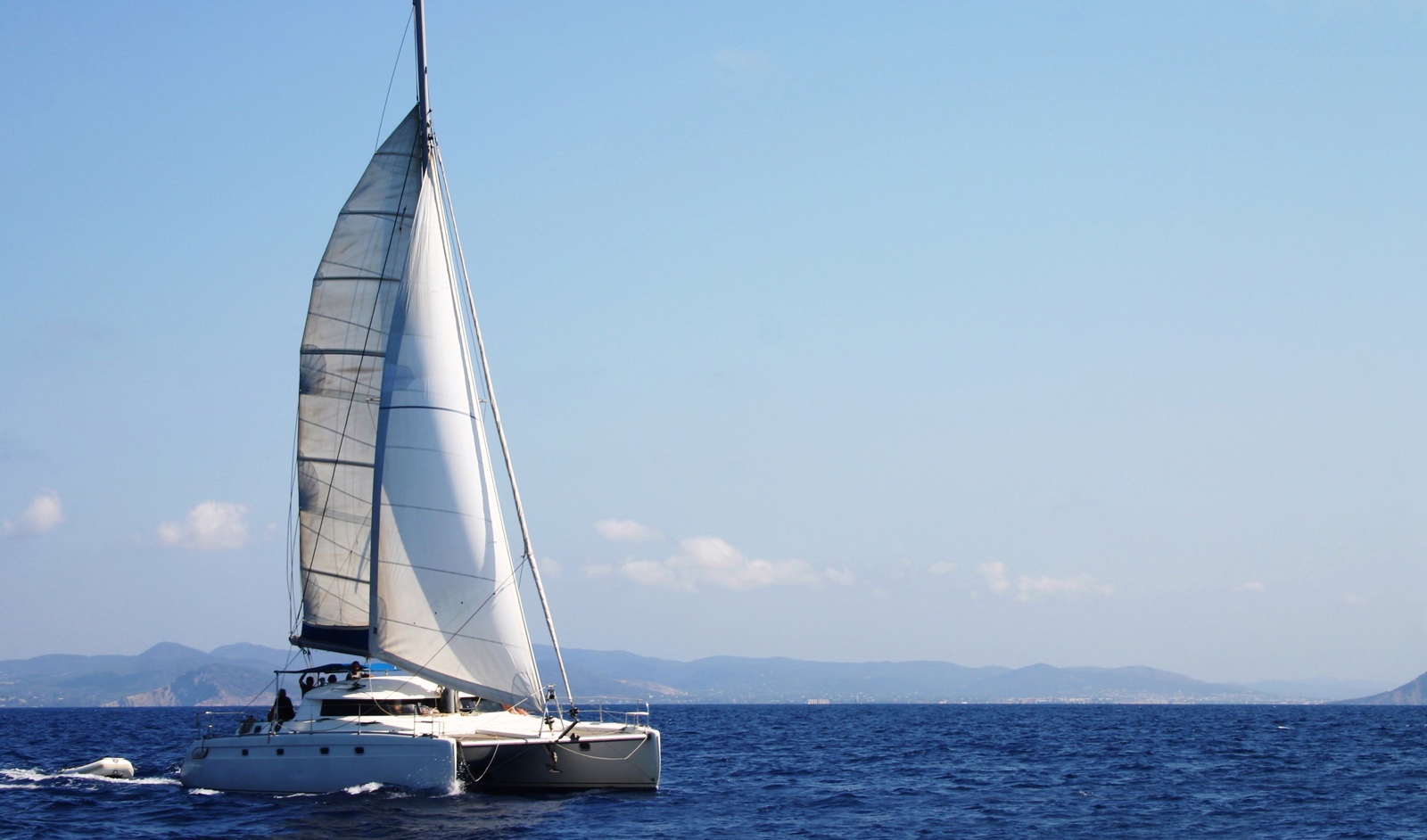
The Outremer 45 is what bluewater sailors buy when they want a cat that actually sails. Outremer Yachting has been building performance cruising catamarans in France since 1985, and the 45 ran from 2015 to 2022 as the company's mid-range bluewater cat. The boats are bought by owners who plan ocean crossings, long-distance cruising, and passages where pace under sail matters and saloon volume does not. The price runs materially higher than a Lagoon or Leopard at the same length, and the buyer is a different person.
What is the Outremer 45?
The 45 is a 45-foot fiberglass performance cruising catamaran with a 23-foot beam, daggerboards rather than fixed keels (3 feet 7 inches up, 8 feet 2 inches down), and a displacement around 21,200 pounds. The displacement is the spec line that tells you what the boat is. A comparable Lagoon or Leopard at the same length sits around 28,000 to 30,000 pounds. The Outremer is materially lighter, which translates to faster acceleration, better light-air pace, and a hull that moves through the water rather than pushing it.
The hull is VPLP-designed, with a fine entry and a moderately narrow beam by cat-segment standards. The narrower beam asks for daggerboards because the fixed-keel cat layout depends on wider beam for upwind ability. The daggerboards open up to genuine upwind sailing capability that a production cruising cat does not have.
Power comes from twin Volvo Penta diesels in the 30 to 40-horsepower range, driving sail-drives. The smaller engines reflect the lighter displacement, and the fuel burn is correspondingly lower. Fuel capacity sits at around 130 gallons split between the two hulls.
Below decks the layout prioritizes weight and sailing performance over saloon volume. Three or four-cabin layouts are available, with the owner version putting a master cabin and a private head in the starboard hull. The saloon is at deck-cabin level with 360-degree visibility, and the helm is at deck level rather than on a flybridge. Helm at deck level is the layout choice that performance-minded sailors prefer because sail trim and feel come through the helm directly. We rode aboard a 2019 Outremer 45 at the dock in Papeete, Tahiti, one warm Pacific afternoon a couple of years back, and the difference between the Outremer helm and a Lagoon flybridge was immediate. The boat feels like a sailing boat at the wheel, not like a platform.
Who is it good for?
Bluewater sailors planning ocean crossings or long-distance cruising are the core buyer. The Outremer 45 is the right boat for a Pacific run, a transatlantic, a Southern Ocean season, or any passage where pace under sail and seakeeping matter. The light displacement, the daggerboards, the fine entry, and the deck-level helm all combine to produce a cat that ocean-crossing sailors actually choose for the work.
Performance-minded couples upgrading from a monohull who want the cat platform are the second profile. The Outremer is the cat that monohull sailors can step into without giving up the sailing feel they care about. The boat heels less than a monohull but it still has the responsive helm and the wind-sensitivity that monohull sailors recognize.
The third buyer is the long-hold owner. The Outremer holds its price on resale better than almost any cat in the segment. Five-year depreciation on a clean hull sits below 25 percent, and ten-year curves flatten further. Owners who buy at year three and sell at year fifteen often walk away with most of what they paid.
Who is it not good for?
Charter buyers should walk past the 45. The Outremer is not designed for charter-fleet use, and the management math does not work the way it does on a Lagoon or Leopard. The boat is owner-cruiser focused and the build, the layout, and the systems all reflect that.
Buyers who want maximum saloon volume should also skip. A Lagoon 42 or a Leopard 45 at the same length carries materially more interior space. People who plan to entertain or live aboard with a lot of guests get more saloon for their dollar from the production builders.
The third anti-profile is the first-time cat owner. The daggerboard system rewards crew that knows it, and the deck-level helm asks for a different sail-handling rhythm than the flybridge layouts most people learn on. Owners stepping straight into the Outremer without cat experience face a learning curve, and the boat is too expensive to be a teacher.
Pricing
The Outremer 45 is no longer in current production. The 45 successor is in the current catalog. On the used market, 2017 to 2021 hulls in clean condition sit in the $795,000 to $1,095,000 band depending on owner-version layout, electronics, watermaker presence, sail inventory, and how recently the standing rigging and daggerboard systems were serviced. The boats hold their value strongly compared to the production-cat segment.
Depreciation on a clean Outremer 45 has flattened over the last several seasons. A boat that sold new for around $1.15 million in 2019 sits in the $895,000 to $975,000 band, which is close to where it has been for the last couple of seasons. The flattening is part of what justifies the entry price for buyers who plan a long ownership.
What works
- VPLP-designed hull with daggerboards. The boat sails noticeably better than the production-cat segment
- Light displacement at around 21,200 pounds
- Fine entry and narrower beam at 23 feet. The boat moves through the water rather than pushing it
- Twin Volvo Penta diesels in the 30 to 40-horsepower range fit the lighter displacement
- Build is segment-leading. Foam-cored hulls with vinylester resin and carbon-reinforced laminates
- Holds its price on resale strongly. Five-year depreciation is below 25 percent
- Helm at deck level rather than on a flybridge. Sail trim and feel come through the helm
What doesn't
- Entry price is materially higher than a Lagoon or Leopard at the same length
- Cabin volume is modest by cat-segment standards
- Daggerboard system asks for crew comfortable with cat sail handling
- Used-market pool is thin. Selling can take time
- Charter-fleet placement is not realistic
- Standing rigging and high-load hardware are sized for the performance brief
Year-by-year notes
The Outremer 45 ran from 2015 to 2022. The twin Volvo Penta diesel platform did not change meaningfully across the production. Electronics shifted toward B&G across the production as plotter technology updated. The daggerboard system, the VPLP hull form, and the deck-level helm layout stayed consistent. Interior trim and finish got incremental updates. There is no defect cutover year worth screening on, but on any 45 over 5 years old the daggerboard cases, the sail-drive seals, the standing rigging, and the watermaker (if fitted) should all be inspected closely.
Cost of ownership
A 45 kept in a tropical slip at 200 sailing days a season costs roughly $38,000 to $58,000 a year all-in once you spread the recurring lines across an ownership year. The performance-cat brief asks for closer attention to sail care, daggerboard service, and bottom condition than a production cruising cat would. Annual haul-out and bottom paint runs $2,800 to $4,800.
Twin Volvo Penta diesels each want oil and impeller service every 100 hours or annually, at $350 to $550 per engine in parts. Sail-drive service every 200 hours runs $700 to $1,100 per drive. Daggerboard service every 3-5 years runs $1,500 to $3,500 depending on what is needed. Standing rigging replacement comes due every 10 to 15 years and costs $16,000 to $26,000 on the high-load performance rig. Sail life on the original main and headsail is 5 to 7 seasons of regular use, with replacement at $14,000 to $22,000 for the package in good cruising fabric. Insurance on an $895,000 hull value is $6,000 to $10,000 a year depending on cruising area and named-storm exposure.
Best year and trim to buy
A 2017 to 2021 Outremer 45 in owner version with the twin Volvo Penta diesels, B&G plotter at the helm, daggerboards (the standard build), watermaker fitted, and a recent rig service is the right buy in 2026. Look for a boat that has been used and maintained by an owner-cruiser rather than one that has been sitting unused.
Check five things before buying. First, the daggerboard cases and the boards themselves. The performance-cat system asks for inspection that not every yard knows how to do. Second, the sail-drive seals and the lower-unit service log on both drives. Third, the standing rigging age and condition. Performance rigs run higher loads than production-cat rigs. Fourth, the engine hour logs and the heat-exchanger service. Fifth, the hull bottom for any damage from daggerboard impacts or coral strikes. Pre-purchase survey by a surveyor who knows the brand is non-negotiable.
Alternatives
The production-cat cross-shop is the Leopard 45, which trades the Outremer's sailing pace for more saloon volume and a wider dealer footprint at materially less money. The volume-seller cross-shop is the Lagoon 42, with more interior volume and a wider dealer footprint, but the boat does not sail like the Outremer. The middle-ground cross-shop is the Fountaine-Pajot Elba 45, which sails better than Lagoon or Leopard but not as well as Outremer, at a price between the two.