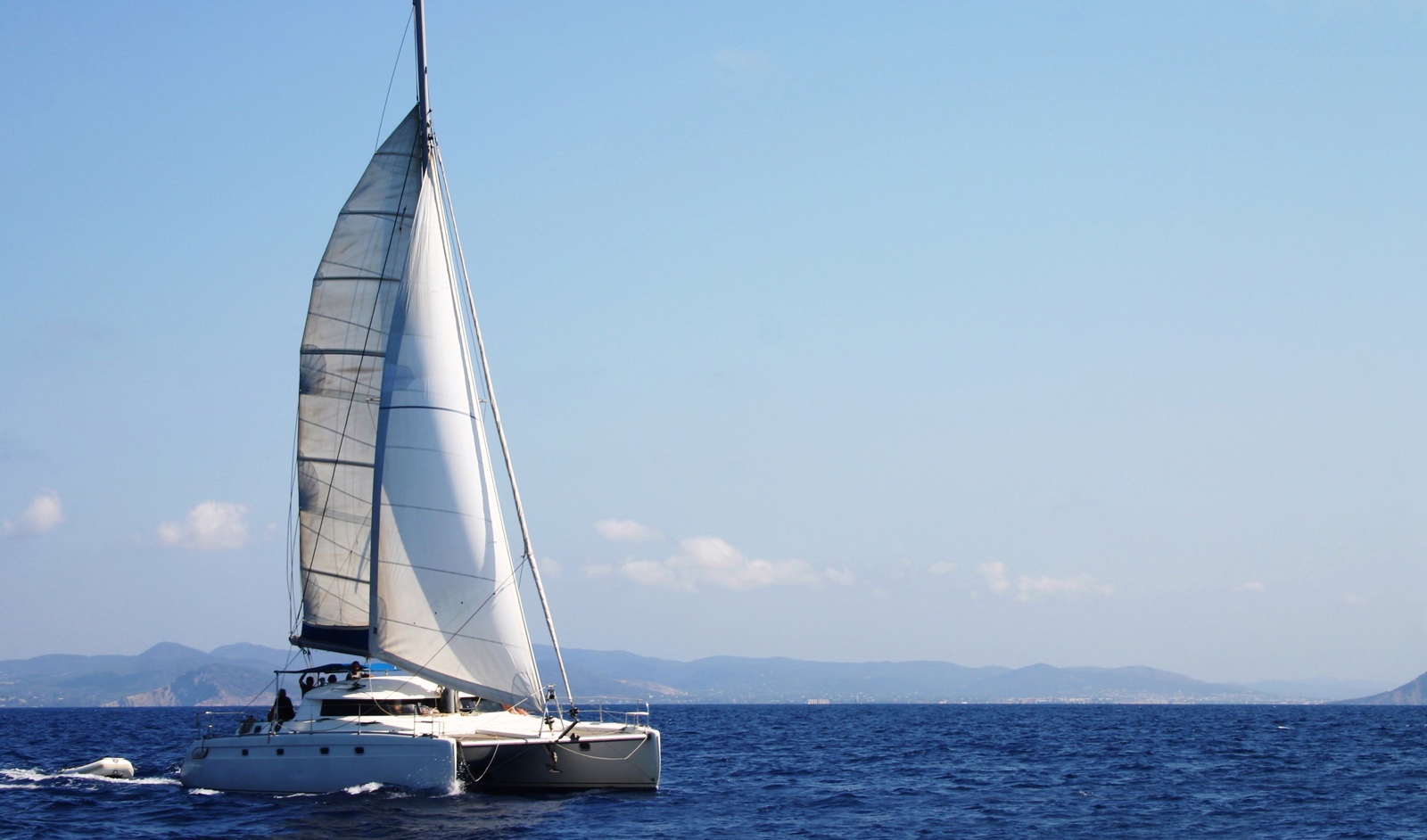
The Leopard 45 is one of the cruising catamarans you see on every dock in the Caribbean and the South Pacific. Robertson and Caine has been building cats in South Africa since the 1990s, and the 45 ran from 2017 to 2022 as the boat between the Leopard 42 and the Leopard 48. The hulls are sold worldwide under the Leopard brand for owners and the Moorings brand for charter operators, and the boats are mechanically the same with different deck and interior finishes.
What is the Leopard 45?
The 45 is a 44-foot 9-inch fiberglass cruising catamaran with a 24-foot 7-inch beam, a draft of around 4 feet 9 inches, and a displacement around 30,000 pounds. The hull form is moderately fine forward, with bridgedeck clearance sized for the production cruising-cat brief rather than for performance work. The signature Leopard layout features a forward cockpit accessible through a sliding door from the saloon, an aft cockpit with a deep lounge directly off the galley, and a saloon at deck-cabin level with 360-degree visibility. The helm is up on a flybridge accessible from the cockpit by a short set of steps.
Power comes from twin Yanmar diesels in the 45-horsepower range, one in each hull, driving sail-drive units. Twin diesels in the cat segment serve as both propulsion and redundancy, and the math of one diesel out of service still leaves the boat with safe passage capability. Fuel capacity sits at around 160 gallons split between the two hulls. The diesels handle the displacement at around eight knots under power and burn roughly two gallons per hour combined at cruise.
Below decks comes in two main layouts. Owner-version puts a full master cabin and head in the starboard hull, with two guest cabins and two heads in the port hull. Charter-version puts four equal cabins and four heads across both hulls, sized for paying guests rather than for owners. We rode aboard a 2020 owner-version at the dock in Road Town, Tortola one afternoon in the trade-wind season, and the difference between the owner master and the charter four-cabin layout was the volume of stowage. Owner boats give up a cabin and gain the storage cruisers actually need.
Who is it good for?
Cruising couples and families running multi-month tropical cruising are the core buyer. The 45 is the right boat for a Caribbean season, a Bahamas spring, a Pacific Northwest summer, or a Mediterranean run. The forward cockpit is the feature owners actually use at anchor. The aft cockpit and galley flow is the feature they use at sea. The flybridge helm puts the helmsman up out of spray and weather and gives a good view forward over the hulls.
Owners who plan to spend half the year on the boat are the second profile. The cat layout, the volume below, the systems redundancy, and the watermaker option turn the 45 into a livable platform for stretches that would feel cramped on a monohull at the same length. Liveaboard owners pick the cat segment for these reasons, and the Leopard 45 is one of the most-bought hulls in the segment.
The third buyer is the practical one. Robertson and Caine builds the boats in volume, parts are available worldwide, and the Moorings charter fleet creates a service infrastructure that supports the brand wherever charter operators run. Buyers planning to cruise far from a builder's dealer network appreciate that.
Who is it not good for?
Performance sailors should walk past the 45. The hull form is cruiser-typical for the cat segment, and light air means motoring rather than sailing. Owners who want a fast cat are looking at an Outremer 45 or a Catana in similar length.
Buyers on a tight budget should also skip. The 45 is expensive to buy and expensive to run. Twin-diesel maintenance, twin sail-drive service, two heads or four, and the storage and slip costs of a 24-foot 7-inch beam all add up. The boat is not in the segment for people watching every dollar.
The third anti-profile is the buyer who wants a monohull's feel under sail. A 45-foot cruising cat sails like a cruising cat. Wide and stable, easy on the crew, slow to react to gusts, and never going to heel the way a monohull does. Some sailors love it. Others miss the monohull feel. Try a cat before you commit to one.
Pricing
The Leopard 45 is no longer in current production. The Leopard 46 replaced it in the current catalog. On the used market, 2018 to 2021 hulls in owner version in clean condition sit in the $485,000 to $685,000 band depending on electronics, sail condition, watermaker presence, and how recently the standing rigging was serviced. Charter-fleet ex-boats sell lower, often in the $385,000 to $525,000 band, because the boats carry more hours, more wear, and a charter-spec layout that owner-cruiser buyers usually want to modify.
Depreciation on a clean owner-version 45 has flattened over the last few seasons. A boat that sold new for around $750,000 in 2019 sits in the $585,000 to $625,000 band, which is close to where it has been for the last couple of seasons.
What works
- Forward cockpit through a sliding door from the saloon. The Leopard layout signature
- Aft cockpit with a big lounge and direct galley access
- Saloon at deck-cabin level with 360-degree visibility
- Twin Yanmar diesels give redundancy and handle the displacement at eight knots
- Owner-version layout puts a full master cabin and head in the starboard hull
- Wide 24-foot 7-inch beam translates to a saloon and galley that feels like a 50-foot monohull
- Robertson and Caine builds the boats in volume. Parts and service available worldwide
What doesn't
- Limited stowage relative to the cabin volume
- Ex-charter hulls carry hard hours and a charter-spec layout
- Performance is cruiser-typical for the cat segment
- Bridgedeck clearance is adequate but not generous. Slamming in head sea is a recurring observation
- Twin-diesel service is more expensive than monohull service. Two of everything
- Sail handling from the flybridge asks for crew comfortable with the layout
Year-by-year notes
The Leopard 45 ran from 2017 to 2022. The twin Yanmar diesel platform did not change meaningfully across the production. Electronics shifted toward B&G across the production as plotter technology updated. The forward-cockpit, aft-cockpit, saloon-and-flybridge layout did not change. Interior finish and trim got incremental updates. There is no defect cutover year worth screening on, but on any 45 over 5 years old the sail-drive seals, the standing rigging, the bridgedeck through-hulls, and the watermaker (if fitted) should all be inspected closely. Charter-fleet hulls in particular reward a careful pre-purchase survey by a surveyor who knows the boat.
Cost of ownership
A 45 kept in a tropical slip at 150 sailing days a season costs roughly $35,000 to $55,000 a year all-in once you spread the recurring lines across an ownership year. The boat is larger than a 40-foot monohull on every dimension that costs money to maintain. Annual haul-out and bottom paint runs $2,500 to $4,500 because the catamaran has two hulls and a wider footprint than a monohull at the same nominal length.
Twin Yanmar diesels each want oil and impeller service every 100 hours or annually, at $300 to $500 per engine in parts. Sail-drive service every 200 hours runs $600 to $1,000 per drive. Standing rigging replacement comes due every 10 to 15 years and costs $14,000 to $22,000 on the cat because there is more wire. Sail life on the original main and headsail is 5 to 7 seasons of regular use, and replacement is $9,500 to $16,000 for the main-and-headsail package in cruising fabric. Insurance on a $585,000 hull value is $4,200 to $7,500 a year depending on cruising area and named-storm coverage. Slip rental varies widely by location.
Best year and trim to buy
A 2019 to 2021 Leopard 45 in owner version with twin Yanmar 45-horsepower diesels, B&G plotter at the helm, a serviced sail-drive log, and a recent standing-rigging inspection is the right buy in 2026. Owner version costs more than charter version but the layout, the storage, and the lower hours pay back over a long ownership.
Check five things before buying. First, the sail-drive seals and the lower-unit service log. This is the cat-specific failure mode and it is expensive to ignore. Second, the standing rigging age and condition. Cats carry more wire than monohulls, and replacement costs scale. Third, the bridgedeck through-hulls and the seacock service. Fourth, the engine hour logs and the heat-exchanger service on both Yanmars. Fifth, the watermaker if one is fitted. Watermakers that have been sitting unused are often a project, not a working system.
Alternatives
The smaller cross-shop in the same family is the Leopard 42, which trades the 45's cabin volume for a slightly more manageable ownership footprint. The previous-generation cross-shop is the Leopard 44, with a slightly different layout from the 45. The most-compared direct competitor at this length is the Lagoon 42, which has more interior volume and a more European feel with Lagoon's market-leading dealer footprint.