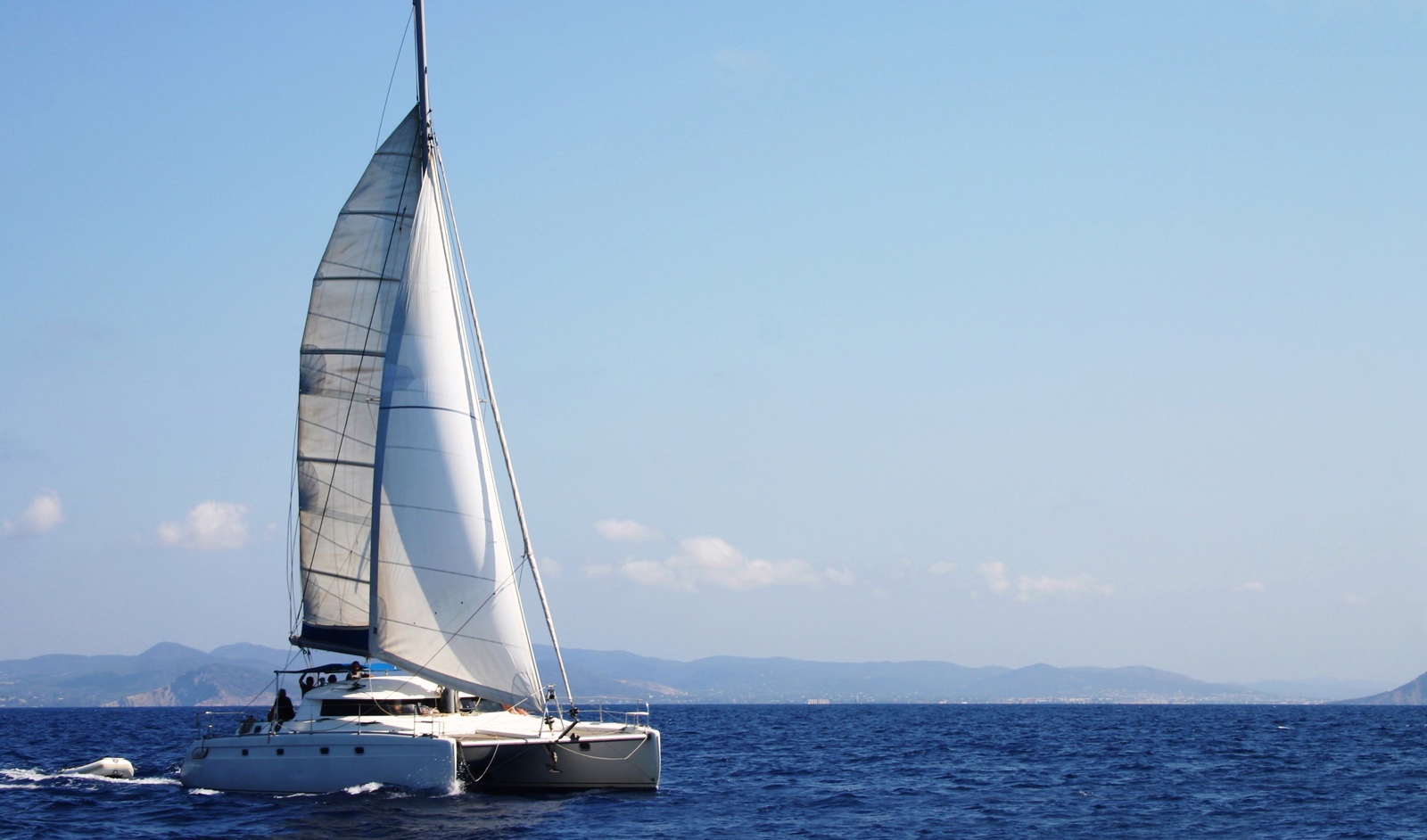
The Lagoon 42 is the volume seller in the 42-foot cruising catamaran segment. Lagoon has been building cats in France since 1984, and the 42 ran from 2016 to 2024 as the company's mid-range cruiser. It is the boat other 42-foot cats get compared to in the segment, and it is the dominant hull in the European charter fleet for the same reason the Leopard dominates the Caribbean: the volume, the systems redundancy, and the dealer footprint.
What is the Lagoon 42?
The 42 is a 42-foot fiberglass cruising catamaran with a 25-foot 4-inch beam, a draft of around 4 feet 3 inches, and a displacement around 27,500 pounds. The hull is VPLP-designed, with the mast moved aft from the more traditional location and a self-tacking jib forward. The mast-aft rig is the signature design feature on the 42 and on the Lagoon lineup more generally. It trades some upwind performance for ease of handling, which is what the segment wants.
Power comes from twin Yanmar diesels, in 45-horsepower form on the standard build and 57-horsepower as a popular option. The bigger engines handle the displacement and motoring against wind and current better, and most owner-version builds carry the upgrade. Fuel capacity sits at around 160 gallons split between the two hulls. The diesels handle the displacement at around eight knots under power and burn roughly two gallons per hour combined at cruise.
Below decks come in two main layouts. Owner-version puts a full master cabin and a private head in the starboard hull, with two guest cabins and two heads in the port hull. Charter-version puts four equal cabins and four heads across both hulls. The saloon sits at deck-cabin level with 360-degree visibility, connects directly to the aft cockpit through sliding doors, and houses the galley along the back wall facing forward. The flybridge helm is the layout's defining feature, putting the helmsman well above the deck on a covered platform reached by a short ladder from the cockpit. We rode aboard a 2020 owner-version at the dock in Simpson Bay, St Maarten one afternoon during a moderate trade-wind breeze, and the flybridge view forward over both hulls and the relative isolation of the helm from saloon traffic both came across.
Who is it good for?
Cruising families running tropical or Mediterranean cruising are the core buyer. The 42 is the right boat for a Caribbean season, a Med summer, or a Pacific Northwest run. The mast-aft rig with self-tacking jib lets a couple handle the boat without bringing crew aboard, the flybridge helm gives a good seat and a good view, and the saloon and galley volume turn anchorages into livable stays of multiple days.
Owners planning to charter the boat through a management company for part of the year are the second profile. The Lagoon 42 fits well into charter-fleet programs because the brand sells widely into the segment, and the management math pays back better than for less-common cat brands. Owners who buy with a fleet placement in mind get a partial offset on the carrying cost in exchange for surrendering use during the prime weeks.
The third buyer is the liveaboard or long-term cruising couple. The cabin volume, the galley, the storage, and the systems redundancy support multi-month cruising in a way a comparable monohull at the same length does not. Owners who plan to spend a season or more on the boat get more out of the 42 than out of a monohull alternative.
Who is it not good for?
Performance sailors should walk past the 42. Cats this size are cruisers, not racers, and the mast-aft self-tacking rig is the design feature that makes the boat easy to handle but also slow upwind. People who want a fast cat are looking at an Outremer 45 or a similar performance design.
Buyers on a tight budget should also skip. The Lagoon 42 is expensive to buy and expensive to keep running. The price runs higher than a 42-foot monohull from a comparable builder, the cost of ownership scales with the wider footprint, and the twin-diesel maintenance asks for more time and more parts than a single-engine boat.
The third anti-profile is the buyer who wants a monohull's sailing feel. The 42 sails like the cruising cat it is. Wide, stable, easy on the crew, slow to react. Sailors who love the monohull feel of heeling and weather helm should try a cat before committing to one.
Pricing
New 2026 Lagoon 42 pricing in recent production (the 42 was succeeded by a new model in the current catalog, with similar pricing structure) sits between $795,000 and $925,000 in standard configuration before option packages. Adding watermaker, air conditioning with generator, full electronics, and the upgraded sail inventory can push the price past $1.05 million.
On the used market, 2018 to 2022 owner-version hulls in clean condition sit in the $425,000 to $665,000 band. Charter-fleet ex-boats sell lower, in the $325,000 to $485,000 band, because the boats carry more hours and a charter-spec layout. Depreciation on a clean owner-version 42 has flattened over the last few seasons. A boat that sold new for around $800,000 in 2019 sits in the $565,000 to $625,000 band, which is close to where it has been for the last several seasons.
What works
- VPLP-designed hull with mast moved aft for a self-tacking jib
- Flybridge helm separates the helmsman from saloon traffic and gives a good view over the hulls
- Saloon at deck-cabin level with 360-degree visibility and direct connection to the aft cockpit
- Twin Yanmar diesels in the 45 to 57-horsepower range give redundancy
- Wide 25-foot 4-inch beam translates to a saloon and galley that feels like a 50-foot monohull
- Lagoon dealer footprint is the widest in the cat segment
- Owner-version layout puts a full master cabin and private head in one hull
What doesn't
- Performance is cruiser-typical. Light air means motoring
- Bridgedeck clearance is adequate but not generous
- Twin-diesel and sail-drive service is more expensive than a monohull
- Ex-charter hulls carry hard hours and a charter-spec layout
- Flybridge helm asks for getting used to. Crew handoff at sea is different than a deck helm
- Mast-aft self-tacking rig trades upwind performance for ease of handling
Year-by-year notes
The Lagoon 42 ran from 2016 to 2024. The twin Yanmar diesel platform did not change meaningfully across the production, with the 45 and 57-horsepower options available throughout. Electronics shifted toward B&G across the production. Interior finish and trim got incremental updates, and the cabin layout configurations stayed consistent across the run. There is no defect cutover year worth screening on, but on any 42 over 5 years old the sail-drive seals, the standing rigging, the bridgedeck through-hulls, and the watermaker (if fitted) should all be inspected closely. Charter-fleet hulls in particular reward a careful pre-purchase survey.
Cost of ownership
A 42 kept in a tropical slip at 150 sailing days a season costs roughly $32,000 to $52,000 a year all-in once you spread the recurring lines across an ownership year. The cat's two hulls and wider footprint scale every recurring line above what a monohull at the same nominal length would cost. Annual haul-out and bottom paint runs $2,200 to $4,200.
Twin Yanmar diesels each want oil and impeller service every 100 hours or annually, at $300 to $500 per engine in parts. Sail-drive service every 200 hours runs $600 to $1,000 per drive. Standing rigging replacement comes due every 10 to 15 years and costs $12,000 to $20,000. Sail life on the original main and self-tacking jib is 5 to 7 seasons of regular use, with replacement at $8,500 to $14,000 for the package in cruising fabric. Insurance on a $565,000 hull value is $4,000 to $7,000 a year depending on cruising area and named-storm exposure.
Best year and trim to buy
A 2019 to 2022 Lagoon 42 in owner version with the twin Yanmar 57-horsepower diesels, B&G plotter at the helm, watermaker fitted (or budget the install if not), and a recent standing-rigging service is the right buy in 2026. Owner version costs more than charter version but the layout, the storage, and the lower hours pay back over a long ownership.
Check five things before buying. First, the sail-drive seals and lower-unit service log. Cat-specific failure mode and expensive to ignore. Second, the standing rigging age and condition. Third, the bridgedeck through-hulls and the seacock service. Fourth, the engine hour logs and heat-exchanger service on both Yanmars. Fifth, the watermaker if fitted. Sitting unused, watermakers become a project to bring back online.
Alternatives
The smaller boat in the same family is the Lagoon 380, which trades the 42's volume for a smaller, less expensive ownership footprint. The previous-generation cross-shop is the Lagoon 400 S2, the slightly older boat the 42 replaced. The most-compared direct competitor is the Leopard 45, which trades Lagoon's flybridge layout for the Leopard signature forward cockpit and Robertson and Caine build. The French cross-shop at similar length is the Fountaine-Pajot Lipari 41, a slightly older design with a different hull form and a similar charter-fleet presence.