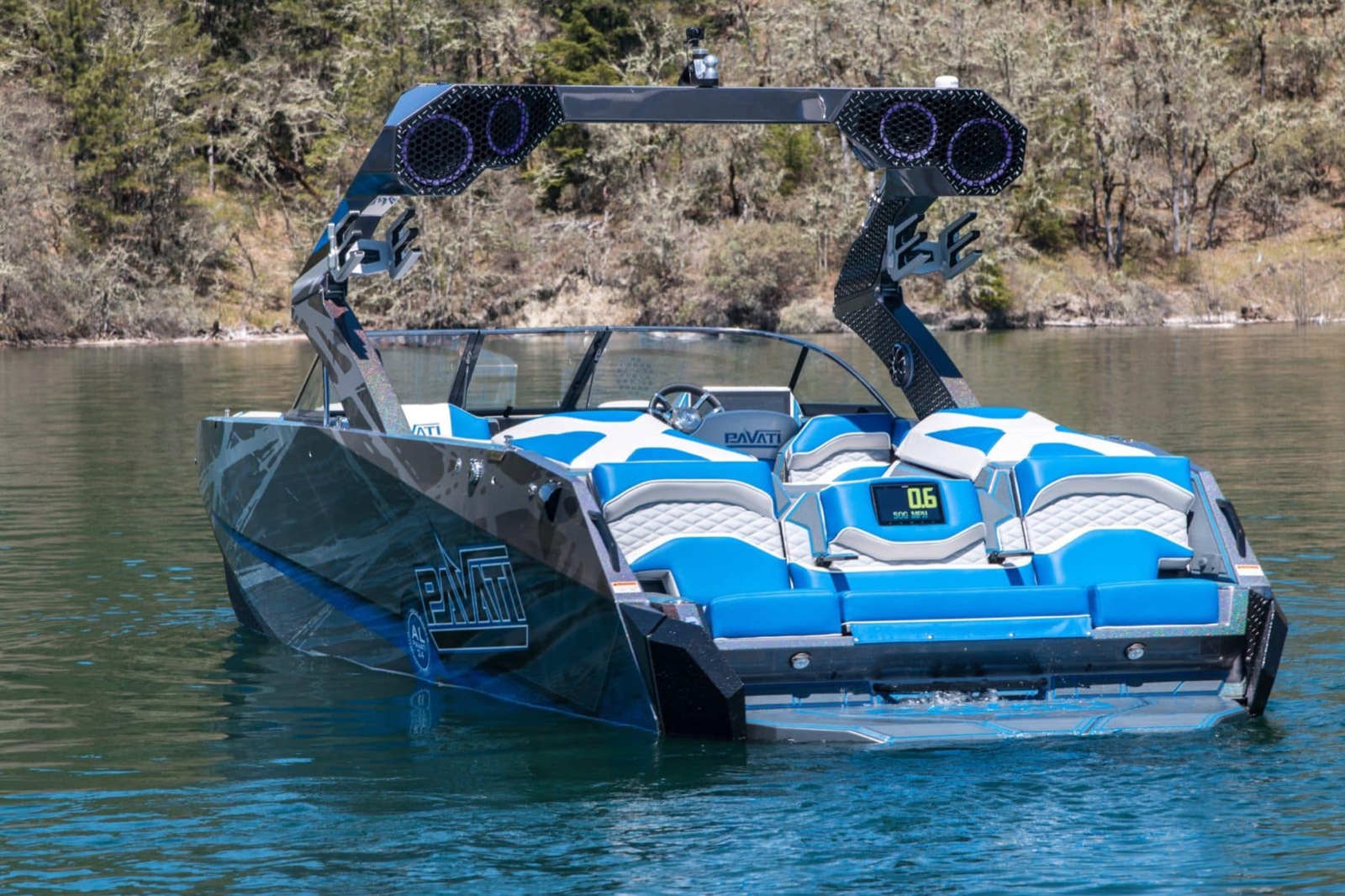
What is the Pavati AL26?
The Pavati AL26 is a 26-foot 8-inch welded-aluminum wake boat built in Pasco, Washington. LOA with the swim platform is 28 feet 8 inches. The beam is 8 feet 6 inches and the boat weighs about 8,000 pounds dry. Fuel capacity is 80 gallons with dual fills port and starboard. Standard power is an Indmar Raptor 6.2L Supercharged V-drive making 575 horsepower, with an optional LT4 Supercharged at 650 horsepower. Top speed is about 50 mph. The hull carries up to 5,988 pounds of water ballast, run through a 22-inch Garmin touchscreen at the helm. Seating is rated for 14.
The hull is welded heavy-gauge aluminum throughout, with billets up to an inch thick in load areas. The boat ships with a lifetime transferable hull warranty, which no fiberglass production builder matches. The Rip Tide surf system uses a quick-planing tab plus dual heavy-duty surf tabs at the transom to shape the wave, with presets controlled at the helm. Pavati has been building the AL26 on the current platform since 2020 and the boat is a custom build, ordered to spec with lead times that have run six to twelve months depending on the production calendar.
What's it like on the water?
The first thing you notice is the wave. We watched a 2023 AL26 on Lake Powell one August afternoon with a family running four surfers through the rotation, two regular stance and two goofy. The crew flipped between presets at the helm between riders and the wave was clean and shaped right for each one inside ten seconds. That is the Pavati pitch. The wave is one that owners describe as bonkers, easily adjustable for kids or adults without filling all the ballast.
Push the throttles up and the Raptor 575 pulls the boat out of the hole quickly even with full ballast loaded. Surf speed is 10 to 12 mph and the boat is steady there with the wave set up clean off the corner. At wide-open throttle on flat water the AL26 will see close to 50 mph, faster than most wakesurf hulls in the segment. The 22-inch Garmin at the helm is unusual in a wake boat. Ballast, surf-system presets, audio, and engine data are all on one screen.
Sound character is different from fiberglass. Aluminum boats carry a different ride feel and a different sound underway. Some owners love it. Others find it tiring on long days. Try one before you commit.
Docking is conventional V-drive. The boat pivots cleanly at idle and the helm has good sight lines from the captain's seat. The aluminum interior structure is quieter at idle than you'd expect, but at planing speed the hull does sound metallic. That's the cost of the lifetime warranty and the freeze-tolerant build, and most Pavati owners say it stops bothering them after a few outings.
Who is the AL26 for?
The AL26 is for the wakesurf family that switches between regular and goofy stance riders and wants the wave dialed for each one in seconds. The Rip Tide adjustability lets the boat set up a clean wave for any rider without long resets, which is the entire point. For a family with multiple skilled surfers, that flexibility shows up every session.
It's also for owners who store on lifts or trailers in cold climates. Aluminum survives freeze-thaw, sun exposure, and the abuse of winter storage in ways fiberglass doesn't. Aluminum doesn't blister, doesn't gel-craze, and doesn't take the freeze-and-flex damage fiberglass can. For an owner in the upper Midwest, the Pacific Northwest, or any northern lake where the boat spends winter on a lift, the construction translates to longer service life and the lifetime hull warranty backs it.
It's not for you if you're shopping on price. The AL26 is well above Malibu 22 LSV and MasterCraft X24 hulls at similar length. The aluminum construction and the Rip Tide range justify the cost for buyers who value those features. The math doesn't work for buyers who don't. It's also not for casual watersports families who ride a single wake setup all summer. A Malibu, MasterCraft, or Axis A22 at noticeably less money produces a wake that's plenty for casual surfing. And it's not for buyers who need a finished boat in 90 days. Pavati builds to order. Plan ahead or shop production.
Pricing
New 2026 MSRP on a base AL26 lands around $394,000 and full-spec boats with the LT4 engine, custom paint, the Eclipse hard top, and the top audio package push past $498,000. Trailer is extra. Pavati lists the tri-axle aluminum trailer most buyers spec at $9,500 to $14,000.
The used market in 2026 is thin because production volume is low. Hulls trade through Pavati's own inventory page, specialist brokers, and direct private sales. Listings on Boat Trader and YachtWorld for 2021 to 2024 AL26 hulls with low hours and complete service files run $250,000 to $325,000. Five-year depreciation on a clean Pavati AL26 is around 14 to 18 percent, which is segment-leading and reflects the small specialist demand for the brand. Sweet spot for a 2026 buyer is a 2022 or 2023 hull with 100 to 300 hours, documented service, and the current Rip Tide generation, landing between $260,000 and $300,000.
Year-by-year notes
The AL26 launched on the current platform in 2020. 2021 hulls established the current Rip Tide surf system configuration with the quick-planing tab and dual surf tabs. The 2022 model added refinements to the surf-system software and the helm electronics, and the 22-inch Garmin became standard. The 2023 model added an updated audio system with the upgraded subwoofers and improved ballast control. The 2024 hulls brought the LT4 650 hp engine as an option and refinements to the surf tab actuators. 2025 and 2026 boats carry the 2024 spec with cosmetic and trim updates. For used buyers the 2022 onward boats are the right target because that's when the current Garmin helm and the refined Rip Tide software became standard.
Cost of ownership
Annual costs on a Pavati AL26 are well above mainstream wake-boat numbers and that is by design.
V-drive service on the Indmar Raptor follows the factory schedule. Annual service is $800 to $1,500 in parts and labor at a Pavati or Indmar dealer. Transmission and drive-shaft service every three years is $1,500 to $3,000. The Rip Tide surf system needs periodic software updates and occasional surf-tab actuator service. Plan for $500 to $1,200 a year on the surf system.
Most owners lift-store or trailer-store, so bottom paint doesn't apply. Insurance on a $280,000 hull is $2,500 to $4,800 a year in most freshwater markets. Slip rental in season, if you use one, is $3,000 to $9,000 a year depending on the lake. Lift storage is $2,500 to $5,500 a year.
A five-year hold on a 2023 used AL26 bought at $280,000 with 150 hours, run 80 hours a season on a freshwater lake with lift storage and a covered slip in season, lands around $14,000 to $22,000 a year all-in including amortized capital cost. The capital line stays small because Pavati hulls hold their value. We refueled a 2023 AL26 at the pump after a six-hour wakesurf day at Lake Powell. The boat used 38 gallons of 91-octane ethanol-free, so the bill at the dock was about $235.
Best year and spec to buy
The best buy for 2026 is a 2022 to 2024 hull with documented annual service, the current Rip Tide generation, recent helm software, and a clean Indmar Raptor service file. The 575 hp Raptor is plenty for almost everyone. The LT4 650 hp upgrade is appealing on paper but adds capital cost and fuel burn without making the wave better. Skip it unless you want the speed.
Verify five things pre-purchase. First, the welds along the hull-to-deck joint and around the transom. Aluminum welds are the structural element. Inspection is non-negotiable and ask the surveyor to focus there. Second, the Indmar Raptor service file, supercharger condition, and the propeller. Third, the Rip Tide surf-tab actuators and the helm electronics. The system is what you're paying for. Fourth, the ballast tank integrity and the ballast pump condition. The hull carries nearly 6,000 pounds of water and a leak is expensive. Fifth, the trailer if included. Tri-axle aluminum trailers at this length take abuse.
Alternatives
The Malibu 22 LSV is the volume cross-shop in the segment. Tournament-grade wake with Malibu's Surf Gate system, fiberglass construction, and faster lead times at noticeably less money. The right answer for buyers who want a finished boat now over aluminum and the broader Rip Tide range.
The MasterCraft X24 is the performance cross-shop. Covers the same wakesurf brief with different hull geometry and the Gen 2 Surf System, plus a less-aggressive adjustment range than the Rip Tide. Different builder culture, fiberglass construction, similar interior quality at a lower price.
The Axis A22 is the value cross-shop in the Malibu family. Axis delivers a serious wake at a much more reasonable price. The right answer for buyers who want wakesurf capability without the Pavati or Malibu spend.