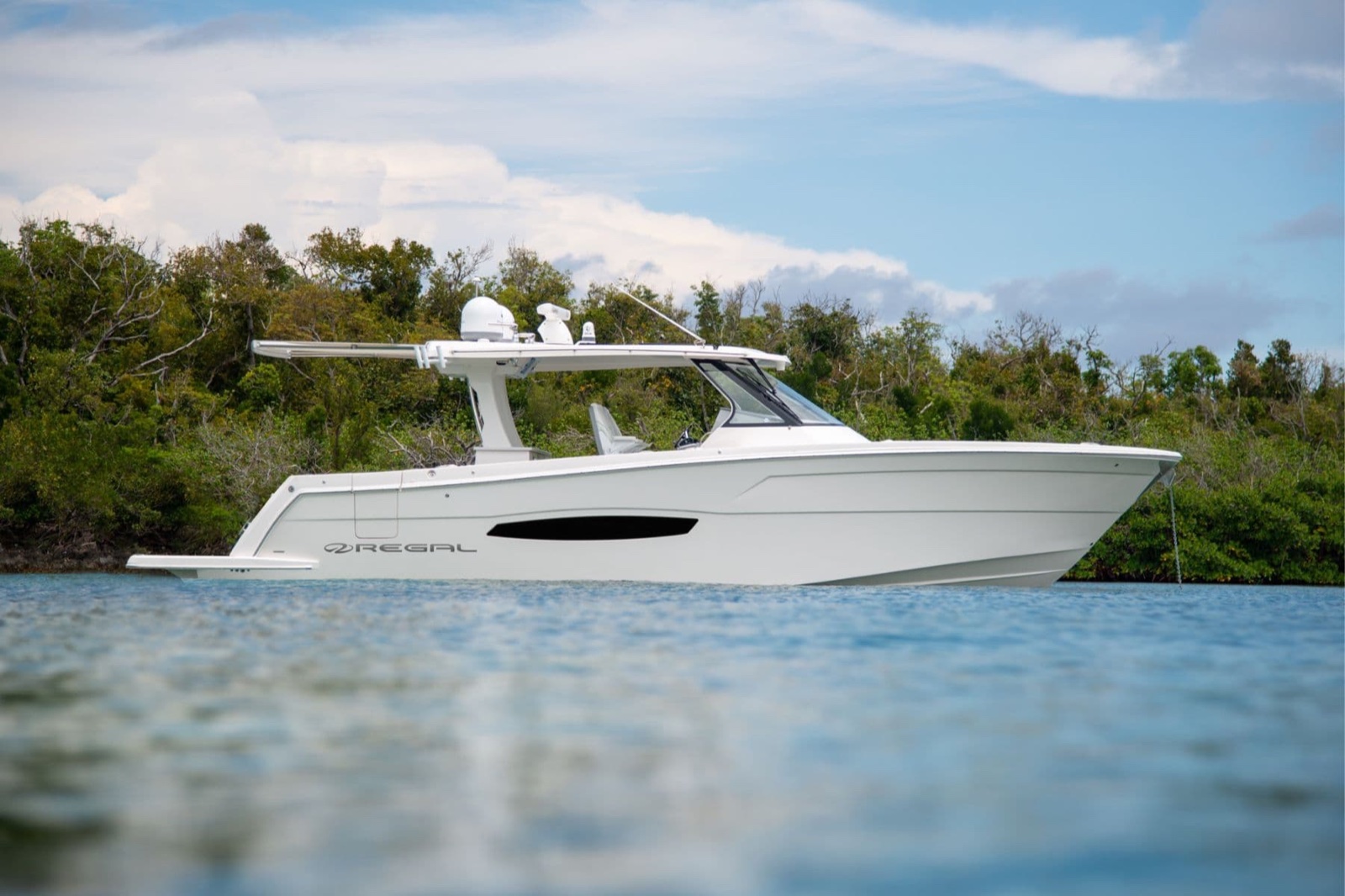
The Regal LS6 Surf is Regal's answer to the wakeboat question without giving up the bowrider layout. The brief in plain language: families want a wake the kids can surf, families also want a boat that works as a day-cruiser when the wake is not the priority, and families do not want to pay $150,000 for a dedicated wakeboat that does only the one job. Regal built the LS6 Surf for that family, and the FasTrac stepped hull plus the Volvo Penta Forward Drive package is what makes the math add up.
What is the Regal LS6 Surf?
The LS6 Surf is a 22-foot fiberglass bowrider built on a FasTrac stepped hull, with a Volvo Penta 6.2L Forward Drive sterndrive, a factory-integrated ballast system, and a surf-side door cut into the gunwale for swimmer access from the cockpit. The cockpit holds seven adults in cruise mode with the surf bench up. The bow seating fits three.
The FasTrac stepped hull is the part that makes the surf wake work. The stepped underbody changes the planing surface and the wake shape so that a 22-foot boat with 1,200 pounds of ballast aboard produces a wake that compares with a dedicated 22-foot wakeboat at the same ballast load. Pure bowriders without a stepped hull do not produce that wake at the same length and ballast. The FasTrac is Regal's competitive advantage in this segment, and it shows up on the water.
The Volvo Penta Forward Drive is the other half of the package. A Forward Drive points the props forward of the transom, which means a surfer behind the boat at the wake is not in the prop's blade path. Traditional sterndrives put the props at the transom, which is the safety reason families historically picked a dedicated inboard wakeboat with the prop tucked under the hull. The Forward Drive lets the bowrider layout do the wakeboat job without the prop-strike risk.
The surf system works through a touchscreen at the helm, with auto-trim and auto-ballast. The cockpit has the surf-side door for swimmer access, a Garmin chartplotter standard, a JL Audio package with cockpit and surf-bench speakers, and trim tabs that integrate with the surf-system trim logic. Hand-laid fiberglass with a composite stringer grid. Stainless hardware on the visible mounts. Gelcoat quality is comparable to Sea Ray and a step below Cobalt at the same length.
Who is it good for?
Surf-curious families who do not want to commit to a dedicated wakeboat are the core buyer. The household where the kids want to surf and the parents want a boat that also handles a lunch run to an anchorage, with seven seats in the cockpit and a real bow. The LS6 Surf is exactly that boat. We watched a family at Lake Cumberland last summer push the ballast button at noon, surf for 90 minutes, drain the ballast, and drive across the lake to a marina restaurant with the surf bench folded down and seven people aboard. The boat handled both jobs without the kind of compromise that families notice.
Buyers cross-shopping the Mastercraft NXT22 are the second profile. The NXT22 is the dedicated-wakeboat answer at a comparable length, with a deeper wake at maximum ballast and a tower-and-rack layout that prioritizes surf and wakeboard. The LS6 Surf gives up some wake depth at the high-ballast setting and gains the bowrider layout, the cockpit volume, and the lower price. Families who want the wake but also want the lunch-cruise capability tend to pick the LS6 Surf.
The third profile is the buyer running 30 to 50 hours of surf time a season alongside another 50 hours of bowrider use. That use mix is the math the LS6 Surf is built for. A buyer running 100-plus hours of surf time and not much else should consider a dedicated wakeboat like the Malibu 22 LSV or the Axis A22 instead.
Who is it not good for?
Pure bowrider buyers who do not want the surf premium should walk past. The LS6 Surf carries a $20,000 to $30,000 price premium against a comparable Regal bowrider without the FasTrac and Forward Drive package. If the household does not surf, that premium does not pay back, and a Cobalt R6 or a Sea Ray SLX at the same length is the right answer for a pure day-cruiser.
Saltwater coastal owners should also think carefully. The Volvo Penta Forward Drive is freshwater-friendly first. The lower-unit corrosion pattern in saltwater is workable with disciplined rinse-after-use practice, but the Forward Drive service network is concentrated in inland markets, and the lead time for parts on the coast can stretch. Owners running the boat in protected coastal water with daily freshwater rinses can make the math work. Owners running in open saltwater are buying a service-network problem.
The third exclusion is buyers who want the deepest possible surf wake at full ballast. The LS6 Surf produces a credible wake for a 22-foot bowrider with 1,200 pounds of ballast. A dedicated wakeboat at the same length pushes more ballast and a hull shape optimized for the surf wake alone. If the surf brief is primary, the dedicated boat is the right answer.
Pricing
New 2026 LS6 Surf pricing is $98,000 to $122,000 depending on the trim package, the tower option, the audio upgrade, and the surf-shaper add-on. Used 2019-to-2022 hulls land at $58,000 to $88,000 depending on hours, condition, and the completeness of the standard options on the build.
The sweet spot for 2026 buyers is a 2021 hull with under 200 hours, the FasTrac and Forward Drive package, the touch-controlled surf system, and the surf-side door at $68,000 to $78,000. That is the price tier where the LS6 Surf is the strongest value against a dedicated wakeboat. Below $58,000 the listings tend to be earlier 2019 hulls without the latest surf-system electronics or with high-hour use cycles. Above $88,000 the listings tip into 2023-and-newer territory at a different value math.
A clean 2021 LS6 Surf at $73,000 sits roughly $25,000 to $35,000 below a comparable-year Mastercraft X24 or Malibu 22 LSV, which is the dollar number that drives most of the cross-shopping in this segment.
What works
- FasTrac stepped hull produces a surf wake that competes with dedicated wakeboats at a 22-foot length and 1,200 pounds of ballast
- Volvo Penta 6.2L Forward Drive eliminates prop-strike risk during surfing, which is the reason families pick this layout over a traditional sterndrive bowrider
- Surf-side door cut into the gunwale is a segment standout for swimmer access from the cockpit to the wake
- Cockpit fits seven adults with the surf bench up in cruise mode. The boat works as a day-cruiser when the wake is not the priority
- Touch-controlled surf system with auto-trim and auto-ballast is a one-button operation once the preset is configured
- 48 mph top end and 28 mph cruise at 3.2 mpg makes the boat usable across a Midwestern or Southern lake without fuel anxiety
What does not
- Volvo Penta dealer network is thinner than Mercury's, and Forward Drive service turnaround in some regions is longer
- Sterndrive bellows and Forward Drive lower-unit maintenance are annual lines that an outboard equivalent does not have
- The premium-tier price is real money for what some buyers see as a compromise between dedicated surf and pure bowrider
- Forward Drive is freshwater-friendly first. Saltwater service is workable but the corrosion pattern needs disciplined rinse-after-use
- Ballast pump auto-fill cycle is the recurring service line. Pumps wear and the timing drift catches first-time owners
- Gelcoat quality is comparable to Sea Ray and a step below Cobalt at the same length
Year-by-year notes
The LS6 Surf launched for the 2019 model year on the FasTrac stepped hull with the Volvo Penta Forward Drive. The 2020 model added the touch-controlled surf system as standard, replacing the rocker-switch ballast control on the 2019 hulls. The 2021 model added the surf-side door as a standard cockpit feature. The 2022 model carried minor cockpit upholstery and audio package refinements without a meaningful drivetrain change. From 2023 onward, the LS6 Surf continued with iterative updates to the surf-system electronics and the helm chartplotter.
The 2021-and-newer hulls are the ones worth screening for buyers who want the complete surf-side door and touch-control package as factory equipment. The 2019 and 2020 hulls can be retrofitted with the door, but the factory-cut version is the cleaner installation.
Cost of ownership
Annual costs are higher than a non-surf bowrider because of the surf-system service and the Forward Drive maintenance. Volvo Penta 6.2L service every 100 hours costs $500 to $700 in parts and $400 to $600 in dealer labor. Forward Drive lower-unit service is $600 to $1,100 a year. Bellows replacement on the Forward Drive every two to three years is $1,400 to $2,000.
The ballast pump and surf-system service is the LS6-specific line. Ballast pump replacement costs $400 to $700 per pump, and the auto-fill timing drift is the wear pattern that owners notice after 200 to 300 hours of surf use. Replacing the pumps as scheduled prevents the slow-fill issues that show up first.
Insurance on a $70,000 hull is $1,200 to $2,000 a year. Trailer storage at home is the cheapest setup. Slip rental in a Midwestern or Southern lake market is $1,800 to $4,500 a season.
A five-year hold on a 2021 used LS6 Surf bought at $73,000 with 150 hours, used 75 hours a season including 35 hours of surf use on a Southern lake with trailer storage, lands at roughly $9,000 to $13,500 a year all-in including insurance, fuel, service, launch fees, and the amortized capital cost.
Best year and trim to buy
A 2021-or-newer LS6 Surf with the FasTrac stepped hull, the Volvo Penta Forward Drive, the touch-controlled surf system, the surf-side door, the integrated ballast tanks, the Garmin chartplotter, and the JL Audio package with surf-bench speakers is the right buy in 2026. Hour count under 200 is the sweet spot for the used market.
Verify four things pre-purchase. First, the ballast pumps are within service interval and the auto-fill timing is clean on a sea-trial cycle. Second, the Forward Drive lower unit has been serviced at the documented hour interval, with bellows replacement dated within two years. Third, the FasTrac hull surface shows no impact damage at the steps. Fourth, the surf-system electronics power up and the touchscreen response is clean on a cold-start.
Alternatives
The dedicated surf alternative at a comparable length is the Axis A22, built for the surf-first buyer with a different layout and a deeper wake at the high-ballast setting. The premium dedicated wakeboat cross-shop is the Malibu 22 LSV, which is the boat to look at if the surf brief is primary and the bowrider layout is secondary. For the pure-bowrider buyer who skips the surf premium, the Cobalt R6 covers the day-cruising and entertaining brief at the same length without the FasTrac and Forward Drive package.