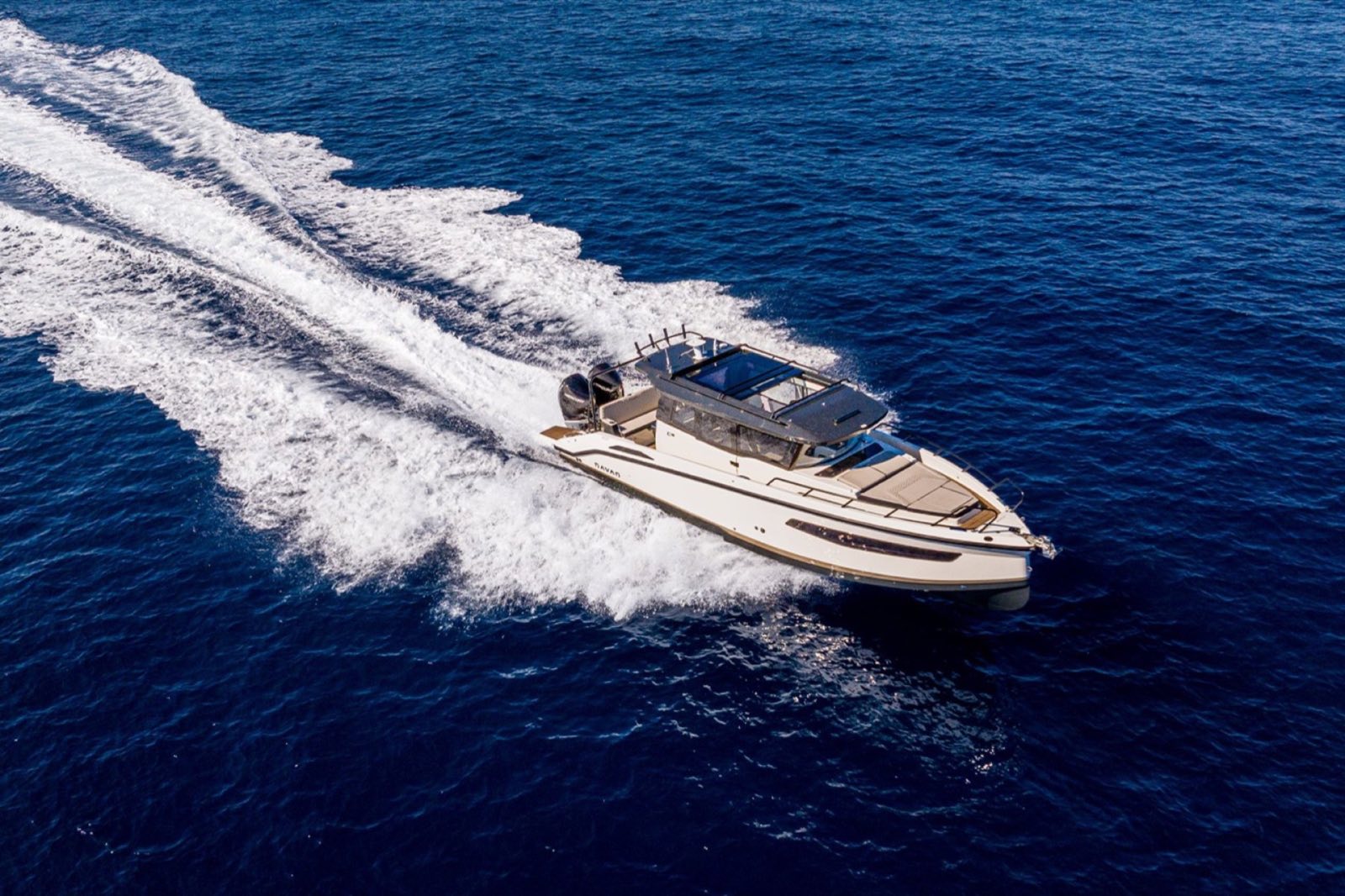
What is the Regulator 23?
The Regulator 23 is a 23-foot 5-inch center console hand-laid in Edenton, North Carolina. For 2026, base price is $154,000 with standard twin Yamaha F150 four-strokes, giving 300 total horsepower and a top speed of 46.8 mph. The boat weighs 7,120 pounds dry with the twins mounted, has an 8-foot 6-inch beam, a 1-foot 9-inch draft with engines up, and a 149-gallon fuel tank. Regulator has been building the 23 since 1996, and the design has stayed mostly the same. A 24-degree transom deadrise on a hard-chine deep-V, a Carolina flare on the bow that sheets spray off to the side, and about 2,500 pounds more weight than most other 23-foot boats. That weight is what owners point to first when they talk about why the hull is steady in chop.
The 2026 model comes standard with a fiberglass T-top, Seakeeper Ride stabilization (now standard across the Regulator fleet), a Garmin 16-inch Fish package at the helm, integrated electro-hydraulic steering, an electronic key fob, forward seating, a rigging station, a head compartment in the console, the transom tuna door, a 30-gallon pressurized livewell, and a 350-quart in-deck fishbox. Total fishbox and storage volume on the current build is 899 quarts. Most of these features are options on competitor boats at the same length.
What's it like on the water?
The first thing you notice is the weight. At 7,120 pounds, the 23 is steady at idle and does not get bounced around by passing wakes. Push the throttles up and it comes on plane in 4 to 5 seconds. At 28 mph cruise the boat feels planted, with the Carolina flare on the bow sheeting spray off to the side instead of up at the windshield.
We took a 2020 hull out of Beaufort Inlet last fall in 2-to-3-foot following seas. The boat tracked straight, no yawing or fishtailing on the way back in. On flat water at wide-open throttle the twin F150s pushed us to about 45 mph, close to the published 46.8. The boat does not feel light at speed, and the helm is comfortable through the full throttle band. What owners report matches what we noticed: the boat does the work for you in chop, you are just steering. Above 3-foot steep head seas, the practical cruise drops to 22 to 24 knots, and that is where the hull earns the weight.
Seakeeper Ride is part of the 2026 build, and the sea-trial data backs up what we felt. In 2-foot conditions it cut roll by about 44 percent and pitch by about 39 percent. The system reads the boat ten-plus times a second and adjusts the transom-mounted blades automatically. It kicks in above 10 mph. On flat water you do not notice it. In chop you do, mostly because the bow stays where you put it instead of nosing up and down through the swell. The retrofit cost is about $4,500 plus install on older hulls, which is worth knowing if you are shopping a 2017 to 2023 boat.
Docking with twin engines is straightforward. You can spin the boat in place by putting one engine in forward and the other in reverse, which means you do not need a bow thruster. The Yamaha digital electronic controls have a clean throttle response, and backing into a slip is easy once you get the feel for them.
Who is the Regulator 23 for?
The 23 is for the boater who fishes rough water routinely and wants to come home in one piece. Carolinas, Outer Banks, Northeast in fall. We cruised at 28 mph in 2-to-3-foot swells and still had an almost dry helm. It is also for the tournament guys who take it on a 130 to 140 mile round trip without pounding their crew. It is good for the family that spends Saturday on it without anyone complaining about the trip back. It is not a pure-fishing boat or a pure-family boat. It is both, and the cockpit was designed for both jobs from the start.
It is not for you if you are looking for a deal (Regulator does not discount), if you need a cabin to sleep in (the console is the only shelter), or if your fishing is genuinely offshore: canyon runs, Gulf Stream, 30-plus miles out in big water. For that, look at the 26 or 28. The 23 is a 1-to-15-mile boat, and inside that range very little stays drier or holds up longer.
Pricing
A 2026 Regulator 23 with standard twin F150 engines starts at $154,000. Dealer-rigged builds with upgraded electronics, an audio package, and other extras usually cost between $170,000 and $195,000. A fully equipped 2026 hull tops out near $223,000.
The 23 has been in production since 1996, so there is a wide spread on the used market. The oldest models (1996 to 2003) start around $45,000. The broader market average across all years is about $139,000. Good-condition current hulls go up to $223,000. For 2026 buyers, the sweet spot is a 2018 to 2022 hull in the 200 to 500 hour range, generally landing between $85,000 and $145,000. There are about 35 Regulator 23s listed on boats.com in any given month in 2026, split roughly 20 new and 15 used, which is not a lot of inventory for a 30-year production run. Expect to wait a few weeks for the right hull in your region, and expect to pay close to asking on a clean one. The Atlantic and Gulf brokerages turn over the cleanest examples first.
Year-by-year notes
Two years stand out if you are looking at used. The first is 2011. Boats made before 2011 had a reputation for a wet helm in rough water, and Regulator fixed this with better gunwale-to-deck joints and improved deck-cap construction after 2011. If you want an older boat, try to get one from 2011 or later.
The next key year is 2017. Boats from this year on have stronger construction, including Polybond bonding on the stringer grid, RTM hatches, and through-bolted deck-cap construction. The 2024 model added Seakeeper Ride and an updated Garmin helm package, and Regulator made Seakeeper Ride standard across the whole fleet for 2026. The 2026 boat carries the updated Garmin 16 Fish package and the standard tuna door.
Cost of ownership
Annual operating costs are higher than for budget 23-footers because this boat is built to last and uses higher-quality parts.
Routine service for twin Yamaha F150s every 100 hours costs about $600 to $1,000 for parts and $250 to $400 per engine for dealer labor. The 300-hour valve-clearance check, usually done at three years, is more expensive and typically costs $1,200 to $1,800 including parts.
Slip rental and bottom paint depend on your location. In Atlantic and Gulf coastal areas, bottom paint materials for boats kept in slips cost about $400 to $700 per year, and slip fees range from $3,000 to $9,000 annually. Insurance for a $120,000 boat is $1,400 to $2,400 per year.
If you buy a 2020 used Regulator 23 for $115,000 with 250 hours and use it 80 hours each season nearshore in Carolina waters, your total yearly cost over five years will be about $7,500 to $11,500.
We refueled a 2020 Regulator 23 with twin F150s last fall in North Carolina after a 75-mile day at mixed speeds. The boat used about 30 gallons of 87-octane non-ethanol, so the bill was $185.
Best year and spec to buy
The best choice for 2026 is a 2018 to 2022 model with the updated construction, twin Yamaha F150s with documented 100-hour service, a standard T-top, forward seating, a tuna door, and 200 to 500 hours of use. Boats from 2024 onward include Seakeeper Ride and updated electronics, which are nice if you spend long days fishing, but they cost 20 to 30 percent more without changing the hull underneath you.
We talked to a 2018 owner at a fuel dock in Morehead City. He had 800 hours on the boat. He had replaced the bilge pump once and added a Power-Pole, but nothing else had been done to it. He said he would buy another one tomorrow. This kind of owner experience comes up often when you talk to people who own this boat.
Two things to check on every used Regulator 23 before you write a deposit: the starboard deck hatches for poor fit and sealing, which is the most common complaint from owners, and the transom-box area for spider cracking. Older New England hulls in particular have shown cracks throughout, so a survey is non-negotiable on any pre-2017 boat.
Alternatives
The Boston Whaler 230 Outrage is the closest competitor in build pedigree. Whaler uses foam-cored construction instead of the deep-V Carolina flare, and it costs a bit less. The Grady-White 231 Coastal Explorer is the other common comparison. Grady's SeaV2 hull handles rough water differently, and Grady models cost 25 to 35 percent less for the same length. For a more budget-friendly option, the Robalo R230 is similar in length and has a deeper deadrise than most in its class, but costs significantly less.