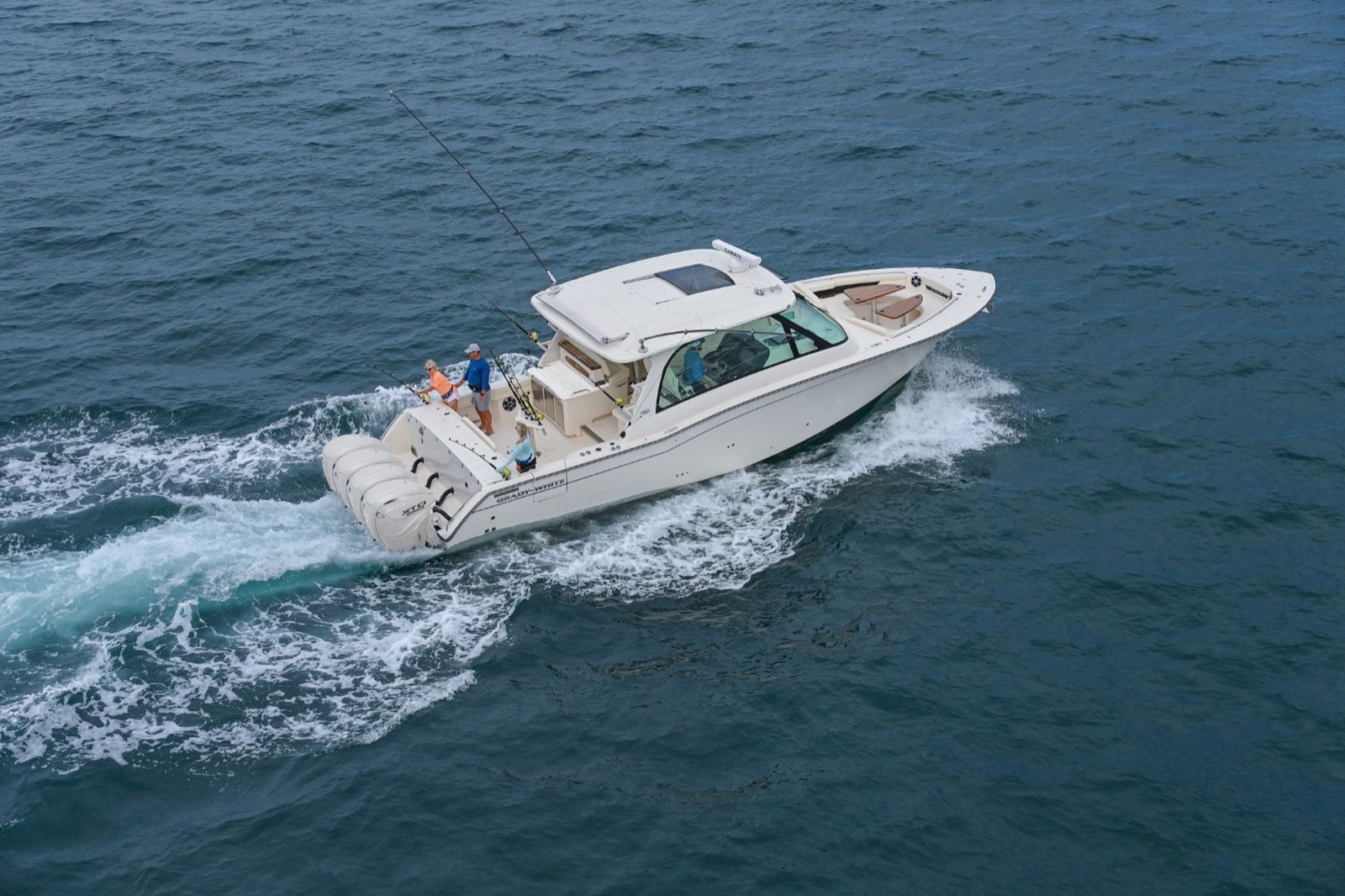
The Scout 215 XSF is the smallest boat Scout builds and the one that does the most with its length. Scout Boats has been building center consoles in South Carolina since 1989, and the 215 XSF sits at the small end of the lineup, anchoring the inshore-first part of the catalog. It ranks fifth in our 2026 center-consoles-under-30 guide because the console layout density is segment-leading at 21 feet, the build sits half a tier above the value segment, and the 25-gallon livewell does what it claims to do.
What is the Scout 215 XSF?
The 215 XSF is a 21-foot 6-inch fiberglass center console with an 8-foot 6-inch beam and a 16-degree transom deadrise. Hand-laid fiberglass with foam coring in the structural laminates, a hand-laid stringer grid, and stainless deck hardware throughout the visible spec. Rigging options are Yamaha F200 or Yamaha F250 four-stroke outboards, with the F250 the more-sold spec on the 2026 used market because the holeshot and cruise numbers favor the larger engine on this hull.
The deck plan is what makes the boat. A center console with a head compartment in the base, a Garmin chartplotter at the helm on standard spec, a leaning post with rod storage, and a forward seating arrangement that converts to a bow casting deck without removing the cushions. The 25-gallon pressurized livewell sits aft and works off a dedicated pump on the post-2015 hulls. The anchor locker has a dedicated freshwater rinse shower that owners point to as the feature they did not know they needed until they had it. Console storage holds day-trip gear and the head compartment fits a Porta-Potti or a marine head depending on owner spec.
The hull is the limit. A 16-degree deadrise is a calm-water and bay number, not a head-sea offshore number. The boat plans early because the deadrise is shallow, it corners stable, and it holds a dry ride in 1-to-2-foot conditions. In 3-foot chop the ride goes from acceptable to working, and beyond that the boat is the wrong tool for the conditions. The honest framing is that the 215 XSF is a bay boat with center-console layout, not a small offshore boat. Owners who shop it as the second category are disappointed. Owners who shop it as the first category are happy.
Who is it good for?
Inshore-first anglers are the core profile. Flats fishing for redfish, trout, and snook on the Gulf Coast. Bay fishing in protected coastal water on the Atlantic. Striped bass in the back bays of the Northeast. The 25-gallon livewell holds bait for a full day, the casting deck conversion works for two anglers up front, and the rinse shower in the anchor locker is the small convenience that pays back daily. We ran a 2019 hull out of a Pine Island Sound marina on a January morning, a one-foot chop on the Gulf side and protected water inside the keys, and the boat did exactly what the spec sheet says. Plane early, hold a comfortable cruise, run dry, and stay out of the way of fishing.
First-boat buyers who want feature density are the second group. The 215 XSF gives you a console layout that works without paying for length you do not need. A first-time center-console owner trading up from a bay boat or a small skiff finds the 215 a meaningful step up on the systems side without the slip rate or trailer cost of a 23 or 25 footer.
Cross-shoppers from the value segment are the third profile. Buyers looking at a Robalo R230 or a NauticStar 215 who want a build that sits half a tier above the value tier without paying full Grady or Regulator pricing. The Scout build is honest about where it sits. Hardware quality is a step below Grady, console-layout thinking is a step above Robalo, and the price lands roughly in the middle. That is the buyer the 215 was designed for.
Who is it not good for?
Anyone planning to run 15-plus miles out regularly is the wrong buyer. The 16-degree deadrise is the limit. Offshore-crossing in any real sea state is not the boat's job. A Scout 235 LXF two feet longer with more deadrise is the right answer if your fishing crosses to nearshore more than occasionally. For real offshore work, a deeper-V hull from Regulator, Grady, or Boston Whaler at 23 to 25 feet is the right tool.
Buyers who want a cabin or an enclosed head at this length should walk past. The console serves as the only weather shelter, and the head compartment in the console fits a Porta-Potti, not a sit-up enclosure. Families who plan to overnight aboard need a different boat.
Pacific Northwest and Great Lakes buyers should think carefully about the dealer network before committing. Scout's footprint is concentrated on the Atlantic and Gulf. Parts and warranty service in the Pacific and Great Lakes markets are workable but they require freight on most non-stock items. Buyers in those markets should check the closest dealer relationship and the parts-availability question before they sign.
Pricing
New 2026 Scout 215 XSF builds with the Yamaha F250, the T-top, and a standard electronics package land in the $78,000 to $95,000 range depending on dealer and option lines. Stepping up to a hardtop, a trolling motor, a Power-Pole, an upgraded Garmin or Simrad helm, and a trailer can push the build past $115,000 at the dealer. The base build with the F200 and no T-top trims roughly $8,000 to $12,000 off the higher spec.
The used market spans $22,000 at the bottom (pre-2015 hulls with the original scupper design, deferred service, and shared-pump livewells) to $78,000 at the top (current-year hulls with full electronics and the F250). The sweet spot in 2026 is the 2018-2022 hull with the post-2015 redesign, Yamaha F250 rigging, current 100-hour service, and 200 to 500 hours, which lands in the $38,000 to $65,000 band.
Five-year depreciation on a clean 215 XSF is about 28 to 34 percent off new MSRP, slightly worse than the segment leaders (Grady, Regulator) but better than most volume-tier center consoles. The dealer-network concentration on the Atlantic and Gulf supports the resale in those markets and softens it slightly on the West Coast and Great Lakes. Buyers planning to hold the boat five-plus years can model their capital cost with reasonable confidence.
What works
- Console layout density is segment-leading at 21 feet. The rinse shower in the anchor locker, the casting-deck conversion, and the console storage all add up to a deck plan that works.
- 25-gallon livewell holds pinfish or pilchards for a full day without intervention. The dedicated pump on the post-2015 hulls solved the earlier shared-pump issue.
- Plans early, corners stable, stays dry in 1-to-2-foot conditions.
- Yamaha F250 rigging gives the boat the holeshot and the cruise rpm it needs for the displacement.
- Mid-tier price with a build that feels closer to Grady than to Robalo on hardware.
- Forward seating converts to a bow casting deck without removing the cushions.
- Resale is steady on the used market in Scout's core dealer geography.
What doesn't
- 16-degree deadrise is the limit. The boat pounds in 3-foot chop and beyond. Not a head-sea offshore boat.
- Pre-2015 hulls had scupper drain and shared-pump issues. The 2016 redesign solved both, but pre-2015 boats still trade on the used market and warrant a more careful sea-trial.
- Scout's warranty has been a friction point on some dealer claims. What owners report is uneven, with some markets reporting straightforward service and others reporting runaround on legitimate hull or build issues.
- Dealer network is concentrated on the Atlantic and Gulf. Pacific and Great Lakes buyers pay freight on most non-stock parts.
- No berth, no enclosed head, no overnight capability. The console is the only weather shelter.
- T-top and freshwater washdown are option lines on the base build, not standard.
Year-by-year notes
The 215 XSF has been in production since the early 2010s with the major hull and deck refinement coming in 2015. Pre-2015 hulls carried the original scupper drain design (which allowed water back into the cockpit in certain following-sea conditions) and a livewell pump shared with the washdown (which compromised both functions on a long day). The 2016 model year brought a redesigned scupper drain that solved the back-flow issue and a dedicated livewell pump that solved the shared-circuit problem. The 2016-onward production is the cutover most buyers screen for.
Yamaha rigging shifted from F200 dominance toward F250 popularity through the 2018-2022 production as buyers found the larger engine matched the displacement better. The console electronics moved from a single Garmin display to a flush-mount setup with optional dual displays in the same window. The casting-deck conversion design has been consistent across the production. No single defect cutover year defines the post-2016 production, but the 2018-2022 boats are the most-sorted hulls in the 2026 used market.
Cost of ownership
Annual operating costs on a Scout 215 XSF sit in line with the mid-tier center-console segment. Yamaha F250 service every 100 hours costs $300 to $500 in parts and $250 to $400 in dealer labor. The 300-hour valve-clearance check at the three-year mark steps the labor budget up. Bottom paint for slip-stored hulls costs $300 to $500 in materials a year. Trailer-stored hulls skip that line entirely, which is part of the math that makes the 215 XSF work as a trailer boat.
Insurance on a $55,000 hull is $700 to $1,400 a year in coastal US markets. A trailer-stored 215 XSF used 80 hours a season for inshore fishing on the Gulf Coast costs roughly $3,800 to $6,500 a year all-in including insurance, fuel, service, ramp fees, and amortized capital cost on a five-year hold. Slip storage doubles that number in major coastal markets. The boat works best as a trailer boat, and the displacement is light enough that a half-ton pickup can pull it.
Best year and trim to buy
The 2018-2022 Scout 215 XSF with the Yamaha F250, the post-2015 hull redesign, current 100-hour service, and 200 to 500 hours is the right buy in 2026. The F200 spec is also a correct buy at a lower price point for owners who fish closer to home and care less about the holeshot. Both engines are the same Yamaha service ecosystem, and both rigging configurations move on the used market.
Verify five things before purchase. The hull is the post-2015 redesign (not a pre-2015 boat with cosmetic updates), confirmed by the hull-identification number and the dealer or seller records. The scupper drain back-flow test on the trailer with a hose at the stern shows clean drainage and no cockpit ingress. The livewell pump cycles cleanly and the pressurized livewell holds water under power. The Yamaha service file is current and the 300-hour valve clearance has been done if the boat is at or past that hour mark. The anchor-locker rinse shower works (a small detail but the indicator that the freshwater plumbing has been maintained). A clean 2020 hull with these five boxes ticked lands in the $48,000 to $58,000 range from a Scout-experienced dealer.
Alternatives
The closest value cross-shop is the Robalo R230, two feet longer at materially less money with a similar deadrise philosophy and a similar inshore-first brief. The premium cross-shop is the Grady-White 231 Coastal Explorer, which costs more but uses the SeaV2 hull that handles weather the Scout cannot. The step-up within the Scout line is the Scout 235 LXF, two feet longer with more deadrise and more livewell capacity, the right answer if your fishing crosses to nearshore more than occasionally.