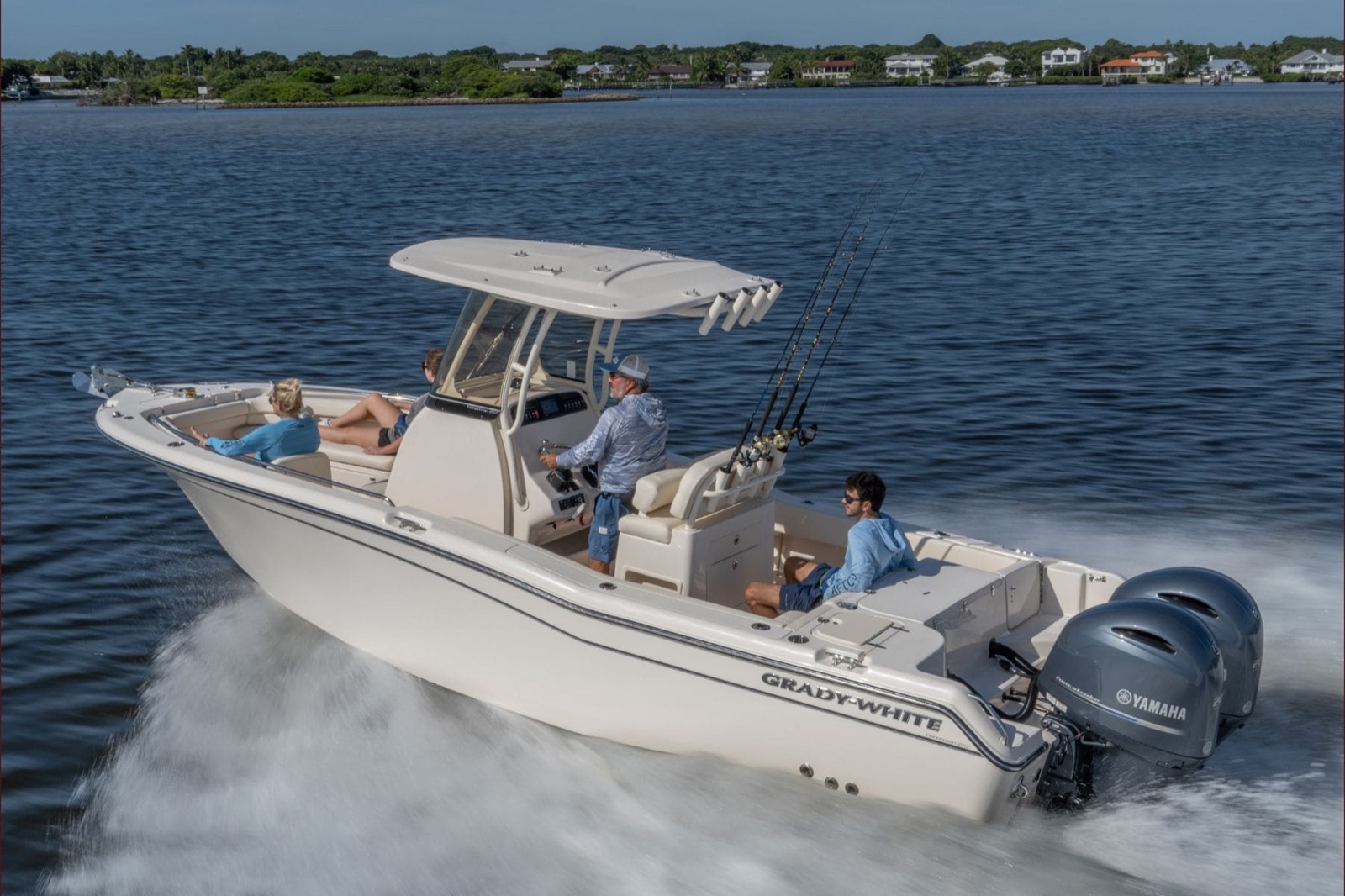
Scout's 235 LXF is the bay-and-light-offshore center console that puts running surface ahead of every other spec under 25 feet. Scout has been building boats in Summerville, South Carolina since 1989, and the LXF lineup represents the company's volume play in the 21-to-29-foot bay-and-offshore segment. The 235 launched on the current N3 hull platform in 2020 and has carried through the 2026 model year with running changes to electronics, helm hardware, and seating layouts.
What is the Scout 235 LXF?
The 235 LXF is a 23-foot 6-inch fiberglass center console with an 8-foot 6-inch beam. The N3 hull is the design feature owners pay the premium for. A 22-degree transom deadrise, integrated bow flare, and a stepped pad mid-hull that breaks surface tension and reduces wetted area at cruise speed. The result is a boat that hits a 32-knot cruise on a single Yamaha F300, holds 3.4 mpg at that cruise, and gets on plane in under four seconds with a full crew aboard.
Construction is hand-laid fiberglass with vinylester resin on the outer skin, a composite stringer grid bonded to the hull, and a closed-cell foam coring through structural deck areas. Stainless on visible mounts and hardware. The gelcoat quality is solid. Not at the same level as a Boston Whaler but a meaningful step up from the value-tier brands at the same length. The hardtop is fiberglass with stainless support tubes. It's heavier than an aluminum-frame alternative but holds shape better over time and doesn't develop the rattles that aluminum frames pick up after a few seasons.
The cockpit layout works for the boat's split-use case. Forward casting deck big enough for two anglers without crowding, with a removable cushion and bow seating that converts to family-cruising mode in about ninety seconds. Aft jump seats fold out for two more passengers. Two pedestal helm seats. Enclosed head under the console with a porta-potti or marine head depending on build. Standard livewell aft, plus a leaning post with rod holders and tackle storage. Eight people fit in the cockpit for cruising. Five fish comfortably.
Standard rig is a single Yamaha F300 V6 four-stroke. Some hulls left the factory with the F250 to hit a lower price point, but the F300 is the right engine for the platform. With the F300, the boat tops out around 53 mph and cruises at 32 knots burning roughly six gallons an hour. Range on the 80-gallon tank is real for a coastal day. Electronics are typically a Garmin GPSMap chartplotter at the helm, JL Audio stereo, and trim tabs as standard from 2021 onward. The hardtop electronics box is optional and worth specifying at this price.
Who is it good for?
Coastal buyers running a mix of bay fishing and family days are the core profile. Saturday morning chasing trout on a flat with two anglers up front, Sunday afternoon taking the kids out for a sandbar swim and a tube pull. The 235 does both jobs without obviously compromising on either. The casting deck is a real fishing platform, not a token gesture, and the bow cushions and aft seating turn the same boat into a family weekender in five minutes.
Owners cross-shopping a Robalo R230 who value the running-surface upgrade are the second profile. Robalo gives you a competent hull at lower money. The Scout gives you a running surface that genuinely rides better at cruise speed and a holeshot that's noticeably faster. For the buyer who runs the boat 80 to 150 hours a year, that performance difference shows up every trip. We ran a 2022 235 LXF for a long afternoon out of a Charleston ramp one fall, with two anglers fishing the inlet and then a run back inside to a sandbar, and the running surface is what the day was about. Through a sloppy three-foot inlet on the way in, the bow flare kept the helm dry and the stepped pad let the boat ride flat rather than bow-up.
The third profile is Florida and Carolina coastal buyers with the Scout dealer network nearby. The brand is strongest in the Southeast and Florida markets, which is also where the used-market depth is biggest. Buying a 235 LXF in those markets gives you support nearby for warranty and service work, plus a deeper pool of comparable hulls when you sell.
Who is it not good for?
Build-first owners cross-shopping a Boston Whaler at the same length should pass on the 235. The gap is build, not running surface. Boston Whaler's foam-cored unsinkable construction is in a different category, and buyers who put hull construction first will see the Whaler as the better long-term boat. Scout builds a good boat. Whaler builds a different category of boat at noticeably more money.
Heavy-offshore households running 4-foot chop regularly should also walk past. The 235 LXF is a 22-degree-deadrise bay-and-light-offshore platform. Capable in 2-to-3-foot chop with the F300 and a competent driver. Wrong for owners who routinely fish 25-plus miles offshore in real sea states. The Scout 251 XSS or the 281 Sport Fish is the right answer for that work.
Buyers far from the Scout dealer footprint should think carefully. The dealer network is Southeast-heavy with patchy coverage in the Pacific and Great Lakes. Warranty work and parts logistics get noticeably more expensive away from the core markets, and the resale value of a Scout in a non-Scout market is materially weaker.
Pricing
New 2026 pricing on the Scout 235 LXF runs roughly $118,000 to $142,000 depending on engine choice, electronics, and option lines. Standard build with the Yamaha F300, base Garmin electronics, and the fiberglass hardtop lands near the bottom of the range. Adding the hardtop electronics box, dual-battery switch, premium audio upgrade, outriggers, and a fully-equipped tackle station can push the build past $145,000.
The used market in 2026 spans about $58,000 at the bottom (high-hour 2020-2021 hulls with deferred service and a smaller engine) up to $108,000 at the top (a 2023-2024 hull with full options, low hours, and a clean service file). The sweet spot is the $74,000 to $96,000 band on 2021-2023 hulls with the F300, Garmin standard, and the hardtop electronics box.
Five-year depreciation on a clean 235 LXF lands around 26 to 30 percent off new MSRP. That's strong for the segment and reflects the Scout brand demand in the Southeast and Florida. Three-year depreciation runs slightly tighter than Robalo R230 on comparable hulls.
What works
- N3 hull with stepped pad gives a sub-four-second holeshot. Segment-leading for LOA
- Cruise at 32 knots holds 3.4 mpg with the F300. Range is real on the 80-gallon tank
- Forward casting deck fits two anglers without crowding
- Bow seating converts to family-cruising mode in under two minutes
- Resale tracks within 28 percent of new at five years
- Enclosed head under console makes the boat workable for a long day with kids aboard
What doesn't
- Scout premium of about 15 percent over Robalo at the same length
- Single battery standard. Order the dual-battery upgrade at delivery
- Hardtop electronics box is optional. Recommended at this price
- Hardtop is fiberglass and heavier than aluminum-frame alternatives
- Single-engine rig means no offshore redundancy. Plan accordingly
- Dealer footprint is Southeast-heavy. Coverage thins elsewhere
Year-by-year notes
The 235 LXF launched on the current N3 hull platform in 2020. The 2021 model added the Garmin GPSMap as standard at the helm and the trim tab integration with the Yamaha digital throttle. The 2022 model brought minor seating updates, with a slightly redesigned leaning post that incorporates better tackle storage. The 2023 model added a refresh of the helm layout and integrated a digital switching package on higher-trim builds. The 2024 model carried minor cosmetic and trim updates. The 2025-2026 models are essentially the 2023-2024 boat with running changes to seating fabric, latches, and small interior hardware. There's no defect cutover year worth screening for. Engine choice (F250 versus F300) and the hardtop electronics box are the bigger variables on used-market shopping.
Cost of ownership
Annual costs on a Scout 235 LXF are average for the segment.
Yamaha F300 service every 100 hours costs $300 to $500 in parts and $200 to $400 in dealer labor. The 300-hour valve-clearance check at the three-year mark adds labor. Bottom paint for slip-stored boats runs $400 to $700 a year. Trailer-stored hulls skip that line. Insurance on a $90,000 hull value is $1,100 to $2,000 a year in coastal markets.
A five-year hold on a 2022 used Scout 235 LXF bought at $84,000 with the F300 and 200 hours, run 100 hours a season on bay and light-offshore water out of a Carolina ramp with trailer storage, lands at roughly $5,500 to $8,500 a year all-in including amortized capital cost. The trailer-storage line and the brand-demand resale keep the math reasonable.
Best year and trim to buy
A 2021-2023 Scout 235 LXF with the Yamaha F300, the Garmin GPSMap standard, the hardtop electronics box, and the dual-battery switch upgrade is the right buy in 2026. The N3 hull markings on the build plate confirm you're getting the stepped-pad version. That's the configuration that justifies the Scout premium.
Verify five things pre-purchase. First, the running surface and the stepped-pad geometry on the build plate. Second, the engine service file shows current 100-hour Yamaha work and the 300-hour valve check if the hours warrant it. Third, the hardtop seal and the electronics box gasket on a hose test. Fourth, the livewell pump runs clean and the deck drains hold seal under load. Fifth, the trailer condition if it's included. Tandem-axle trailers at this length take real abuse on coastal roads and the bearings, brakes, and frame are due for attention every two seasons.
Alternatives
The value cross-shop is the Robalo R230. Robalo's build sits a tier below Scout with a deeper deadrise than most price-segment competitors. The hull handles chop well and the boat is materially less money. Trade is running surface and a slower holeshot.
The step-up cross-shop is the Robalo R242. A longer waterline gives a more capable offshore platform at similar money to the Scout 235. The cost is single-engine economy versus more boat per dollar.
The step-down option in the same lineup is the Scout 215 XSF. Most of the N3 hull character at a smaller LOA, lower entry price, and tighter trailer footprint. The right answer if the bay work outweighs the offshore work in your use case.