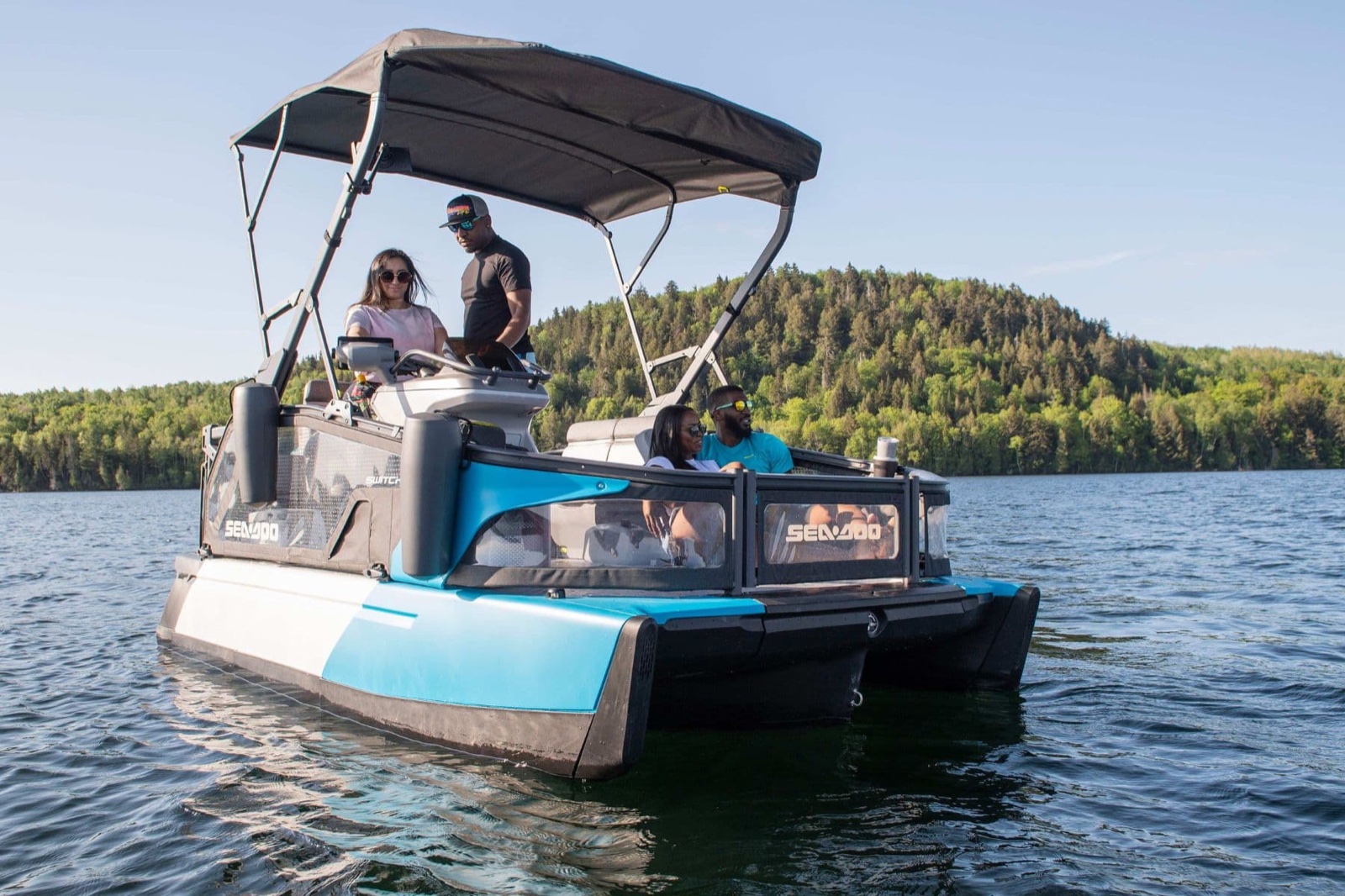
The Sea-Doo Switch Electric is the all-electric version of the Switch jet pontoon platform. Sea-Doo (a brand of BRP) launched the gas Switch in 2022 as a modular-deck jet-powered pontoon, and the Switch Electric followed for the 2024 model year as the all-electric variant. The Switch Electric sits at the head of our 2026 entry-electric-pontoon guide because the platform, the drive, and the modular deck all add up to a boat that nothing else on the U.S. electric pontoon market directly competes with.
What is the Sea-Doo Switch Electric?
The Switch Electric is a 19-foot 3-inch (in the standard length, with shorter and longer variants available) modular pontoon. Beam is 8 feet 4 inches. Draft is 1 foot 1 inch. Dry weight is roughly 2,800 pounds depending on battery package. The hull is the same M-hull design as the gas Switch, with twin polyethylene pontoons running aft to a wide-beam transom for stability.
The drivetrain is the headline. Rotax E-Power electric drive replaces the gas Rotax jet, with a lithium-ion battery pack in three capacity options. The smallest pack gives 25 to 30 miles of cruise range and a 20 mph top speed. The mid pack gives 40 to 45 miles and a 23 mph top speed. The largest pack gives 50 to 60 miles and a 25 mph top speed. Charging from a Level 2 dock charger (240V, 32A) takes 6 to 8 hours for a full top-up depending on pack size. A Level 1 standard outlet charge takes 18 to 24 hours and isn't realistic for daily use.
The modular deck is the second signature. The Switch platform uses a grid of locking deck panels that reconfigure for entertaining (eight bench seats and a center table), fishing (open deck with bow rod holders), or watersports loading (full open deck with a power tower and a swim platform). The deck reconfigures in 15 to 30 minutes with the right tooling and one or two people working.
I watched a 2025 Switch Electric at a Lake Norman marina last May, plugged into the dock charger overnight, and ran it for ninety minutes the next morning around the lake. The quiet was real. There is no engine sound, no exhaust smell, no vibration through the deck. The trade is the range. After ninety minutes of mixed cruise and idle, the largest battery pack showed 55 percent remaining on the helm display, which suggests the manufacturer range numbers hold up in real-world use.
Who is it good for?
Lake-residents running short trips are the core buyer. Owners with dock-charging access at home, running 5 to 20 miles a day for cocktail cruises, swim days, or short fishing trips. The Switch Electric is built for that program. Lake Norman, Lake Travis, Lake Tahoe, Lake Geneva, Lake Cumberland, and any large protected inland water with marina charging support are the natural home for the boat.
Owners who value quiet operation and low maintenance are the second profile. The electric drive has no oil changes, no spark plugs, no carburetor cleaning, and no fuel system to flush at the end of the season. Service intervals are limited to the jet pump bearings, the steering linkage, and the battery health check.
Families with kids who use the boat 30 to 60 hours a season are the third profile. The shallow draft, the swim-platform access, and the modular deck layout all work for swim-day use, and the quiet operation means conversations stay possible at any throttle setting.
Who is it not good for?
Owners running 50-plus mile trips daily should walk past the Switch Electric. The range isn't there on the standard battery pack, and even on the largest pack the range envelope at 25 mph cruise puts you on the dock with the pack depleted on a long day. A gas pontoon at the same size covers that brief better.
Buyers without dock-charging access at home are the second exclusion. Public marina charging infrastructure isn't reliable yet on most U.S. lakes. The Switch Electric without home-dock charging means trailering the boat home each weekend to charge it, which defeats the convenience of a slip-stored pontoon.
Anyone wanting traditional pontoon volume is the third exclusion. The Switch is narrower than a 22-foot conventional pontoon, with seating for eight rather than twelve. A buyer who wants maximum cockpit volume at a similar price wants a traditional pontoon, not the Switch.
Pricing
New 2026 pricing on the Switch Electric runs roughly $48,000 to $72,000 depending on length, battery package, and trim. The base 13-foot Switch Electric with the smallest battery and entry-tier trim lands near the lower end. The 21-foot Switch Electric with the largest battery, the upgraded helm, the wakeboard tower, and Bluetooth audio pushes past $72,000.
The used market is still young because the model launched for 2024. Listings span roughly $38,000 at the bottom (2024 first-year 13-foot hulls with the smallest battery) to $58,000 at the top (2025 21-foot hulls with the largest battery and full options). The sweet spot for a buyer in 2026 is a 2024-2025 hull with the largest battery package and 50 to 200 hours, which lands in the $48,000 to $56,000 band. Five-year depreciation curves on the model aren't established yet. Electric-pontoon resale is the long-term unknown.
What works
- All-electric Rotax E-Power drive. Quiet operation at any speed, no exhaust, no fuel system to maintain.
- Modular deck layout. Panels reconfigure for entertaining, fishing, or watersports loading.
- Lithium-ion battery in three capacity options. The largest pack gives 50 to 60 miles of cruise range.
- Low maintenance compared to gas. No oil changes, no spark plugs, no fuel system flush at end-of-season.
- Shallow draft at 1 foot 1 inch. The boat gets into anchorages a deeper pontoon can't reach.
- Trailerable at 19 feet behind a half-ton vehicle.
- Distinctive Sea-Doo design. The boat reads as different from traditional pontoons.
What doesn't
- Range at 25 mph cruise is 25 to 60 miles depending on battery package. Range anxiety is real on longer trips.
- Charging from a Level 2 dock charger takes 6 to 8 hours for a full top-up.
- Public marina charging infrastructure isn't reliable yet on most U.S. lakes.
- Top speed of 25 mph is below a comparable gas pontoon at similar length.
- Entry price is similar to a gas Switch at the same size. Operating-cost savings take three to five years to pay back the premium.
- Battery pack longevity is the long-term unknown. Replacement cost on a worn pack is $12,000 to $20,000.
- Resale is uncertain at this early stage. The used market is too young to read a depreciation curve.
Year-by-year notes
The Switch Electric launched for 2024 as the all-electric variant of the Switch platform. The 2025 model added the largest battery option as a near-standard choice and upgraded the helm display to a full-color touchscreen. The current 2026 catalog continues on the 2025 layout with minor trim updates. There is no defect cutover year yet, but the 2024 first-year hulls had a few owner reports of charge-port seal issues that later production has cleaned up. Verify charge-port seal condition on those hulls.
Cost of ownership
Annual recurring costs on a Switch Electric used 50 hours a season are materially lower than a gas pontoon at the same size. Charging cost at residential electricity rates (12 to 15 cents per kWh) is $300 to $600 a year depending on use. Slip rental at a Lake Norman or Lake Travis marina at $12 a foot per month is roughly $2,800 a year. Service intervals on the electric drive are limited to the jet pump bearings, the steering linkage, and the annual battery health check. Total service cost is $400 to $800 a year. Insurance on a $52,000 hull value is $700 to $1,400 a year. Trailer storage in the off-season is $400 to $1,200 a year.
A five-year hold on a 2025 used Switch Electric bought at $54,000 with 100 hours, used 50 hours a season at Lake Norman with home-dock charging and trailer winter storage, lands at roughly $4,500 to $7,500 a year all-in including insurance, electricity, service, slip, and amortized capital cost.
Best year and trim to buy
The 2024-2026 Sea-Doo Switch Electric with the largest battery package, Level 2 dock charging compatibility, the upgraded helm display, and the entertainment deck configuration is the right buy in 2026 for most family buyers. Hours between 50 and 250 are the sweet spot. The largest battery pack is the configuration most buyers prefer because the range envelope works for a real day on the water.
Verify three items pre-purchase. First, the battery state-of-health reading on the helm display shows above 90 percent of original capacity. Second, the charge-port seal is clean and the port itself shows no corrosion (especially on 2024 first-year hulls). Third, the Level 2 dock-charging cable is included and works with a 240V outlet at the marina.
Alternatives
The gas-powered version in the same Switch lineup is the Sea-Doo Switch, which covers the same modular-deck brief with a Rotax jet engine and longer range. The electric foiling alternative at a much higher price point is the Candela C-8, which trades the pontoon layout for a foiling monohull and offers 50 to 60 miles of cruise range at higher speed. The gas-powered family deck-boat alternative at a larger size is the Bayliner 32 Element, which trades electric for traditional gas-outboard volume at a step up in length and entry price.