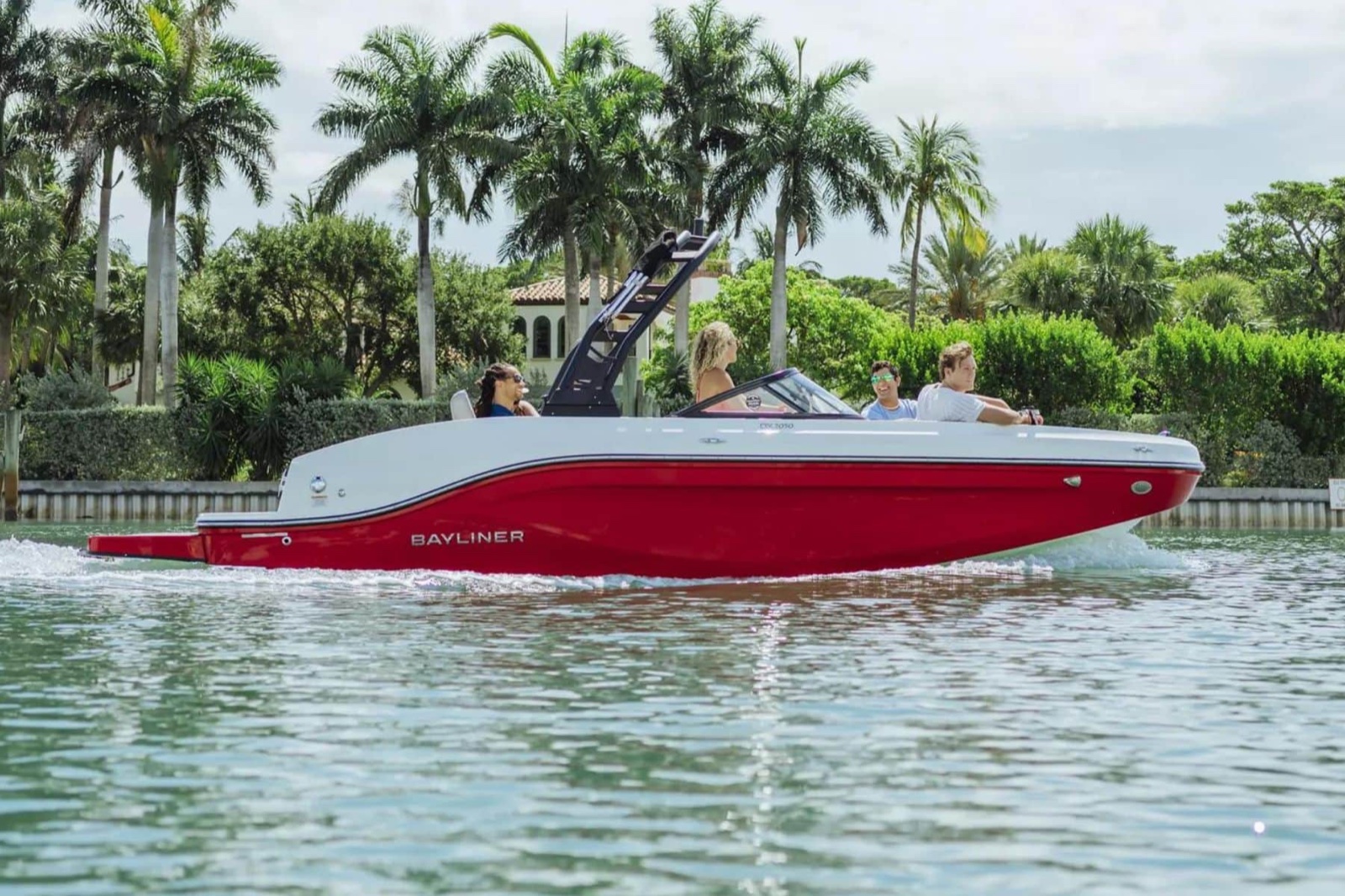
The Bayliner 32 Element is the biggest M-hull deck boat in the Bayliner lineup. Bayliner has been building entry-tier family boats out of Washington State since 1955, and the Element series launched in 2013 with the M-hull design as the brand signature. The 32 sits at the top of the Element range and is in our 2026 entry-tier large-deck-boat guide because the cockpit volume, the M-hull stability, and the entry price all add up to a boat that nothing else at 32 feet directly matches.
What is the Bayliner 32 Element?
The 32 Element is a 32-foot 0-inch fiberglass deck boat. Beam is 9 feet 11 inches. Draft is 1 foot 8 inches. Dry weight is roughly 8,200 pounds. Fuel capacity is 85 gallons. The hull is Bayliner's M-hull design, which pushes the beam to the bow and creates a flat-on-plane running surface. The M-hull is the brand's main selling point at this length and lower. It gives the boat a stable at-rest attitude that is the natural fit for swim-platform use and entertaining, and a flat-on-plane attitude that doesn't lean in turns the way a deep-V does.
Two engine options. Twin Mercury 200 four-stroke outboards at 200 horsepower each is the standard package and delivers a 28 mph cruise with a 38 mph top end. Twin Mercury 250 four-stroke outboards at 250 horsepower each is the upgrade. It pushes cruise to 32 mph and top speed to 44 mph and is the configuration most buyers prefer.
The layout is built around entertaining. Bow lounge with wraparound seating that doubles the usable seating area compared to a center-console at the same length. Cockpit aft of the helm with U-shaped seating, a wet bar with a fridge and a grill in standard packages, and a swim platform with a removable ladder. The console has a head compartment with a marine toilet underneath. There is no sleeping cabin. The whole boat is built around day use, not overnight use.
I watched a family of eight load onto a 2023 32 Element at a Lake of the Ozarks marina last summer, four kids and four adults plus a cooler and a tube and a stereo. The boat absorbed the load without listing, the swim platform took the weight cleanly, and twenty minutes later they were anchored in a cove with the music up. That is the boat the 32 Element was built to be.
Who is it good for?
Families running large inland lakes and protected coastal water are the core buyer. Lake of the Ozarks, Lake Norman, the Florida Intracoastal, Long Island Sound on a calm day, Lake Travis. The M-hull is built for those conditions. Owners hosting eight to twelve people for swim days, tubing, sunset cruises, and on-water entertaining are the natural fit.
First-time large-boat buyers who want maximum entertaining space at an entry-tier price are the second profile. The 32 Element gives 32 feet of cockpit volume at a third of the price of a Sea Ray or a Regal at the same length. The trade is hardware tier and build quality, but for a buyer who values usable space over finish, the equation works.
Who is it not good for?
Anyone running open coastal water in real chop should walk past the 32 Element. The M-hull is stable at rest and pounds in a steep head sea. The boat is built for lakes and bays, not for offshore work or open-water chop. A center-console at a similar length, even at a higher price, covers that brief better.
Owners wanting cabin space, a real overnight capability, or a head with a stand-up shower should also walk past. The console has a head compartment, not a sleeping cabin. Anyone wanting to weekend aboard wants a Sea Ray Sundancer 320 or a Bayliner Ciera 8 instead.
Buyers who care about resale price are the third exclusion. Bayliner deck boats hold price less well than upper-tier brands. Five-year depreciation on a clean 32 Element runs 40 to 50 percent off MSRP, which is steeper than a Cobalt or a Regal at the same length. The entry price is low, but the absolute depreciation in dollars over five years isn't materially better than a more expensive boat.
Pricing
New 2026 pricing on the 32 Element runs roughly $185,000 to $235,000 depending on engine choice, options, and trailer package. The base twin Mercury 200 build with standard electronics and basic upholstery lands near the lower end. The twin Mercury 250 build with the wet bar package, integrated swim platform, Bluetooth audio, the upgraded helm, and a tandem-axle trailer pushes past $235,000.
The used market spans roughly $95,000 at the bottom (2020 first-year hulls with the base engine package and high hours) to $165,000 at the top (2023 hulls with twin 250s and full options). The sweet spot for a buyer in 2026 is a 2022-2023 hull with twin Mercury 250s and 100 to 300 hours, which lands in the $125,000 to $155,000 band. Five-year depreciation runs 40 to 50 percent on a clean hull, which is steeper than upper-tier brands at this length.
What works
- M-hull design gives a flat-on-plane attitude and stable at-rest behavior. The natural fit for swim-platform use and entertaining.
- Cockpit volume at 32 feet is the segment headline. Twelve adults fit comfortably with the wet bar and grill in place.
- Twin Mercury 200 or 250 four-stroke outboards. Reliable, simple service at any Mercury dealer in the country.
- Bow lounge doubles the seating compared to a center-console at the same length.
- Entry price is materially lower than any other 32-foot boat. The value equation is the brand signature.
- Shallow draft at 1 foot 8 inches lets the boat get into anchorages a deeper-V boat can't reach.
- Trailerable at 32 feet with the right tow vehicle, although slip storage is more common.
What doesn't
- Hardware tier is entry-level. Stainless, vinyl, and cushion stitching are below upper-tier brands.
- No real cabin. The console has a head compartment, not a sleeping cabin.
- M-hull pounds in open-water chop. Boat is built for lakes and bays.
- Resale curve is steeper than upper-tier brands. Five-year depreciation runs 40 to 50 percent.
- Bow lounge cushions UV-degrade in three to five years in southern climates. Replacement is a real budget line.
- Entry-tier electronics package. Most buyers upgrade chartplotter and audio at purchase.
- Slip rental at 32 feet adds real money on top of an entry-tier purchase.
Year-by-year notes
The 32 Element launched for 2020 as the largest boat in the Element range. The 2021 model added the twin Mercury 250 engine option alongside the continuing twin 200 build. The 2022 model upgraded the standard electronics package and added the wet bar with fridge and grill as a near-standard option. The 2023 model refreshed the helm console and added Bluetooth audio as standard. The current 2026 catalog continues on the 2023 layout. The 2020 first-year hulls had a few owner reports of deck non-skid issues that later production has cleaned up. Verify non-skid texture on those hulls.
Cost of ownership
Annual recurring costs on a 32 Element used 75 hours a season are lower than an inboard boat at this length. Fuel at 12 gallons per hour cruise burns 900 gallons a year, which at $4.50 to $5.50 per gallon dockside is $4,000 to $5,000 a year. Slip rental at a Lake of the Ozarks or Florida marina at $15 a foot per month is roughly $5,800 a year. Bottom paint isn't typical on trailered boats and is $1,500 to $2,500 a year if slip-stored. Mercury outboard service intervals on twins follow the manufacturer's 100-hour schedule. A service kit costs $300 to $500 per engine in parts, plus dealer labor of $250 to $400 per engine. Cushion replacement, audio repair, and miscellaneous upgrades add another $1,500 to $3,500. Insurance on a $145,000 hull value is $1,800 to $3,200 a year.
A five-year hold on a 2022 used 32 Element bought at $140,000 with 200 hours, used 75 hours a season at Lake of the Ozarks with trailer storage and seasonal slip, lands at roughly $14,000 to $20,000 a year all-in including insurance, fuel, service, slip, and amortized capital cost.
Best year and trim to buy
The 2022-2024 Bayliner 32 Element with twin Mercury 250 outboards, the wet bar package, the integrated swim platform, Bluetooth audio, and the upgraded helm is the right buy in 2026 for most family buyers. Hours between 100 and 400 are the sweet spot. The twin 250 build holds price 5 to 8 percent better than the twin 200 build at the same hours.
Verify four items pre-purchase. First, the deck non-skid texture is clean and even (especially on 2020 first-year hulls). Second, the bow lounge cushions show no UV damage or stitching issues. Third, the Mercury service file shows current 100-hour service on both engines. Fourth, the wet bar fridge cools cleanly and the audio system works on Bluetooth and aux inputs.
Alternatives
The smaller boat in the Bayliner lineup is the Bayliner VR6, which covers the family bowrider brief at a much smaller length and roughly a third of the entry price. The smaller deck boat alternative is the Hurricane SunDeck 2400, which covers the same entertaining brief at 24 feet and a more manageable size. The entry-tier alternative at smaller length is the Starcraft SVX 211, which trades length for a more budget-friendly entry point in the same use case.