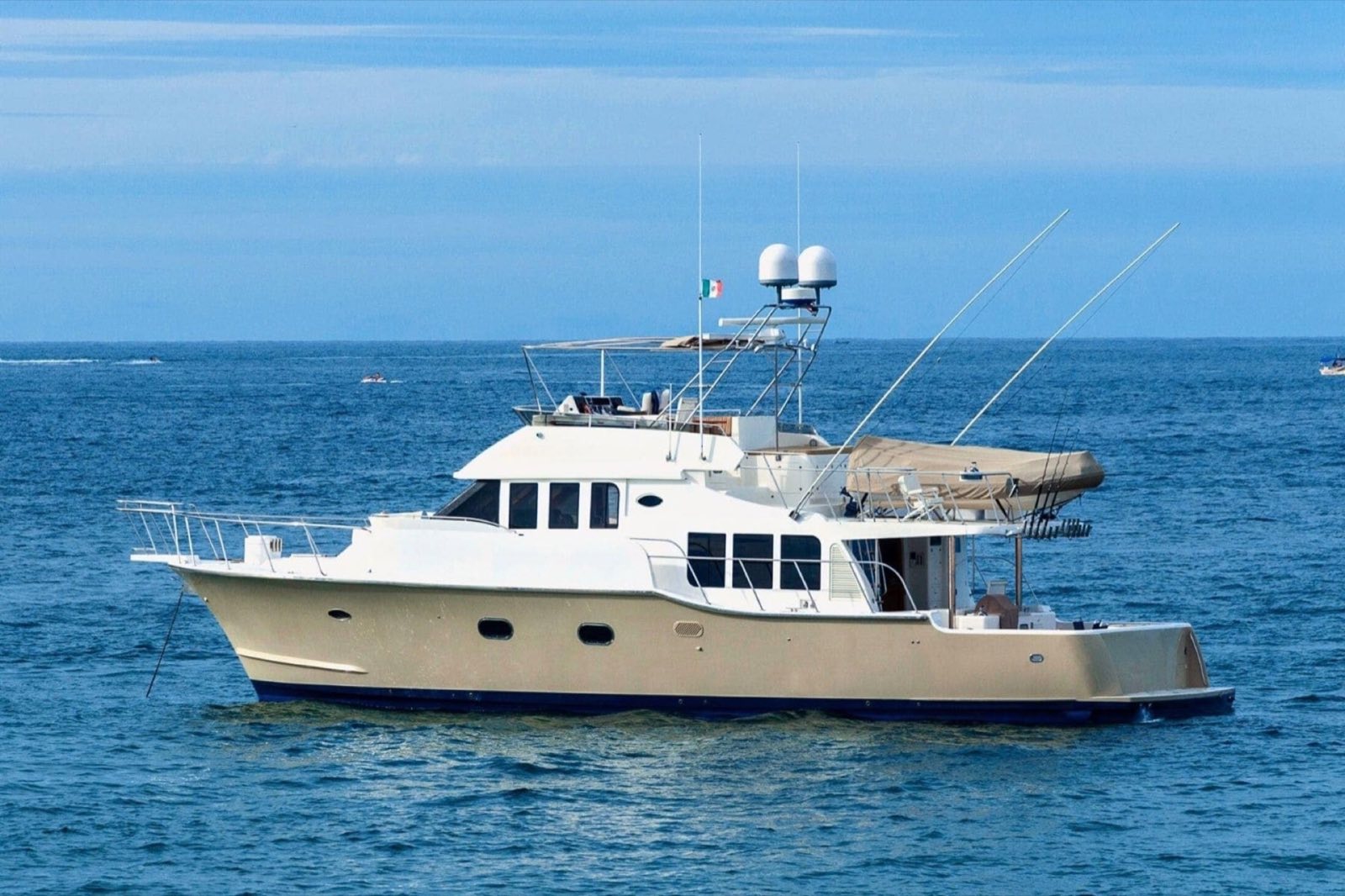
The Sea Ray L590 is the boat Sea Ray built to compete with the European 60-foot motoryachts on their own terms. Sea Ray has been building Sundancers and yachts since the 1970s, and the L-Class lineup launched in the mid-2010s as the upper-tier line above the Sundancer range. The L590 sits in the middle of the L-Class and is at the top of our 2026 American-built motoryacht guide because the cabin volume, the engine options, and the dealer network all add up to a serious 60-foot cruiser that holds its price on the U.S. market.
What is the Sea Ray L590?
The L590 is a 60-foot 11-inch resin-infused fiberglass motoryacht. Beam is 16 feet 5 inches, draft is 4 feet 7 inches, dry weight is roughly 76,000 pounds. Fuel capacity is 1,200 gallons, water 250 gallons. Two engine options. The Cummins QSC8.3 twin diesel build at 600 horsepower per engine is the standard package, delivering a 24-knot cruise and a 30-knot top end. The MAN i6 twin diesel build at 800 horsepower per engine is the upgrade. It pushes cruise to 28 knots and top speed to 33 knots, and it holds resale better than the Cummins build.
The hull is resin-infused fiberglass with cored hullsides and solid laminate below the waterline. Sea Ray's L-Class layup is a step above the standard Sundancer build, with vacuum-bagged infusion across the major panels. The hardtop flybridge with the second helm is the layout signature. It sits forward of the boat deck and the dinghy davit, with sightlines that work in any sea state the boat will see.
Below decks the layout is three full staterooms with three full heads. Master amidships with an island queen and a stand-up shower. Forward VIP stateroom with a queen berth, full head, and stand-up shower. Guest stateroom with twin berths convertible to a single double. The galley is up off the salon, which is the U.S. layout preference and one of the things that separates Sea Ray from the European competition. The salon and cockpit together fit eight comfortably for dinner aboard, and the wet bar and grill in the cockpit are standard on 2020-onward builds.
I walked through a 2021 hull at the Palm Beach show two seasons back, taking my time in the master stateroom and the engine room. The headroom in the master is sized for sleeping and sitting, not standing for a tall owner, and that is the first thing six-foot-plus shoppers notice on a walkthrough. The engine room access is good, with a real walking-headroom space around the Cummins blocks, which matters when service is happening.
Who is it good for?
Coastal cruisers running 100 to 200 hours a season are the core buyer. Florida to the Bahamas, Newport to Block Island, the Maine coast in summer. The L590 has the fuel range, the cabin volume, and the systems for a real cruising program. The Seakeeper 16 is a near-standard option that turns a marginal sea state into a comfortable one for guests aboard.
Families with two adult couples are the second profile. Three full staterooms with three full heads is rare at 60 feet on the U.S. market, and the layout works for a long weekend with another couple aboard without anyone feeling cramped. The third profile is owners trading up from a Sundancer 400 or a 50-footer who want the same dealer relationship and the same brand experience at the larger boat.
Who is it not good for?
Tournament fishing teams should not buy the L590. The cockpit doesn't have rod stowage, a mezzanine, or a tournament-spec transom layout. A Viking 52 Convertible is the right boat for that brief, and it costs about the same money.
Anyone who can't carry $200,000 a year in operating costs as a baseline should walk past too. Fuel, slip, insurance, service, and capital cost on a $2.5 million asset add up faster than most first-time 60-foot owners expect, and the boat doesn't reward part-time use.
The third exclusion is the buyer who plans to keep the boat in a region without Sea Ray dealer coverage. The dealer network and the resale value are tied together at this length. If your local market doesn't have an L-Class-experienced Sea Ray yard, the value equation changes materially.
Pricing
New 2026 pricing on the L590 runs roughly $2.95 million to $3.6 million depending on engine choice, electronics, Seakeeper option, and interior finish lines. The base Cummins build with standard electronics and a basic interior lands near the lower end. The MAN build with full Raymarine glass, a Seakeeper 16, custom teak, and full enclosure pushes past $3.6 million. Allow another $100,000 to $200,000 for custom paint, davit upgrades, and tender packages.
The used market spans roughly $1.45 million at the bottom (early 2016 hulls with high hours and the base Cummins package) to $2.65 million at the top (2022 hulls with MAN diesels and full options). The sweet spot for a buyer in 2026 is a 2019-2022 hull with MAN i6 diesels and 400 to 1,200 hours, which lands in the $1.85 to $2.45 million band. The MAN build holds price roughly 10 to 15 percent better than the Cummins build at the same hours, and that gap is the recurring conversation in the broker market.
What works
- Three full staterooms with three full heads. The cabin volume is the segment standard at 60 feet.
- Resin-infused hull with cored hullsides. The L-Class layup is a step up from standard Sea Ray production.
- Hardtop flybridge with second helm. Sightlines work in any sea state the boat will see.
- Twin Cummins QSC8.3 or MAN i6 diesels deliver a 24 to 28-knot cruise and a 30 to 33-knot top end.
- Sea Ray dealer network at 50 to 60 feet is broader on the U.S. market than any European competitor's.
- Salon-and-cockpit entertaining layout fits eight comfortably for dinner aboard.
- Holds its price better than Princess or Azimut at this length on the U.S. resale market.
What doesn't
- New MSRP starts near $3 million. Full-option MAN builds push past $3.6 million.
- Fuel burn at cruise is roughly 50 gallons per hour. A 150-hour season is $40,000 in fuel alone.
- Slip rental, bottom paint, and yard service at 60 feet add $25,000 to $35,000 a year on top of fuel.
- Service intervals require a Sea Ray-experienced yard with the right tooling.
- Older 2016-2017 hulls had owner reports of gelcoat crazing on the hardtop. Pre-purchase inspection is critical.
- Master stateroom headroom is sized for sleeping and sitting, not for a six-five owner to stand up next to the bed.
- Cummins-build hulls hold price less well than MAN-build hulls. The engine package matters at resale.
Year-by-year notes
The L590 launched for 2016 on the L-Class hull platform. The 2018 model added the MAN i6 engine option alongside the continuing Cummins QSC8.3 build. The 2020 model upgraded the standard electronics package to Raymarine glass and added the Seakeeper 16 as a near-standard option. The 2022 model refreshed the salon and master stateroom layout with new joinery and a revised galley layout. The current 2026 catalog continues on the 2022 layout with minor electronics updates. The 2016-2017 first-year hulls have the owner reports of gelcoat crazing on the hardtop and superstructure that later production has cleaned up. Pre-purchase inspection of the hardtop, the superstructure, and the bow cap is non-negotiable on those years.
Cost of ownership
Annual recurring costs on an L590 used 150 hours a season are real money. Fuel at 50 gallons per hour cruise burns 7,500 gallons a year, which at $5 to $6 per gallon dockside is $37,000 to $45,000 a year. Slip rental at a Florida East Coast marina at $25 a foot per month is roughly $18,000 a year. Bottom paint, waxing, and detail on a 61-foot hull is $10,000 to $15,000 a year. Engine service on Cummins or MAN diesels at the manufacturer's interval is $5,000 to $9,000 per engine per year depending on hours. Generator service, Seakeeper service, watermaker service, and air conditioning service adds another $10,000 to $18,000. Insurance on a $2 million hull value is $22,000 to $35,000 a year on the coast.
A five-year hold on a 2020 used L590 bought at $2.1 million with 600 hours, used 150 hours a season Stuart to the Bahamas with a covered slip and full service file, lands at roughly $200,000 to $260,000 a year all-in including insurance, fuel, service, slip, and amortized capital cost.
Best year and trim to buy
The 2019-2022 L590 with twin MAN i6 diesels, Raymarine glass, a Seakeeper 16, and full enclosure is the right buy in 2026 for most cruising owners. Hours between 400 and 1,200 are the sweet spot. A 2020-2021 hull with the MAN package and a clean service file at $2.0 to $2.3 million is the most-listed configuration in the broker market.
Verify five items pre-purchase. First, the hardtop, the superstructure, and the bow cap show no gelcoat crazing on a close inspection (especially on 2016-2018 hulls). Second, the engine service file is current on injectors, gear oil, sea strainers, and impellers. Third, the Seakeeper has been serviced and runs cleanly on a sea trial. Fourth, the air conditioning works at the dock on both shore power and the genset for a real-world test. Fifth, the dealer relationship transfers. Sea Ray's service network is half of what you pay the premium for at this length.
Alternatives
The step-down within the same brand is the Sea Ray Sundancer 320, which covers the same weekending brief at a fraction of the length and the operating cost. The catamaran cross-shop is the Leopard 46 PC, which trades absolute length for two real master suites, more deck space, and lower running costs. The smaller dual-purpose cross-shop is the Tiara 43 LE, which covers the cruising-with-some-fishing brief at a smaller length and a materially lower entry price.