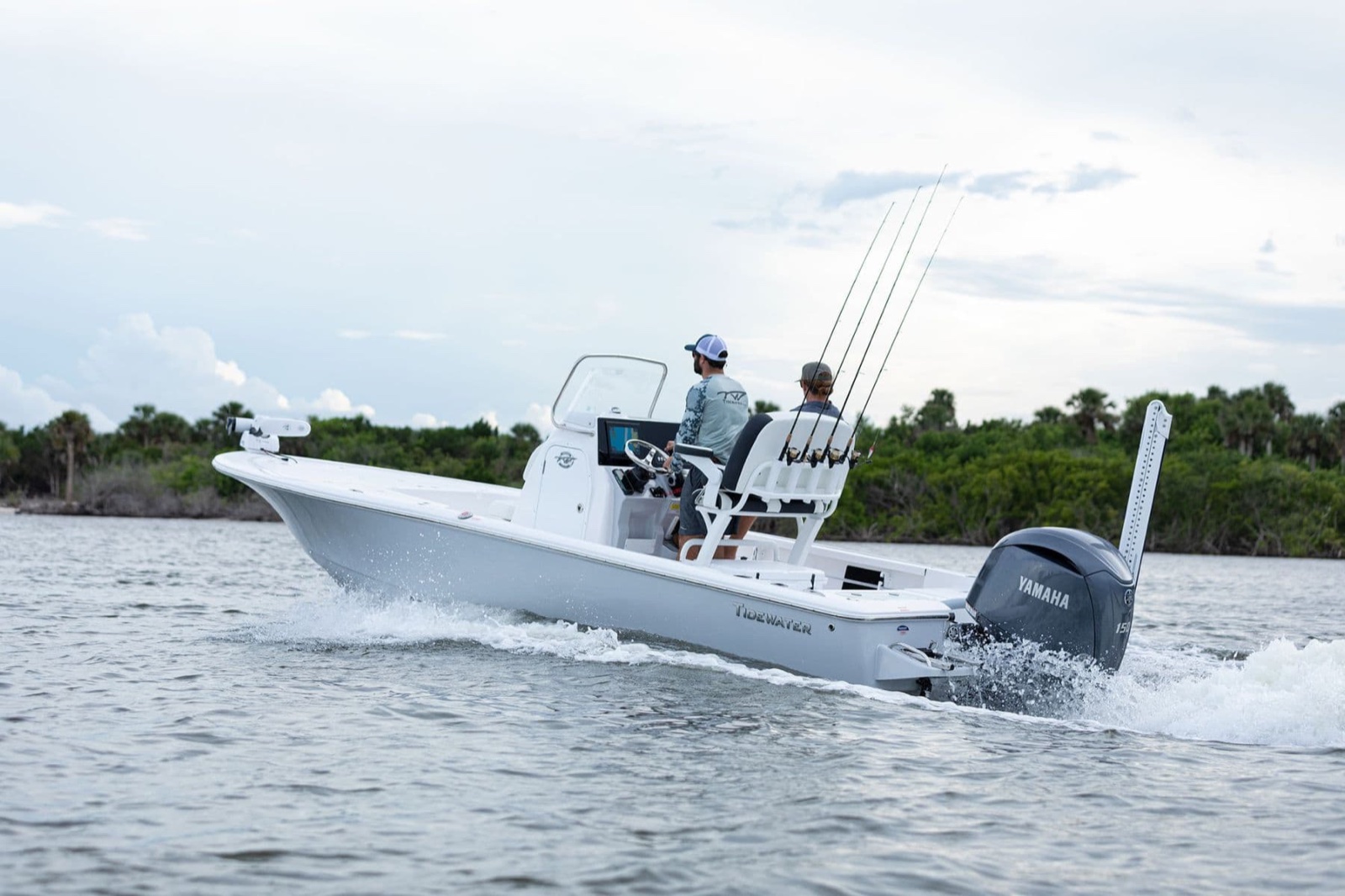
The Skeeter SX240 is the flagship saltwater-series 24-foot bay boat from Skeeter, the Yamaha-owned brand built in Kilgore, Texas. The SX240 sits at the top of Skeeter's bay-boat range and is one of the most common tournament-spec platforms on the Texas redfish circuit. Production has been continuous since 2018 and the 2026 model carries the same hull with refreshed graphics and helm electronics.
What is the Skeeter SX240?
The SX240 is a 24-foot fiberglass bay boat with an 8-foot 6-inch beam and a dry weight of 3,400 pounds before the outboard. Yamaha F300 rigging is the dominant choice on dealer orders, with the Yamaha F250 available on some build configurations as the lower-cost option. The hull is Skeeter's saltwater-series planing bottom with variable deadrise, sized to handle bay chop without pounding the helm and to plane efficiently at the low-end speeds that drift-fishing along a shoreline requires.
The deck layout is built around tournament fishing in deeper bay water. Tall forward casting deck with deep in-deck storage, pre-rigged trolling-motor mount, and rod-storage tubes. Center console with helm seating, fuel tank below, and a head compartment in the console base on most build configurations. Tall aft casting deck with two pressurized livewells (the tournament livewell package), a fish box, and timer-controlled recirculation at the helm. Standard equipment from 2020 onward includes the tournament livewell system, basic instrumentation, locking rod storage, and a 12-volt outlet at the helm. Optional packages added a multifunction display, Power-Pole anchor, hardtop with electronics box, premium audio, and a trolling motor with i-Pilot.
I ran a 2022 Skeeter SX240 on Laguna Madre out of Port Mansfield, Texas, one September weekend in 15-knot wind and choppy bay water. The boat cruised at 32 mph against the chop without pounding the helm, drifted a flat in about 22 inches of water with the trolling motor down, and the livewells held shrimp and croaker through a seven-hour fishing day in 80-degree water with full sun on the deck. The Yamaha F300 used about 12 gallons per hour at cruise, which on the standard fuel tank gives a real range of roughly 220 miles before reserve. For a tournament bay boat sized for the Texas coast, the SX240 is one of the right answers.
Who is it good for?
Tournament anglers fishing redfish, trout, snook, and tarpon along the Gulf and Atlantic coasts are the core buyer. The 24-foot length, the F300 power, the tournament livewell package, and the corrosion-resistant build all serve the tournament use case. Texas redfish circuits, Louisiana speckled trout tournaments, Florida tarpon-and-snook circuits, and Carolina inshore tournaments all see SX240s on the water.
Owners running long bay-to-bay distances are the second profile. The fuel capacity and the F300 power give the SX240 a useful working range that smaller bay boats don't have. People fishing the Mosquito Lagoon up to the Indian River, or fishing a Texas Gulf bay then running 15 miles to another bay system, get more out of the SX240 than they would out of a 21- or 22-foot boat.
Skeeter brand-loyal owners stepping up are the third group. People who own a 20- or 22-foot Skeeter and are moving up to the flagship typically choose the SX240 over a cross-shop because the dealer relationship, the Yamaha rigging, and the build approach are familiar. The brand consistency matters to this buyer.
Who is it not good for?
Skinny-flats fishermen who need a sub-15-inch draft should walk past. The SX240 is a 24-foot bay boat with a real hull volume and a real beam. It draws more water than a smaller flats boat, and it's not the right tool for fishing 12-inch flats in the Florida Keys backcountry. A pure flats boat from a smaller builder fits that brief better.
Family-first buyers who want a bay boat that doubles as a casual day platform are the second exclusion. The SX240 is built around fishing. The casting decks are tall, the cockpit ergonomics serve tournament use, and the bow seating is sized for fishing access rather than family lounging.
Buyers tight on tow vehicle capacity are the third profile. A 24-foot bay boat with the F300 and a trailer is a real load. A half-ton truck pulls it, but it's a working load rather than a casual one, and at the upper limit of state-trailerable widths in some markets. Owners need to plan tow vehicle, brake-controller, and trailer setup more carefully than they would for a smaller boat.
Pricing
New Skeeter SX240 boats with the Yamaha F300 sold in the $108,000 to $128,000 range for the standard tournament-livewell-package build, with the upper-trim spec including hardtop, full electronics, trolling motor, and Power-Pole running $124,000 to $138,000. The 2026 used market spans about $48,000 at the bottom (older 2018 hulls with high hours and deferred service) up to $118,000 at the top (clean 2023-2024 hulls with full options).
The 2026 sweet spot is a 2021-2023 Skeeter SX240 with the Yamaha F300, the tournament livewell package, the trolling motor, and 150 to 400 hours, in the $74,000 to $98,000 band. Skeeters hold their price the way the tournament reputation suggests, and five-year depreciation lands around 25 to 30 percent on clean hulls.
What works
- Yamaha F300 gives the SX240 a real long-day range. Cruise at 30 to 34 mph at workable fuel burn.
- Tall casting decks improve sight-fishing visibility over low-deck bay boats.
- Two pressurized livewells with timer-controlled recirculation. Bait holds through a tournament day.
- Saltwater-series build with corrosion-resistant hardware across the rigging.
- Fuel tank gives a real all-day range. Long runs between fishing grounds are workable.
- Skeeter dealer network covers the Gulf and Atlantic coasts. Yamaha service support is broad.
- Five-year depreciation runs about 25 to 30 percent on clean hulls.
What doesn't
- Tall casting decks mean a higher freeboard. Older guests find boarding from the swim platform a step.
- At 8 feet 6 inches beam and 3,400 pounds, the SX240 draws more water than a smaller flats hull.
- Single-engine setup has no redundancy on a long offshore day.
- Skeeter premium over value-tier cross-shops is 25 to 35 percent at purchase.
- Cockpit is built around fishing. Family use is a secondary fit.
- Trailer requirement is significant. A 24-foot bay boat plus trailer is a working load.
Year-by-year notes
The Skeeter SX240 launched for 2018 as the flagship of the saltwater-series range. 2019-2020 boats refined the helm electronics and made the tournament livewell package standard. 2021 brought updated rigging and the option for the Power-Pole anchor as a dealer-installed accessory. 2022-2024 boats are the most refined production years with the cleanest spec, the trolling motor as a standard upper-trim feature, and the multifunction display included on most builds. The 2026 model continues the same hull with updated graphics and helm electronics. No single defect cutover year applies, but the post-2020 hatch sealing and electrical work is meaningfully cleaner than the early 2018 production.
Cost of ownership
Annual costs on the SX240 are higher than a value-tier cross-shop because the tournament-spec systems and the F300 add maintenance lines. Yamaha F300 service every 100 hours costs $450 to $750 in parts and labor. The 300-hour valve-clearance check at the three-year mark adds materially. Livewell pump replacement every three to five seasons is $200 to $400 per pump. Trolling motor battery replacement on a three-battery 36-volt setup every four to six seasons is $900 to $1,500.
Insurance on a $88,000 used hull is $1,200 to $2,100 a year in Gulf and Atlantic markets. Trailer storage at home is free. Bay-marina dry slip storage runs $2,200 to $4,200 a season. Fuel for a typical 120-hour season at 12 to 16 gallons per hour at cruise is $2,400 to $3,600 a year. All-in for a 2022 hull bought at $94,000 with trailer storage and dealer service lands around $7,200 to $10,400 a year before fuel.
Best year and trim to buy
The 2021-2023 Skeeter SX240 with the Yamaha F300, the tournament livewell package, the trolling motor, the Power-Pole if equipped, the multifunction display, and 150 to 400 hours is the right buy in 2026. The 2022 and 2023 hulls show up most often in the $84,000 to $108,000 band with the cleanest spec and the most service file remaining.
Five pre-purchase checks. First, the Yamaha F300 hour meter and compression test match the seller's claims. Second, both livewell pumps cycle cleanly and the recirculation timer works through the full interval cycle. Third, the trolling-motor mount and the bow casting deck show no stress cracking or laminate separation. Fourth, the hatch seals are intact and the lockers stay dry on a sea trial. Fifth, the trailer is sized correctly for the boat, with brakes, bearings, lights, and bunk carpet all in working condition.
Alternatives
The closest cross-shop on intent is the Ranger 2310 Bay, which leans tournament-first at a slightly smaller length. For a bay-to-nearshore hybrid at the same length, the Pathfinder 2400 TRS leans more toward nearshore capability where Skeeter leans bay-tournament. For a flats-water-priority cross-shop at a smaller length, the Scout 231 Bay uses the NuV3 hull for skinny-water fishing where the SX240 prioritizes tournament work in deeper bay water.