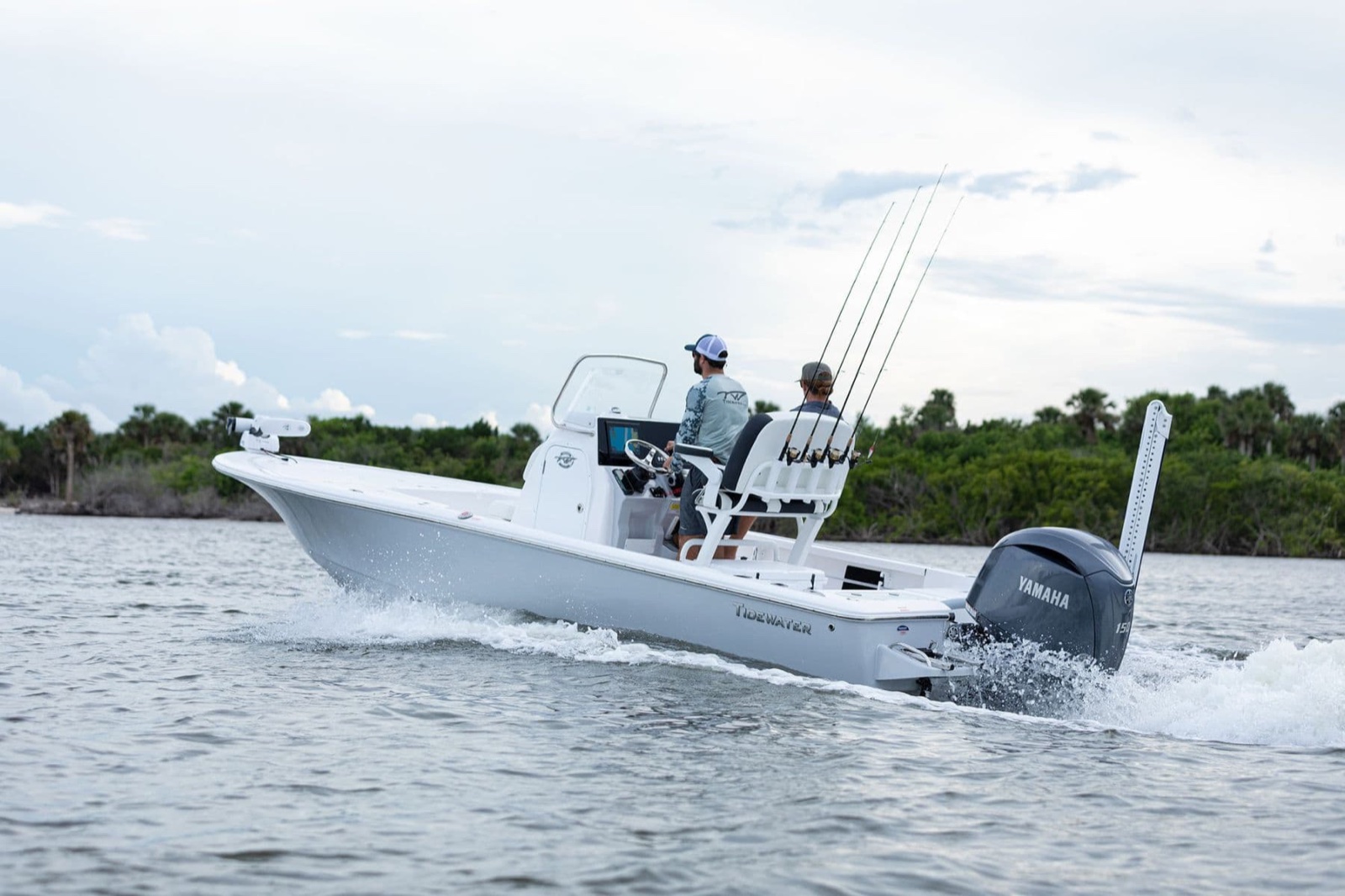
The Scout 231 Bay is the 23-foot bay boat from Scout Boats of Summerville, South Carolina, sitting in the middle of Scout's bay-boat lineup and matched closely to the build philosophy that drives the brand's offshore center consoles. The NuV3 hull, the casting deck, and the finish are what owners pay the premium for, and the 231 Bay is one of the strongest residual-value boats in the inshore segment.
What is the Scout 231 Bay?
The 231 Bay is a 23-foot fiberglass bay boat with an 8-foot 8-inch beam and a dry weight of 3,200 pounds before the outboard. Single-outboard rigging, with Yamaha F250 and Mercury 250 as the dominant choices on dealer orders. The hull is what Scout calls NuV3, a variable-deadrise shape that flattens through the forward sections to give the boat 12 inches of draft with the motor trimmed up, then adds deadrise aft to give the hull bite when crossing a passage in chop.
The deck layout is the bay-boat brief executed cleanly. Wide forward casting deck with a deep in-deck storage locker, dedicated bow trolling-motor mount, three pre-rigged rod-holder positions, and forward seating cushions that double as a swim-step pad. Center console with helm seating, fuel tank below, and a head compartment in the console base on most build configurations. Aft casting deck with the 30-gallon pressurized livewell, a fish box, and the poling-platform mount on most builds. Standard equipment from 2021 onward includes the poling platform with swing-up ladder, the pressurized livewell, basic instrumentation, and a 12-volt outlet at the helm. Optional packages added a multifunction display, premium audio, hardtop with electronics box, and a trolling motor with i-Pilot.
I ran a 2022 Scout 231 Bay on the Mosquito Lagoon near Titusville in light wind and clear water one March morning. The boat poled cleanly off the platform with the motor up, drifted a flat in about 14 inches without bumping bottom, and ran back through the open lagoon in light chop at a 28 mph cruise that stayed comfortable. The pressurized livewell kept shrimp alive through five hours of fishing in 75-degree water. That's the use case the 231 was built for, and it covers it as cleanly as anything else in the segment.
Who is it good for?
Inshore anglers fishing flats, mangroves, and bay water in 12 to 24 inches of depth are the core market. The NuV3 hull's shallow-draft front section is the whole reason to buy this boat. If your fishing life is the Florida Keys flats, the Mosquito Lagoon, the Indian River, the Texas Laguna Madre, or the Carolina sounds, the 231 fits the brief.
Long-hold owners who care about resale price are the second profile. Scout boats hold value better than any of their volume cross-shops in the inshore segment. Five-year depreciation on a clean 231 lands around 18 to 25 percent, which is materially less than a comparable Sea Hunt or Robalo at the same age. Owners who plan to keep the boat five-to-eight years and sell to a Scout dealer get a friendlier resale equation than they'd get from a value-tier brand.
Solo and two-person crews who fish hard are the third group. The casting deck is wide and uncluttered, the helm placement gives the captain a clean line to the bow trolling motor, and the boat poles well off the platform. For two anglers fishing flats together, the 231 is sized correctly. The brief assumes you fish two people most of the time, with a third aboard occasionally.
Who is it not good for?
Crews of four actively fishing together should look longer. The cockpit and the casting decks are sized for two to three working anglers, and a fourth person on the boat starts to make the working space tight. For families fishing as a four-person team, a larger bay boat or a nearshore Robalo R242 makes more sense.
Buyers running long offshore distances are the second exclusion. The 231 Bay is a bay boat, and the NuV3 hull gives it more nearshore capability than a flatter-bottom flats boat would have. It is not a nearshore center console. For 20-mile-plus offshore runs in a building sea state, a boat like the Robalo R230 or a deeper-V center console makes more sense than a bay boat at the limit of its design envelope.
Tight-budget buyers are the third profile to walk past. Scout asks a 25 to 35 percent premium over the value-tier cross-shop at the same length, and the dealer network does not discount. The premium pays off on resale if you hold the boat. The premium is real at purchase if you're trying to fit a build into a tight budget.
Pricing
New 231 Bay boats with the Yamaha F250 or Mercury 250 sold in the $98,000 to $118,000 range for the standard build, with the upper-spec package including hardtop, full electronics, and trolling motor running $112,000 to $128,000. The 2026 used market spans about $42,000 at the bottom (older 2018 hulls with high hours and deferred service) up to $108,000 at the top (current-year demonstrators with full options).
The sweet spot for a 2026 buyer is a 2020-2023 Scout 231 Bay with the Yamaha F250 or Mercury 250, the poling platform, 100 to 350 hours, and full service file, in the $68,000 to $92,000 band. Scouts hold their price the way the brand's reputation suggests, and a clean used 231 still asks a meaningful percentage of new MSRP at five years on.
What works
- NuV3 variable-deadrise hull runs in 12 inches and adds bite aft for crossing a passage.
- Build quality matches Scout's offshore center consoles. Vinylester resin, foam-cored laminates, stainless hardware throughout.
- Poling platform with swing-up ladder is standard on most build configurations.
- Casting deck is wide and uncluttered. Solo angler has room to fish in any direction.
- 30-gallon pressurized livewell holds bait through a long fishing day.
- Resale value is among the strongest in the segment.
- Scout's dealer network covers the Gulf, Atlantic, and Pacific coasts.
What doesn't
- Single-outboard setup has no redundancy on a long offshore day.
- Cockpit is tight for four anglers fishing actively together.
- Scout's price premium over Robalo-tier competitors is 25 to 35 percent.
- Storage compartments are competitively sized but not segment-leading.
- Forward bow seating is fishing-access sized, not family-lounging sized.
- Dealer network is concentrated on the Atlantic and Gulf. Other-region buyers pay freight.
Year-by-year notes
The Scout 231 Bay launched for 2018 on the NuV3 hull as the modern replacement for Scout's prior 23-foot bay platform. The 2020 model year added the pressurized livewell as standard and refined the helm layout. 2021 brought the poling platform with swing-up ladder as standard on most build configurations. 2022-2024 boats are the most refined production years with the cleanest spec and the trolling motor mount included on the upper-trim builds. The 2026 model continues the same hull with refreshed graphics and helm electronics. No single defect cutover year applies, but the post-2021 hatch sealing is meaningfully cleaner than the early 2018-2019 production, so the older boats need closer pre-purchase inspection of the locker seals.
Cost of ownership
Annual costs on the 231 Bay are higher than a value-tier cross-shop because the build supports a longer ownership cycle. Yamaha F250 or Mercury 250 service every 100 hours costs $400 to $700 in parts and labor at a dealer. The 300-hour valve-clearance check at the three-year mark steps the labor budget materially. Bottom paint costs $400 to $700 in materials annually for slip-stored boats, less for trailered hulls.
Insurance on a $78,000 used hull is $1,100 to $1,900 a year in Gulf and Atlantic coastal markets. Slip storage at a bay-area marina is $2,800 to $5,400 a season. A typical inshore angler running 80 hours a season with trailer storage spends $1,400 to $2,200 on fuel. All-in for a 2022 hull bought at $84,000 with trailer storage and dealer service lands around $6,200 to $9,400 a year before fuel.
Best year and trim to buy
The 2020-2023 Scout 231 Bay with the Yamaha F250 or Mercury 250, the poling platform, the pressurized livewell, and 100 to 350 hours is the right buy in 2026. The 2022 and 2023 hulls show up most often in the $74,000 to $92,000 band with the cleanest hatch sealing and the most service file remaining.
Five pre-purchase checks. First, the outboard hour meter and compression test match the seller's claims. Second, the livewell pump cycles cleanly and the pressurized recirculation holds pressure during a sea trial. Third, the hatch seals are intact and the lockers stay dry on a long-day sea trial. Fourth, the trolling motor mount shows no stress cracking or laminate separation, because this is a high-load area. Fifth, the poling platform welds and mounts are clean, no stress cracking at the base where the platform attaches to the deck.
Alternatives
The closest hull-and-intent cross-shop is the Shearwater 23 LTS, which leans into shallower-water performance with a different cockpit priority. For a value-tier cross-shop at lower entry price, the Sea Hunt BX 22 sits a tier below Scout on build but covers a similar inshore brief. For anglers who cross into deeper water more often, the Pathfinder 2400 TRS is a larger hybrid bay-to-nearshore boat that handles a wider range of conditions.