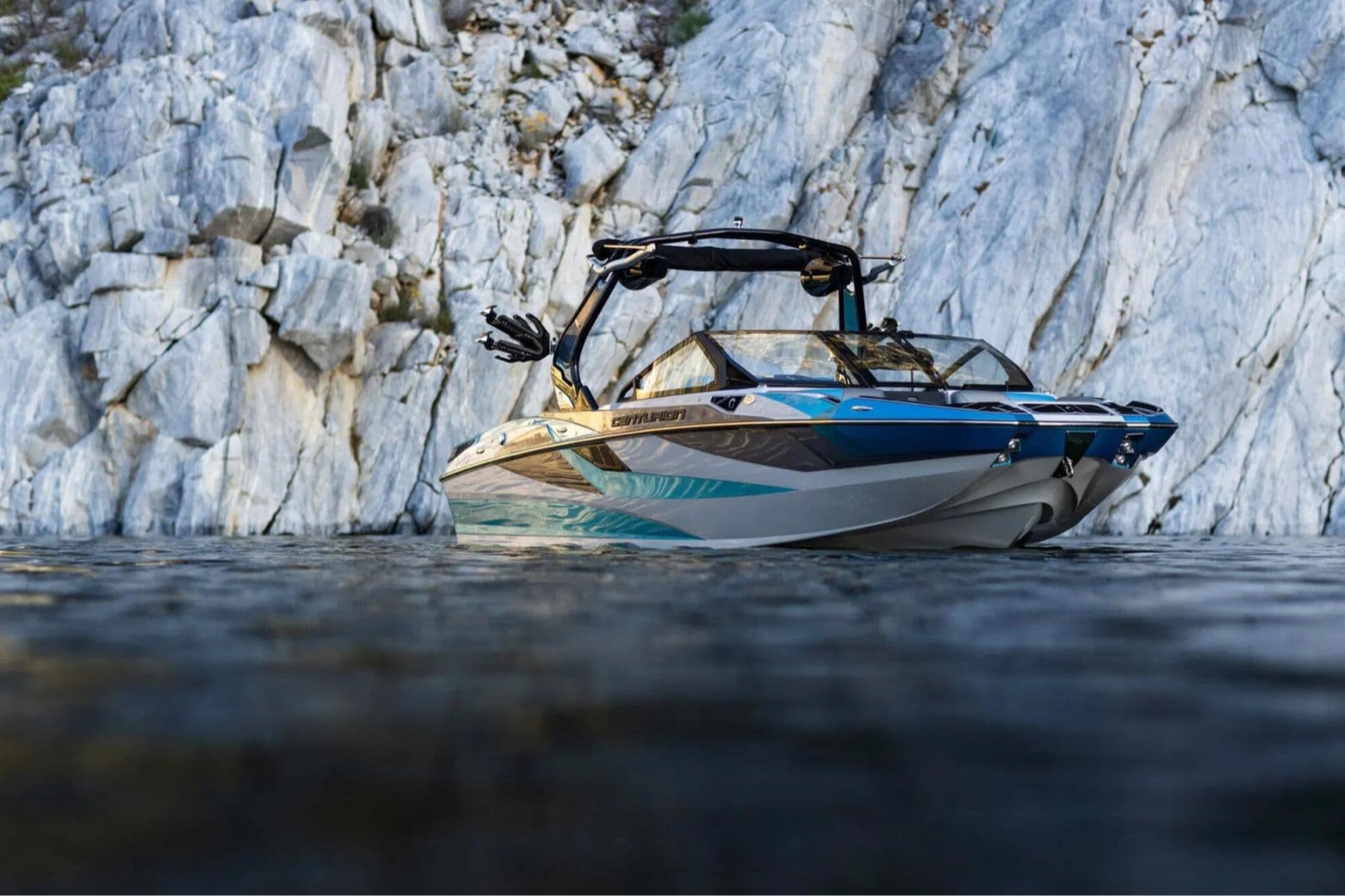
The Supra SA 450 was Skier's Choice's flagship v-drive surf and wakeboard platform. Skier's Choice is the parent that also built Moomba, and the SA platform sat on top of the Supra lineup with the polished touchscreen helm, the gen-2 SwellSystem ballast, and the Surf Edge transom plates. The SA 450 ran from 2016 through 2024 before Skier's Choice consolidated production and ended the model.
What is the Supra SA 450?
The SA 450 is a 23-foot 1-inch fiberglass v-drive inboard. Beam is 8 feet 6 inches, dry weight is 5,800 pounds, fuel is 50 gallons. The drivetrain is an Indmar 6.2L gas inboard in a v-drive layout. V-drive means the engine sits in the back of the boat with the prop and rudder behind it, weight shifted aft, which is how a surf-and-wakeboard hull produces the steep clean wave a v-drive is built to throw.
The wave-shaping setup is the headline feature. SwellSystem ballast on later builds fills port, starboard, and a center reservoir, totaling more than 3,000 pounds of plumbed-in water weight. The Surf Edge plates at the transom hinge out and shape the wave from the helm rather than from manual lead-bag rearrangement. Touchscreen helm holds rider-by-rider surf profiles, board profiles, and a Zero Off speed-control link. Backup camera is helpful for the trailer.
Cockpit fits eight on the bench-and-bow combination. There is a head compartment in the bow on most builds, a removable cooler, a wet bar with a small fridge on higher-trim boats, and a fold-down sun pad on the swim platform. The boat is not a cabin boat but it does day-trip and short-overnight reasonably well for what it is.
Who is it good for?
Surf-and-wakeboard households who do mixed pulls are the core buyer. Two surfers, a wakeboarder, a couple of kids on a tube, an afternoon swim, dinner at a cove restaurant. The SA 450 handles all of that without being out of its element on any of it. Big families with five to eight people aboard most weekends are the second profile. The cockpit volume is real and the surf wave is wide enough to hold an adult surfer comfortably.
Owners trading up from an entry-tier v-drive (a Moomba Mojo, a Bryant Surf, an older Mastercraft NXT) are the third. Same family of v-drive philosophy, a step up in materials, electronics, and surf-shaping precision. On a Lake Powell summer trip last year I watched a SA 450 owner run his teenage son through a surf session at 11 a.m., let his daughter wakeboard for forty-five minutes after lunch, and end the day with the family swimming off the platform as the sun dropped behind the canyon walls. The boat shape-shifts in a way the older single-purpose tournament boats don't.
Who is it not good for?
Tournament slalom skiers should not buy a v-drive surf boat, full stop. The prop is in the wrong place for slalom wake purity, the boat is heavy, and the SwellSystem is not built to shape a flat ski wake. Stay with a direct-drive Ski Nautique 200 or MasterCraft ProStar.
Buyers who need current-production warranty coverage should also walk past. Production ended after the 2024 model year. Some service support exists through the Supra dealer network but the official Skier's Choice production line is closed.
Buyers chasing the segment-leading resale curve should also pause. The SA 450 holds its value well by ski-wake standards, but Malibu and MasterCraft hold theirs better. The math over a five-year hold favors Malibu for resale at a higher entry cost.
Pricing
The SA 450 ended production after 2024. Last new-MSRP windows landed near $145,000 to $185,000 depending on engine, trailer, and option-package spec.
The used market in 2026 spans roughly $65,000 at the bottom (2016-2017 hulls with high hours and older SwellSystem generation) to $135,000 at the top (clean 2023 boats with the current helm and low hours). The sweet spot is the 2020-2023 build with the Indmar 6.2L, the gen-2 SwellSystem, the Surf Edge plates, the current touchscreen helm, and 150 to 400 hours. Those land in the $85,000 to $115,000 band.
Depreciation is steeper than the Malibu and MasterCraft comparables at the same hour count. Five-year hold on a clean SA 450 lands somewhere near 35 to 40 percent off MSRP, which is fine in absolute terms but a step behind the segment leaders.
What works
- Indmar 6.2L gas inboard is a strong v-drive drivetrain with full parts and service support.
- Gen-2 SwellSystem ballast plumbs port, starboard, and center for more than 3,000 pounds of water weight.
- Surf Edge transom plates shape the wave from the helm, eliminating manual lead-bag work.
- Touchscreen helm with rider-by-rider profiles is current-generation electronics done well.
- 8-foot 6-inch beam gives a real cockpit. Eight people fit and the surf-side bench holds three adults.
- 50-gallon fuel tank covers a full day of mixed pulls.
What doesn't
- Production ended after 2024. Parts and service support is dealer-dependent on items unique to Supra.
- Resale curve is steeper than the segment leaders by 5 to 10 points over a five-year hold.
- Surf Edge actuator service has been flagged on some hulls. Confirm on the sea trial that both plates cycle correctly.
- Heavy at 5,800 lb dry with the trailer well past 8,000 lb loaded. Tow vehicle has to be a real one.
- Ballast plumbing is complex enough that owner-level service is limited. Dealer service writers are the realistic repair path.
- Tower height clears most highway underpasses but is worth measuring before a long tow.
Year-by-year notes
The SA 450 launched for 2016 on the 23-foot 1-inch hull. Early builds carried the first-generation SwellSystem ballast and a simpler Surf Edge plate setup. The 2019 model year brought the gen-2 SwellSystem and refinements to the touchscreen helm. The 2021 build adopted the current generation of dash electronics with rider profiles and Zero Off integration. 2023 was the last full production year before the 2024 wind-down. There is no defect cutover year. Buyers should focus on the SwellSystem pumps, the Surf Edge actuators, and the engine hours rather than year-chasing.
Cost of ownership
Annual service on an Indmar 6.2L lands at $500 to $900 in parts and basic labor for oil, impeller, plugs, and helm checks. The 300-hour valve adjustment steps the budget up at the appropriate mark. SwellSystem ballast pumps and Surf Edge actuators want periodic checking and the occasional rebuild, which is a dealer-service line of $400 to $1,200 depending on what comes up.
Insurance on a $90,000 hull is $1,200 to $2,000 a year. Most owners trailer and store under cover. A five-year hold on a 2021 used SA 450 bought at $98,000 with 200 hours, used 90 hours a season for surf and board on a Lake Norman summer pattern with trailer storage, lands at roughly $9,500 to $14,000 a year all-in. The capital line is bigger than the Nautique 200 equivalent because the resale curve is less flat.
Best year and trim to buy
The 2020-2023 Supra SA 450 with the Indmar 6.2L, the gen-2 SwellSystem ballast, the Surf Edge plates, the current touchscreen helm, and 150 to 400 hours is the right buy in 2026. Look hard at the actuators on the surf plates, the SwellSystem pumps, and the trailer bunks and brakes.
Verify five things pre-purchase. First, engine hours match the file and helm hour-meter. Second, the Surf Edge plates cycle cleanly on the sea trial in both directions. Third, the SwellSystem pumps fill and drain in normal time without surging. Fourth, the touchscreen helm boots cleanly and the rider profiles save and recall. Fifth, the tower hinges and fasteners show no corrosion and no stress cracks at the deck mounts.
Alternatives
The closest cross-shop is the Malibu 22 LSV for buyers who want segment-leading surf and resale at a higher entry cost. Malibu's Surf Gate system is the reference surf-shaping setup in the segment, the dealer network is broader, and the resale curve is the line everyone else gets measured against. The trade is real entry-price money.
The value-tier cross-shop is the Axis A22 at materially less money with a step down in trim. Axis is built by Malibu on a simpler platform, the surf wave is real if a step behind the Malibu and the SA 450 on shape, and the entry price opens the segment to first-time wakesurf buyers.
The premium-tier cross-shop is the MasterCraft X24, a bigger hull and a deeper feature set at a higher entry price and a flatter depreciation curve. MasterCraft's tournament-circuit pedigree shows up in the build quality and the dealer-network service experience. For buyers shopping the top of the segment, the X24 versus a current-spec Malibu 23 LSV is the cross-shop most often signed.
The Supra SA 450 sits in the middle of all of that. A real boat for households that want a current-generation surf-and-board platform without the full premium-tier entry cost, with the asterisk that production has ended and the long-hold resale math is a step behind the segment leaders. For a moderate hold of five to seven years, the math works. For a ten-plus-year hold, the cross-shops have the edge on resale strength.