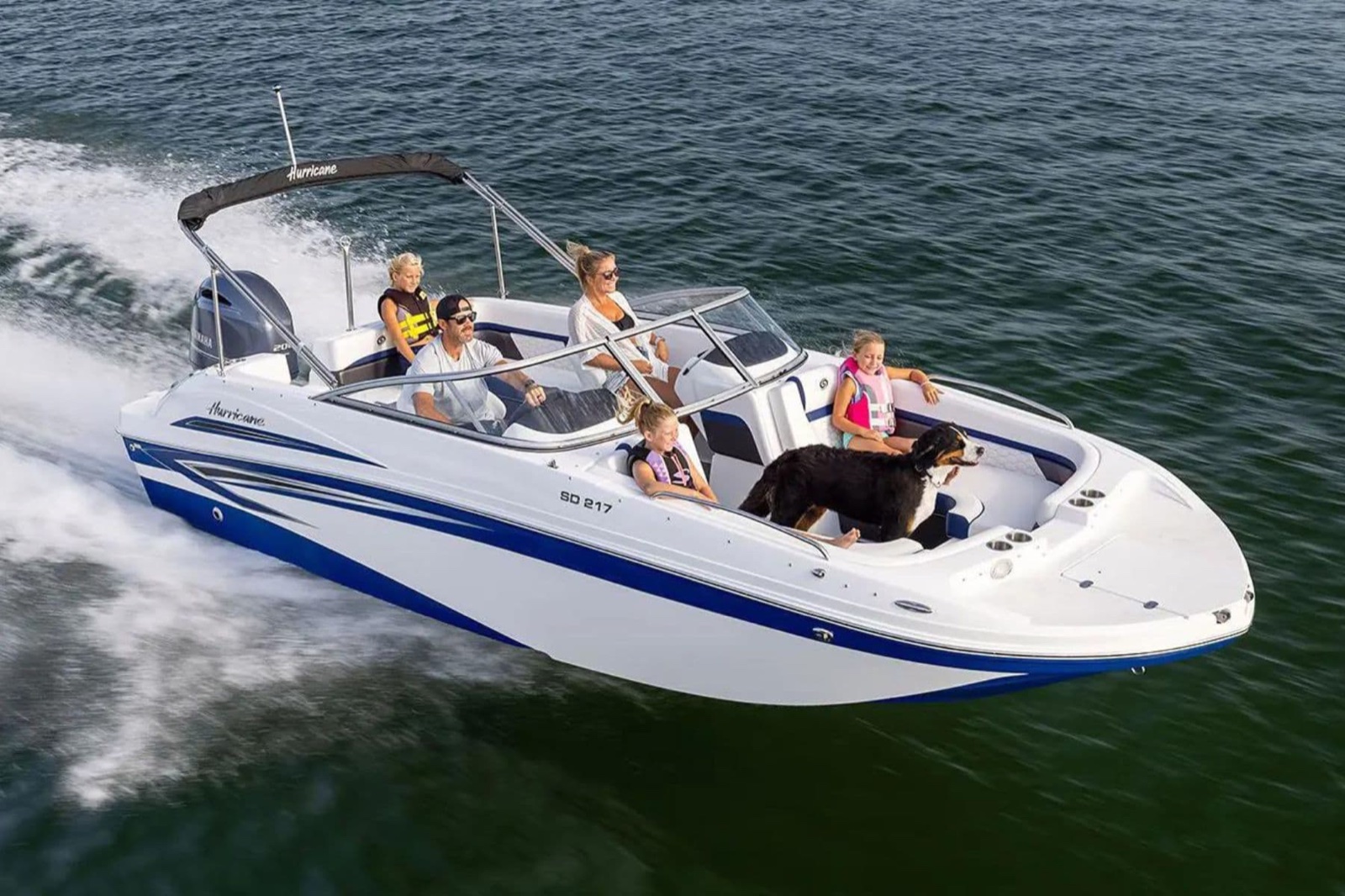
The Tahoe 2150 is Tracker Marine's 21-foot deck boat sold through Bass Pro Shops, the retail-paired sales channel that defines how Tahoe boats reach buyers. Tracker builds the boat, Bass Pro Shops sells it, and the package pricing covers the boat, the trailer, and the Mercury outboard together. The 2150 is one of the most-sold first-boat purchases in the inland-lake market because the buying experience is simple and the entry price opens the category.
What is the Tahoe 2150?
The 2150 is a 21-foot 4-inch fiberglass deck boat with an 8-foot 6-inch beam and a dry weight of 2,950 pounds before the outboard. Power options ran from Mercury 115 on early base trim through Mercury 150 on the dominant late-production spec. A few late-build boats carried the Mercury 175 on the upper trim. The hull is a conventional planing monohull with moderate deadrise, designed for stability at rest and a flat enough ride at cruise in calm water.
The layout is what the buyer pays for. Bow seating wraps the full width with cushions on three sides. Two adults fit per side with room for kids in between, the cushions are flat-bottomed so people can sit upright without wedging in. The cockpit fits a U-shape stern lounge, captain's chair, and companion seat. Seating capacity is rated for nine people. Standard equipment on later production includes a Bimini top, swim platform, four-step boarding ladder, basic instrumentation, and a 12-volt outlet at the helm. Optional packages added a fishfinder, audio, bow trolling motor mount, and an aft-facing pull-out sun pad on the upper trim.
I ran a 2021 Tahoe 2150 with the Mercury 150 on Lake Norman one July weekend in light chop and 88-degree water. The hull planed at about 17 mph, cruised at 26 mph at a workable rpm, and topped out near 40 with two adults and a load of gear. The cockpit kept eight people comfortable through a four-hour cove-hopping run, the swim platform handled a tube launch and a swim call without anyone falling in awkwardly. The boat does what it was built to do.
Who is it good for?
First-time buyers who shop at Bass Pro Shops are the core market. The Tahoe sales model is unusual in the segment because the boat sits next to fishing rods and camping gear, and the buyer is already shopping recreation. Tracker Marine's financing, warranty, and dealer support all run through Bass Pro Shops, which is convenient for buyers who already trust the retail brand.
Inland-lake families on a budget are the second profile. The 2150 covers the same use case as the Bayliner Element E21 at a similar entry price, with a slightly different layout priority. Both boats are calm-water family deck boats at the entry tier of the segment, and both make sense for buyers whose use case fits the design.
Casual watersports households with kids and a tube are the third group. The 2150 isn't a wake boat. It pulls a tube fine, pulls a kneeboard or a ski for casual riders, and the Bimini and swim platform handle the after-skiing routine. For families running 30 to 60 hours a season on protected water, the boat does its job.
Who is it not good for?
Buyers who run open chop or coastal water should walk past. The 2150 is a calm-water deck boat with moderate deadrise and a wide flat-feeling bow. Lake Erie in a building afternoon breeze, the Texas Gulf coast at the mouth of a bay, the Chesapeake at the edge of the Bay Bridge: these are not 2150 waters.
Owners who care about fit-and-finish are the second exclusion. Tracker builds Tahoes to a Bass Pro Shops package price, and the materials show it. Gelcoat is thinner than a Cobalt CS22 or a Chaparral 19 H2O Sport. Upholstery wears faster. Hardware is basic stainless or chrome over zinc on cheaper fittings. That's not a defect, it's a price-point reality.
Long-hold owners chasing resale value are the third profile to think twice. Tahoes depreciate faster than premium competitors, and the dealer network is tied to Bass Pro Shops locations, which limits the resale market to areas where the brand has a presence. If you live in a market without a Bass Pro service center nearby, selling a used 2150 means shipping it or accepting a regional discount.
Pricing
New Tahoe 2150 packages with the Mercury 150 and trailer sold in the $38,000 to $52,000 range across the later production years, depending on options and Bass Pro Shops promotional pricing. The used market in 2026 spans about $14,000 at the bottom (early 2015-2016 hulls with high hours and rough cosmetic condition) up to $36,000 at the top (clean 2023 packages with the 150 and low hours).
The sweet spot for a 2026 buyer is a 2020-2023 Tahoe 2150 package with the Mercury 150, the trailer in good condition, and 100 to 300 hours, in the $22,000 to $30,000 range. Depreciation has slowed because new-boat package prices kept climbing, narrowing the gap between new and clean used.
What works
- Bass Pro Shops package pricing covers boat, trailer, and outboard in one transaction.
- Bow seating is wide and the cushions are flat enough to sit comfortably for hours.
- Cockpit fits eight or nine comfortably for a day trip.
- Single Mercury outboard means simple maintenance and broad service support.
- Standard Bimini, swim platform, bow ladder, and basic instrumentation cover the basics.
- Tracker Marine warranty covers the boat through Bass Pro Shops dealer service.
- Trailerable behind a midsize SUV. Garage-storable.
What doesn't
- Build is entry-level. Gelcoat is thin, vinyl wears, hardware is basic.
- Resale is below segment average and tied to Bass Pro Shops regional presence.
- Base electronics are minimal. Most buyers add a fishfinder and GPS aftermarket.
- Cushion stitching wears in three to five seasons.
- Service away from Bass Pro Shops is harder to arrange. The dealer model is store-tied.
- Fuel capacity is modest. Real range with a Mercury 150 is 90 to 110 miles before reserve.
Year-by-year notes
The Tahoe 2150 launched for 2015 as part of Tracker Marine's expanded fiberglass deck-boat range. The 2017 model year refined the helm and bow seating. 2019 added more standard features and updated the upholstery. The 2020-2023 boats are the most refined production years with the cleanest spec, the Mercury 150 as the dominant package choice, and the fishing-trim variant on the upper trim. 2024 was the final production year before Tracker shuffled the Tahoe lineup. No single defect cutover applies, but the early 2015-2017 hulls show their age cosmetically more than the later production, and the price discount on the older boats doesn't always make up for the wear.
Cost of ownership
Annual costs on the 2150 are at the low end of the 21-foot family-boat segment. Mercury 150 service every 100 hours costs $250 to $400 in parts and an hour or two of labor at a Bass Pro Shops service center or an independent Mercury dealer. Insurance on a $26,000 used hull is $400 to $700 a year in inland markets. Trailer storage at home is free. Fuel for a typical 50-hour season at 7 to 10 gallons per hour at cruise is $850 to $1,300 a year.
All-in for a 2021 Tahoe 2150 bought at $26,000 with self-service maintenance, home trailer storage, and 50 hours of seasonal use lands around $2,500 to $3,800 a year before fuel. Add fuel and you're at roughly $3,400 to $5,100 a year, which is at the affordable end of the family-boat category.
Best year and trim to buy
The 2020-2023 Tahoe 2150 with the Mercury 150, the trailer in clean condition, the Bimini, and 100 to 300 hours is the right buy in 2026. The 2021 and 2022 hulls show up most often in the $24,000 to $30,000 band, with full warranty paperwork still part of the file if the original buyer maintained it.
Five pre-purchase checks. First, Mercury outboard hour meter and compression match the seller's claims. Second, transom shows no soft spots or stress cracks at the outboard mount. Third, the trailer brakes, bearings, lights, and bunk carpet all work, because the trailer is genuinely part of the package value. Fourth, the swim ladder bracket and platform mounts show no fatigue cracking. Fifth, the bow seating cushions show no significant stitching wear or vinyl cracking, because replacement cushion sets are expensive and slow to order through Bass Pro Shops.
Alternatives
The closest cross-shop is the Bayliner Element E21, the deck-boat sibling at the same entry-price tier with a different hull shape. The Starcraft SVX 211 is another cross-shop deck boat at similar money with a slightly different cockpit layout. For buyers willing to step down to a 19-foot bowrider for a tighter footprint at similar entry price, the Four Winns H190 is the boat most cross-shoppers also walk through.
The decision between the Tahoe and the Bayliner Element usually comes down to two things: how close the closest Bass Pro Shops is to where the buyer lives, and whether the buyer wants the M-hull stability-at-rest characteristic that Bayliner emphasizes. The Tahoe runs a conventional planing monohull that handles cruise better. The Bayliner runs the M-hull that holds dead flat at anchor. Both fit the first-time-buyer brief, and at this price tier the cross-shop is real.