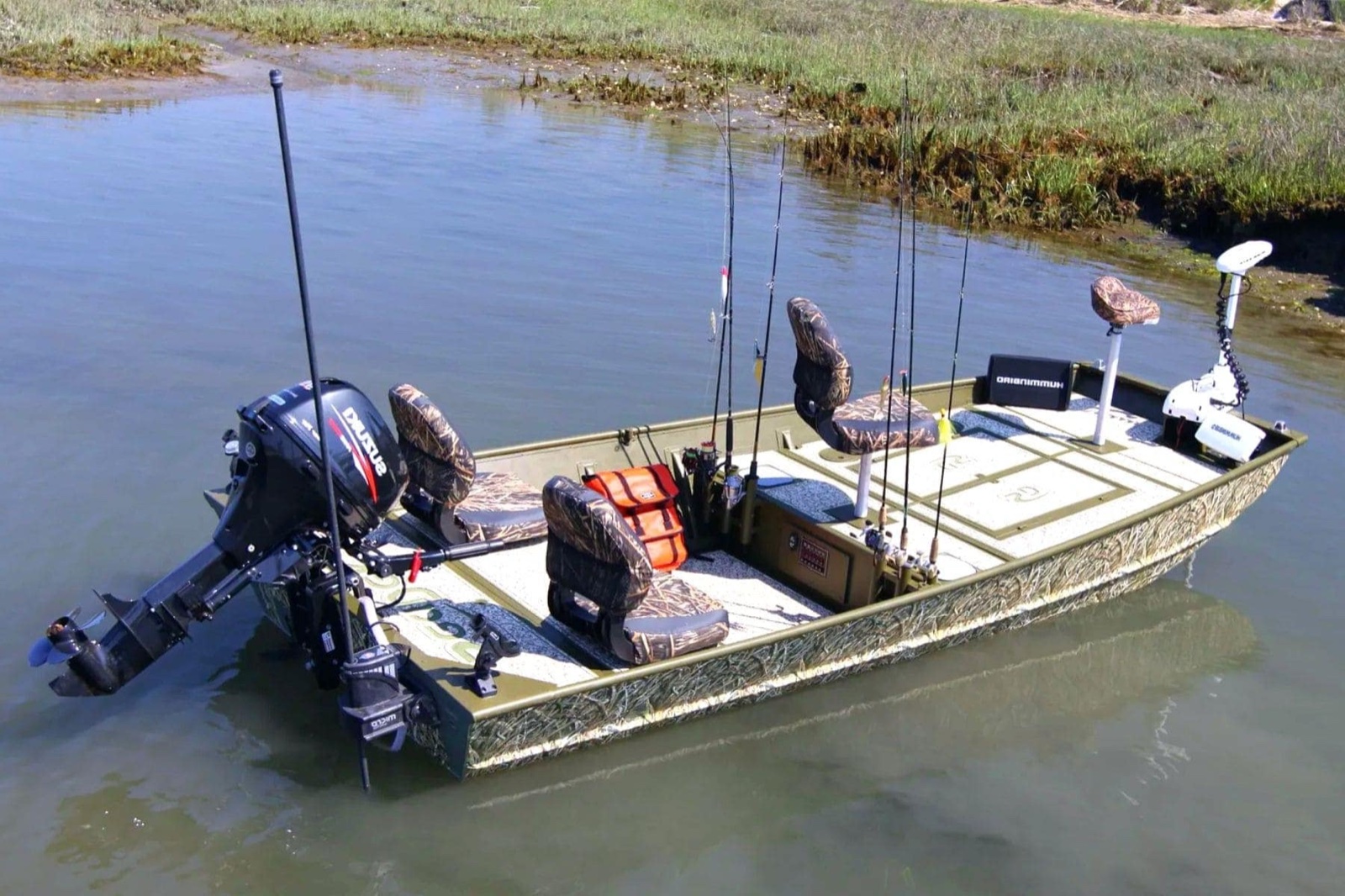
War Eagle Boats has built its reputation on heavy-duty welded jons for duck hunting and mud-motor service. The 754 VS is the model that most often gets pointed at as the brand's signature. It is a 17-foot welded aluminum jon with a heavy-gauge hull, a mod-V bow, and a transom set up to take the kind of mud motor that lighter competitors would feel under hard use.
What is the War Eagle 754 VS?
The 754 VS is a 17-foot all-welded aluminum jon with a 60-inch bottom width, a mod-V bow, and beam at the gunwale of 7 feet 6 inches. Dry weight sits at 780 pounds. Hull construction uses heavier-gauge aluminum than the entry-tier welded jons from G3 and Lowe, with reinforcement at the chine, the keel, and especially at the transom. There are no rivets in the structural hull. The seams are clean welded construction throughout.
The transom is the build detail that separates a War Eagle from a lighter welded jon. The 754 VS transom is reinforced specifically for mud-motor service. A Pro Drive, Gator Tail, or Mud Buddy mounts cleanly with the necessary backing plate already part of the hull. The boat also takes a standard outboard, but the design priority is mud-motor compatibility.
Layout is plain and functional. Bench seats forward, mid, and aft. Bare-aluminum or sprayed floor option. Mounting points for bow trolling motors and stern transducers. Hunting-focused options include camo paint, blind bracketry, and floor mounts for a dog stand. Bass-fishing-focused builds with casting platforms are available but less common in the production mix.
The mod-V bow does more than just soften the ride. It lets the boat work bigger water than a pure flat-bottom jon. Duck-hunting outfitters running the Louisiana bayou often need to cross open water in real wind to get to the back-bay hunting spots, and the mod-V handles that crossing without abusing the people on board.
Who is it good for?
Duck hunters running mud motors are the core buyer. The 754 VS is the boat working hunters in the Louisiana bayou, the Arkansas flooded timber, and the Mississippi Delta carry over and over. The heavy-gauge hull handles submerged logs, the reinforced transom takes the mud-motor weight and torque, and the finish survives a season of hard service. I worked a January morning aboard a 754 VS pushing through flooded timber in southern Louisiana with the mud motor cranked over, two hunters and a dog aboard, the hull bouncing off cypress knees the way a lighter jon would not survive. That is the boat's brief.
Hunting outfitters are the second profile. Outfit operators who run a fleet of jons for client hunts buy War Eagles for the same reasons individual hunters do. The boats outlast the alternatives, the resale supports trading every four or five years to refresh the fleet, and the maintenance burden over a season is lower.
Bowfishers running serious lighting rigs and a heavy generator are the third use case. The transom and the floor handle the weight, and the welded construction does not fatigue under the vibration of a long bowfishing night.
Who is it not good for?
Recreational anglers who fish 15 days a year on a small lake should not pay the War Eagle premium. A Lowe Roughneck or a G3 CCJ at lighter weight and lower cost does the recreational job. The heavy-gauge construction is meant for hard service.
Buyers shopping on entry price are the second wrong fit. The 754 VS is meaningfully more expensive than the standard welded competition at the same length. The build cost reflects what the boat is.
Bass-fishing tournament owners are the third exclusion. The 754 VS can be built as a bass boat, but the layout is fundamentally a hunting hull. A purpose-built welded bass boat or a fiberglass tournament rig is the right tool for that brief.
Pricing
New 2026 pricing on the 754 VS hull lands roughly $9,800 to $15,500 depending on options, hunting package, and finish. Add an outboard or a mud motor, a trailer, and a basic electronics package, and the out-the-door build sits $18,000 to $32,000 depending on motor choice.
The used market is strong. Clean hulls with motor and trailer range $7,500 to $14,000 depending on year and condition. War Eagles hold their price on resale better than any other aluminum jon at this length, which is one of the reasons hunting outfitters buy them as a fleet. The boat depreciates slowly enough that a five-year hold and a trade is a sensible plan.
What works
- Heavy-gauge welded construction. Among the most durable aluminum jons in the segment.
- Mod-V bow gives a real ride in wind chop, not just shallow-water capability.
- Transom is reinforced for mud-motor service. Pro Drive, Gator Tail, and Mud Buddy mount cleanly.
- Finish handles years of rocky launches and timber-bashing without cracking welds.
- Resale is segment-leading on aluminum jons at this length.
- Dealer network is concentrated in the South where the demand sits.
What doesn't
- Hull weight at 780 pounds is significant. Plan the trailer setup accordingly.
- Trailer is not included in the base hull price.
- Build cost is materially more than a Lowe Roughneck or a G3 CCJ.
- Layout is hunting-first, less optimal for bass-fishing rigs.
- Dealer network outside the South means longer freight for parts.
- No center-console option in the standard build.
Year-by-year notes
The 754 VS has been in production since the early 2010s on broadly the same hull. War Eagle has refined the transom reinforcement and the floor options across the years, with the 2018-onward hulls carrying the current welded seam pattern and the strongest transom spec. Older hulls from 2012 to 2017 are still in heavy service across the South, which says something about the durability of the build. There is no defect cutover year worth screening for, but post-2018 boats have the current build spec.
Cost of ownership
Annual costs are higher than the lighter welded competition because of the mud-motor maintenance, not the boat itself. A Pro Drive or Gator Tail wants regular service to the gear case and the impeller, which adds labor over a standard outboard. The hull itself does not need much attention. Insurance on a $22,000 package runs $400 to $700 a year. Trailer bearings repack annually.
A five-year hold on a 2022 754 VS with a Pro Drive mud motor, used 50 days a year between hunting season and summer fishing in the Louisiana bayou, lands at roughly $3,000 to $4,800 a year all-in over the hold. The strong resale flattens the capital cost, which is most of the difference between the War Eagle and the lighter competition over a long hold.
Best year and trim to buy
2018-onward 754 VS hulls with the current welded seam pattern, the reinforced transom, and the sprayed-floor option are the right buy in 2026. Verify five things before signing. First, the welds along the chine, the keel, and the transom are clean and continuous, with no signs of repair work. Second, the transom reinforcement plates are intact if the boat has run a mud motor. Third, the floor coating is intact with no large delamination patches. Fourth, the hull sides have no hard dents at the chine. Fifth, the trailer matches the hull weight and the bunks are in good order.
Sea trial notes
A sea trial on a 754 VS should focus on the heavy-duty hull's behavior under real conditions. First, launch and load from the trailer to confirm the boat handles cleanly. At 780 pounds dry plus a mud motor, the trailer setup is a real factor. Second, run the boat at cruise on whatever water is available. The mod-V should soften wind chop, and the hull should track straight under power even with a mud motor mounted. Third, watch the bilge under load. A welded War Eagle should not be taking on water at the seams. Any standing water in the bilge after a run is a serious flag. Fourth, listen to the welded seams and inspect the transom for any flex with the mud motor running at the rated power.
A pre-dawn winter morning in the Louisiana bayou below New Orleans is a typical environment for this boat. Cold air, marsh grass thick on the surface, two hunters and a dog aboard, decoys stacked on the bow, the mud motor pushing the hull through grass that would stop a propeller cold. The 754 VS does the job without complaint, and the hull at the end of the trip has picked up a few new scratches but no dents or weld cracks. That is the brief.
A second walk-around on a used hull should focus on the welds and the transom reinforcement. Look for continuous, clean weld lines along the chine, the keel, and the transom-to-side joints. Inspect the transom reinforcement plates if the boat has run a mud motor, because that is the highest-stress component on the build. Check the floor coating for delamination, the bench seats for any cracking, and the trailer condition. Pull the registration and check the boat against any factory recall or service-bulletin record.
Alternatives
For buyers stepping down to a lighter welded jon at lower cost, the Lowe Roughneck 1860 is the natural cross-shop. The Yamaha-owned welded alternative with a center-console layout is the G3 Jon 1860 CCJ. The direct mud-motor cross-shop at a similar spec and price is the Weldbilt 1648VS, which is built to a similar heavy-gauge spec from a Louisiana builder with deep mud-motor credentials.