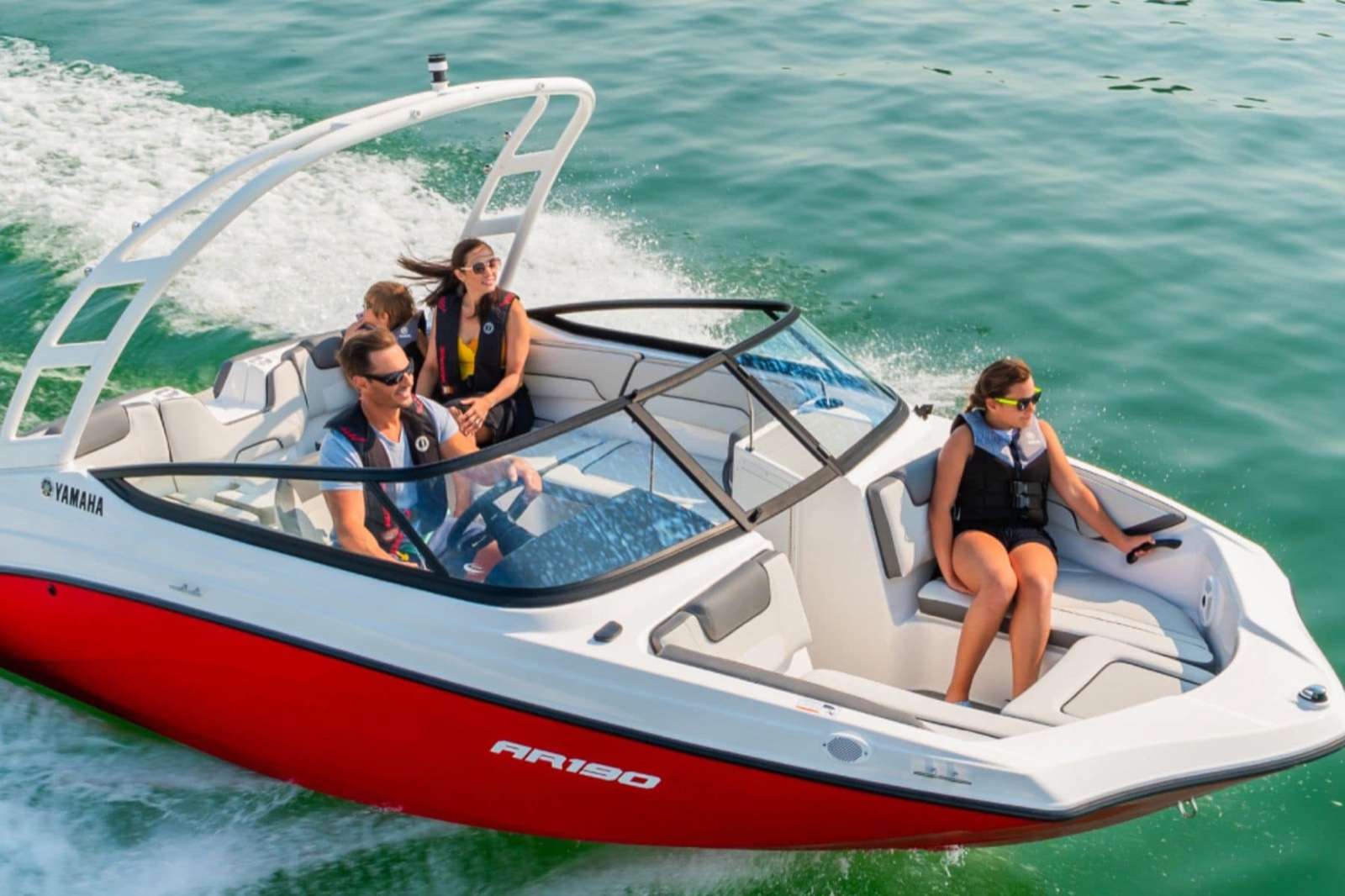
The Yamaha AR210 is the watersports-trim 21-foot jet bowrider Yamaha built from 2016 to 2023, the AR-package sibling to the family-trim SX210. Same hull, same twin TR-1 jet drivetrain, but the AR trim adds the wakeboard tower, the premium audio, and the watersports orientation. Production wrapped after 2023 when Yamaha exited the sport-boat segment, so the used market is the entire game in 2026.
What is the Yamaha AR210?
The AR210 is a 21-foot 3-inch fiberglass bowrider with an 8-foot 6-inch beam and a dry weight of 3,500 pounds. The drivetrain is twin Yamaha TR-1 four-stroke jet engines mounted in the engine compartment under the rear sun pad. Like every Yamaha jet boat, the intakes are flush in the hull bottom and the thrust comes through steerable nozzles at the transom. No outdrive, no propeller.
The AR trim is what separates this boat from the SX210 that shares the hull. Standard from 2018 onward: the wakeboard tower with two board racks and a pair of tower speakers, the premium audio amplifier package, the articulating keel for low-speed steering, the Connext touchscreen at the helm, and the dual-battery system. The cockpit fits eight people comfortably for a day cruise. Bow seating fits two adults per side with room for kids in between. The swim platform sits inches off the water, which is one of the things owners cite most often when they describe what the boat does well.
The fuel tank holds 50 gallons. The two TR-1 engines burn roughly 6 to 8 gallons per hour combined at a 30 mph cruise, which gives a real range of about 150 miles before reserve. The boat planes quickly, holds plane down to roughly 18 mph, and tops out around 47 mph in stock trim.
I ran a 2021 AR210 on Lake of the Ozarks one September weekend in light chop and 80-degree water. The tower pulled a teenage rider on a wakeboard fine for the rider's level, the cockpit kept eight people comfortable through a 25-mile loop, and the swim platform made the after-skiing swim-call easy on everyone aboard. That's the brief, and the AR210 covers it cleanly.
Who is it good for?
Watersports families with casual riders are the core buyer. Skiers, wakeboarders, tube-haulers, kids on inflatables. The tower and the audio package match what the family does most weekends, and the twin-jet drivetrain handles a shallow cove or a sandy beach without anyone watching for rocks.
Lake and river owners who beach the boat are the second profile. The AR210 runs into water shallow enough that a sterndrive bowrider would be stuck nosed off in deeper water with people wading in. The jet drivetrain doesn't care, the swim platform reaches the sand, and people walk on and off without ladders.
Owners stepping up from a 19-foot starter bowrider are the third group. The two-foot length jump plus the tower, the audio, and the wider swim platform changes how the boat lives on a weekend. People moving up from a Four Winns H190 or a Chaparral 19 H2O Sport describe the same thing: same trailerable footprint, materially more boat.
Who is it not good for?
Dedicated wakeboarders who want a surf wave should walk past. The AR210 is a watersports bowrider, not a Malibu 22 LSV or an Axis A22. It doesn't have ballast tanks, it doesn't have a surf gate, and the wake is what a 3,500-pound twin-jet hull makes naturally. That's fine for ski and casual wakeboard. It's not for behind-the-boat surfing.
Big-water cruisers are the second exclusion. The AR210 is a 21-foot hull rated for protected water. It will handle a coastal bay on a calm morning. It is not the boat for a 30-mile Great Lakes run in a building chop.
Buyers who want a quiet helm at speed are the third profile. Twin-jet engines at 35-plus mph make engine noise that an outboard or a quiet sterndrive doesn't. Some owners enjoy the sound. Others find it tiring on long days.
Pricing
New AR210 boats sold in the $58,000 to $72,000 range across the final production years depending on options and market. The 2026 used market spans about $22,000 at the bottom (early 2016 hulls with high hours and deferred service) up to $52,000 at the top (clean 2022 hulls with low hours and full options). The sweet spot for a 2026 buyer is a 2019-2022 hull with 100 to 300 hours in the $34,000 to $46,000 range.
The end-of-production announcement put a floor under used pricing. Brokers move clean AR210s in 30 to 60 days at fair money, and depreciation has slowed materially compared to the early production years when the sport-boat segment was full of new-boat supply.
What works
- Twin TR-1 jet engines mean no outdrive, no propeller, and a hull you can run in two feet of water.
- Wakeboard tower with board racks and speakers is standard on AR trim from 2018 onward.
- Swim platform sits inches off the water and is a real swim-and-board surface, not just a step.
- Premium audio package is part of the AR trim, not an upcharge like on most cross-shops.
- Connext touchscreen from 2018 handles drive mode, navigation, music, and cruise assist together.
- Articulating keel fixed the low-speed-steering issue from earlier-generation Yamaha jets.
- Trailerable behind a midsize SUV or half-ton truck. Garage-storable.
What doesn't
- Twin-engine fuel burn at cruise is higher than a single-sterndrive bowrider at the same speed.
- The wake is fine for ski and basic wakeboard. It's not a surf wake and won't be.
- Bow seating is narrower than the bigger 242 Limited S.
- Pump intakes grab weeds and shells. Cleanout ports help but require habit.
- Helm noise above 35 mph is louder than an outboard or a quiet sterndrive.
- Production ended in 2023. Long-term parts support is fine now but worth watching past 2030.
Year-by-year notes
The AR210 launched for 2016 on the second-generation Yamaha 21-foot jet hull. The 2017 model refined the helm graphics. 2018 was the big year: Connext touchscreen helm became standard, the articulating keel arrived, and the wakeboard tower moved to a standard AR-trim feature. 2019 updated the upholstery and added more standard features. 2020-2022 boats are the most refined years with the cleanest spec. 2023 was the final production year. The single biggest reason to favor a 2018-or-newer hull over a 2016-2017 is the articulating keel. Earlier boats had a low-speed-steering complaint that the keel fixes, and at a lower entry-cost difference it's not worth the older hull.
Cost of ownership
Annual costs on the AR210 are lower than a sterndrive at the same length because there's no outdrive to service. The 100-hour Yamaha service on each TR-1 engine costs $150 to $250 in parts per engine, plus labor if you don't do it yourself. The impellers should come out for inspection every 200 hours or two seasons, with replacement around $180 to $350 per pump.
Insurance on a $38,000 used hull is $550 to $950 a year in inland-lake markets. Trailer storage at home is free. Fuel for a typical 60-hour season at 6 to 8 gallons per hour combined is $950 to $1,400 a year. All-in for a 2020 hull bought at $42,000 with self-service maintenance and home trailer storage lands around $3,000 to $4,200 a year before fuel.
Best year and trim to buy
The 2019-2022 AR210 with the Connext helm, the wakeboard tower, the articulating keel, and 100 to 300 hours is the right buy in 2026. The 2020 and 2021 hulls show up most often in the $36,000 to $44,000 band with the cleanest spec.
Five things to verify pre-purchase. First, both engines start clean from cold and run through a sea trial with no alarms. Second, the impeller inspection is current and the pump tunnels show no impact or grass-jam scoring. Third, the wakeboard tower mounts are tight and the tower hardware shows no stress cracks. Fourth, the Connext screen wakes correctly and the touch responds across the panel. Fifth, the trailer brakes, bearings, and lights all work. A neglected trailer is a $2,000-plus surprise on top of the boat purchase.
Alternatives
Step up two feet to the Yamaha 242 Limited S and you get a wider bow, a bigger cockpit, and a longer swim platform on the same drivetrain philosophy. Go up to the Yamaha AR250 for more cockpit and more audio at a meaningful price step. For a sterndrive cross-shop at lower entry price with a propeller-driven hull, the Four Winns H190 covers a smaller version of the same family-bowrider brief.
The other boat worth a look for buyers who like the AR210 layout but want a sterndrive instead of jets is the Chaparral 19 H2O Sport, which sits two feet shorter on a propeller-driven hull at a similar entry price. Different trade entirely, but for the same family-bowrider use case, it's a common cross-shop. The decision usually comes down to one question: does the family beach the boat and run shallow coves often enough to make the jet drivetrain worth the noise and the fuel burn. If yes, the AR210 wins. If no, a sterndrive at the same length makes more sense.
One last note on the watersports brief. The AR210 was the boat that introduced a lot of inland-lake families to the Yamaha jet drivetrain through the second half of the 2010s and into the 2020s. Production wrapping in 2023 means the used market is the only path forward, but the supply is healthy enough that finding the right hull at the right price is realistic in most regional markets through 2027 at least. After that, parts and dealer support get more interesting to predict.