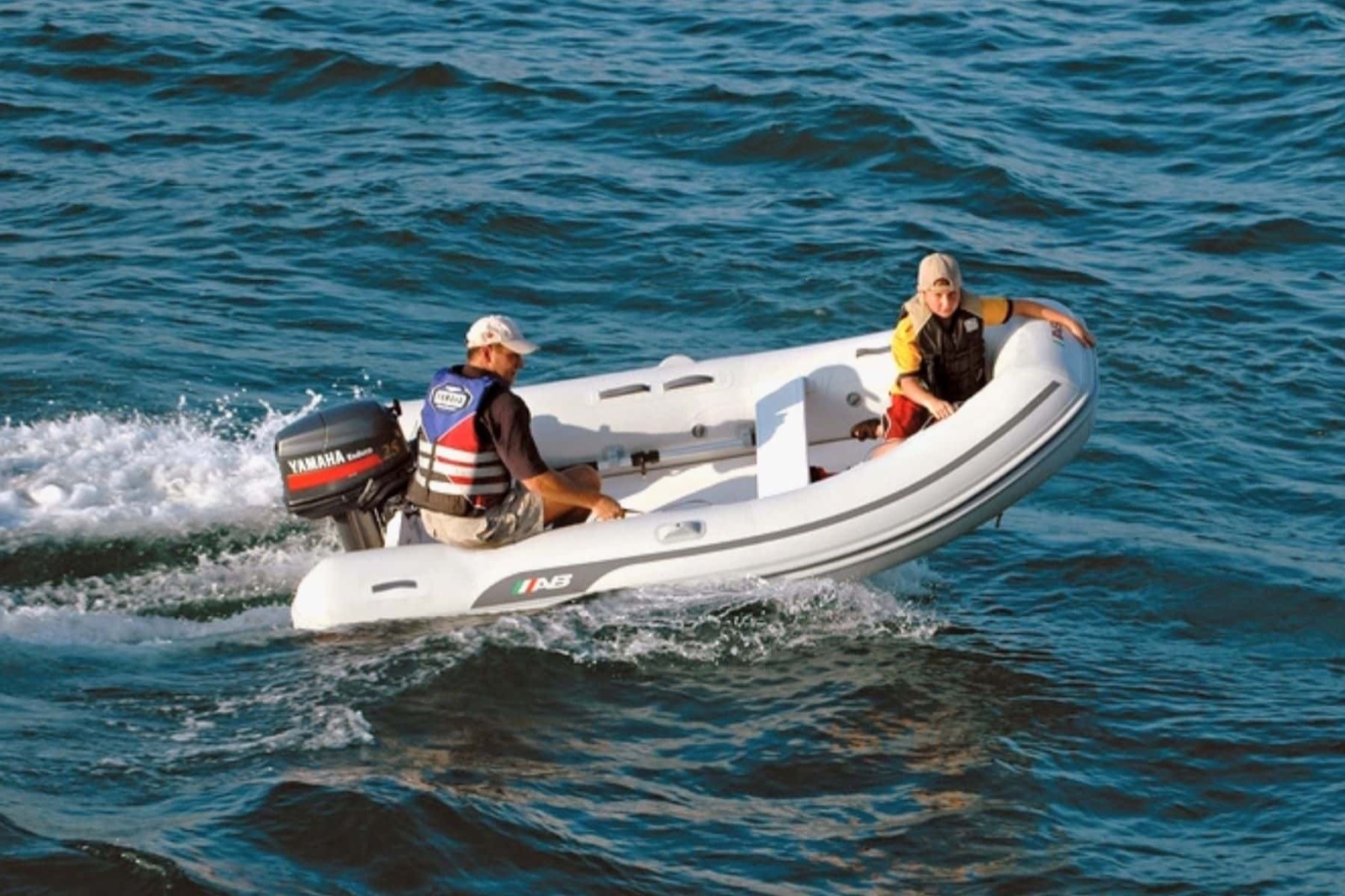
The Zodiac Medline 580 is a 19-foot 1-inch fiberglass-deck RIB with a center console and a deep-V hull. Zodiac has been building inflatables since 1934 and is the most-recognized name in the segment, with a particularly strong following in Europe and the Mediterranean. The Medline line is the company's open-RIB lineup, sitting above the smaller Classic and Cadet tender models in size and capability.
What is the Zodiac Medline 580?
The Medline 580 is a 19-foot 1-inch fiberglass-deck RIB with a 7-foot 5-inch overall beam (the inflated tube width). The deck is a deep-V fiberglass laminate with full-length floorboards integrated into the deck mold. Deadrise is roughly 22 degrees at the transom, which is more than most flat-bottom or partial-floor RIBs at the same length. Tubes are five-chamber Hypalon (CSM) fabric on current builds. Dry weight is 1,168 pounds rigged, which is too much for a 40-to-50-foot cruising-boat stern davit but fits cleanly on a 60-plus foot motoryacht's hydraulic platform.
The layout is built for day-boat or tender use. A center console with a Garmin chartplotter, a Yamaha or Mercury throttle, the steering wheel, and a basic helm seat with a flip-up bolster. A leaning post or a second helm seat is the standard option behind the console. Forward of the console, two bench seats face each other across the centerline, with storage under each. The transom has a swim platform with a folding boarding ladder. A bimini covers the helm and the leaning post.
Engine options are a Yamaha F70 to F115 four-stroke or a Mercury 75 to 115 FourStroke on the transom. The F115 is the right power. Cruise sits at 28 mph and top near 38 mph with two adults and a half tank of fuel. The 60-gallon fuel tank holds a real all-day range at cruise. Push past the F115 by hanging a single F150 and the transom and the deck can handle it, but the boat doesn't gain much. The hull is happy at F115 power.
I ran a 2022 Medline 580 with a Yamaha F115 across the bay at Port Camargue in the south of France one early summer morning. Two adults aboard, the Mistral kicking up a 2-foot chop on the channel out. The deep-V hull and the full floorboards under the helm made the 28-mph cruise feel like a 25-foot day-boat at half the size. Two hours of running and the boat held the helm dry, which is the part that justifies the Zodiac price premium over the partial-floor segment.
Who is it good for?
Owners with a 60-plus foot motoryacht and a hydraulic platform are the first buyer profile. The Medline 580 fits the standard 19-to-20-foot platform sizing on most coastal-cruising motoryachts in that range. The deep-V hull and the console layout make the boat a real day-boat off the mothership, not just a shuttle.
Day-boat owners on the Med, the Caribbean, or the US East Coast are the second profile. The 580 stands on its own as a day-boat. The console layout, the helm seat, the Garmin display, the swim platform, and the bimini cover the day-boat brief. The deep-V hull is the differentiator over a hard-hull bowrider at the same length on chop.
Owners running long shuttles or coastal hops are the third profile. The 60-gallon fuel tank and the deep-V hull are what make a 30-mile shuttle from a Caribbean anchorage to a marina possible without crew fatigue.
Who is it not good for?
Owners with a 40-to-50-foot cruising boat or a midsize motoryacht should walk past. The Medline 580 is too big for a stern davit. The boat needs a hydraulic platform or a slip. If you're shopping a cruising-tender brief, the Highfield Ultralight 340 or an AB at 9 to 11 feet is the right product.
Buyers shopping a smaller tender budget should also walk past. The 580 is materially more boat and more money than a cruising tender. The price gap is real.
The third exclusion is buyers in North American markets far from a Zodiac dealer. The North American dealer footprint is thinner than the European network. Warranty parts and service can stretch lead times.
Pricing
New 2026 pricing on the Medline 580 with a Yamaha F115 four-stroke and the standard console package lands roughly $48,000 to $58,000 at a Zodiac dealer. Stepping up to a loaded build with a Mercury F115, the upgraded Garmin display, the leaning post, the bimini, and a stereo brings the build to $58,000 to $68,000.
The used market spans $18,000 at the bottom (older pre-2018 Medline hulls with UV-damaged tubes and deferred deck service) to $58,000 at the top (current-year demonstrators with a loaded build). The sweet spot is the 2020-2022 Medline 580 with the F115 and the post-2020 console refresh, landing at $34,000 to $52,000 on a clean hull with under 300 hours. Five-year depreciation runs roughly 30 to 35 percent off MSRP, which is in line with the upper tier of the RIB segment.
What works
- Fiberglass deep-V deck with full-length floorboards rides chop better than partial-floor RIBs at any length.
- Hypalon tubes hold up to Mediterranean and Caribbean UV for a long service life.
- Console layout fits a Garmin chartplotter, a stereo, and a real helm seat.
- Yamaha F115 cruises at 28 mph and tops near 38 with two adults and a half tank.
- 60-gallon fuel tank holds a real all-day range at cruise.
- Holds resale well in Mediterranean and Caribbean markets.
What doesn't
- Price wall, rigged crosses $68,000 with a Yamaha F115.
- Too large for stern-davit use on a 40-to-50-foot cruising boat.
- Zodiac North American dealer footprint is thinner than European network.
- Hypalon repair is a specialist skill, $400 to $900 for tube repair.
- Tube fabric on 2018-2019 hulls had seam-stretch reports, the post-2020 spec is the one to find.
- 7-foot 5-inch beam may require a wider hydraulic platform than spec on some motoryachts.
Year-by-year notes
The current Medline 580 hull dates from roughly 2018. The 2020 model refreshed the console with the integrated Garmin mount as a near-standard option and updated the Hypalon fabric spec to address the seam-stretch reports on 2018-2019 hulls. The 2022 model refreshed the bench-seat upholstery and added USB charging at the console. The post-2020 tube spec is the one to find on used hulls.
Cost of ownership
Yamaha F115 service intervals follow the standard 100-hour schedule. A 100-hour kit costs $300 to $500 in parts and $250 to $400 in dealer labor. The 300-hour valve check at the three-year mark adds labor. RIB-specific maintenance is light. Tube cleaning and UV-protectant spray every six months is $100 to $200 in materials. Hypalon repair at year five or six for a tube seam re-glue is $300 to $600 at a marine canvas shop. No bottom paint on most use cases (the boat is platform-stored or trailered).
Insurance on a $50,000 hull is $700 to $1,200 a year. A five-year hold on a 2021 Medline 580 with a Yamaha F115, bought used at $42,000 with 250 hours, used 80 hours a year as a day-boat in the Caribbean with platform storage off a 70-foot motoryacht, lands at $4,200 to $6,500 a year all-in including insurance, fuel, service, and amortized capital cost.
Best year and trim to buy
The 2020-to-2022 Medline 580 with the Yamaha F115 and the post-2020 console refresh is the right buy in 2026. Verify five things pre-purchase. First, the engine service file shows current 100-hour work plus the 300-hour valve check. Second, the tubes are the post-2020 spec without seam stretch on the rub-strake side. Third, the deck-to-tube seam is clean and free of de-glue or fabric stretch. Fourth, the console wiring chase tests dry on a hose test. Fifth, the swim-platform mount and the boarding ladder hardware are tight to the transom.
A second moment to share. I watched a 2021 Medline 580 load four passengers off a 75-foot motoryacht at a hydraulic platform in the harbor at St. Barths one March morning. The platform sized for a 20-foot tender handled the 580 cleanly, the swim-platform mount tucked into the cradle without scraping the gelcoat. The Yamaha F115 started without complaint after a week of platform-stored idle time, and the boat ran the four-mile shuttle to the public dock at 25 mph with the dodger up and the helm seat occupied. That's the use case the Medline 580 is built for. A 60-plus foot motoryacht with a platform sized for a 19-to-20-foot tender, a day's worth of shuttle work between the mothership and shore, and chop coming off the harbor mouth that a smaller tender would soak the crew on.
Alternatives
The lighter cruising-tender cross-shop is the Highfield Ultralight 340, which is materially smaller for a different use case but the same Hypalon construction philosophy. A smaller Zodiac cross-shop is the Zodiac Classic MK2 at a much lower price tier and different use case. For a hard-hull day-boat at similar length, the Yamaha AR250 is a jet-deck-boat cross-shop with a different drivetrain at a comparable family-day-boat use case.