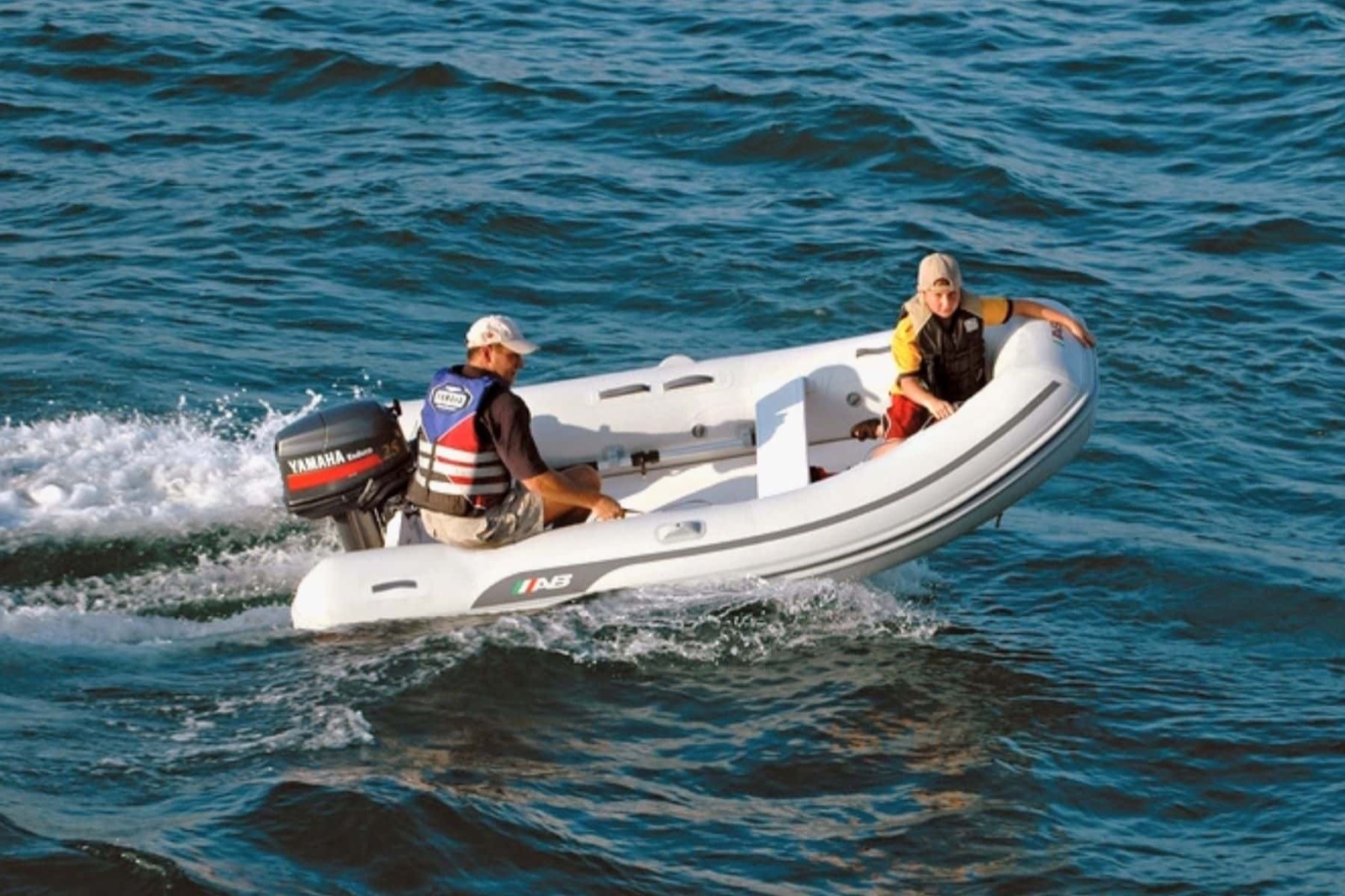
The Highfield Ultralight 340 is an 11-foot 2-inch aluminum-hull RIB built for davit life on a 40 to 50 foot motoryacht. Highfield Boats is based in Hangzhou, China and sells through a global dealer network with strong coverage on the US East Coast, the Med, and the Pacific Northwest. The Ultralight line is the company's weight-optimized lineup, sitting below the heavier-floor CL and DL models in dry weight but above them in transom-rating efficiency.
What is the Highfield Ultralight 340?
The Ultralight 340 is an 11-foot 2-inch aluminum-hull RIB with a 5-foot 8-inch overall beam and a Hypalon (CSM) tube. Hull-only dry weight is 143 pounds, which is the headline number. With a Yamaha F20 four-stroke, a battery if you specify electric start, and a fuel tank, the rigged davit weight lands around 240 to 270 pounds. That fits the weight budget of a standard motoryacht boom davit or a 40 to 50 foot cruising sailboat stern davit without straining the rig.
The hull is a stamped aluminum V with a single keel weld running the length. Deadrise is roughly 18 degrees at the transom, which is enough to take a 1-to-2-foot chop without slamming. Tubes are five-chamber CSM fabric on current builds, which holds up to UV exposure materially better than PVC at the same hours on davit. The floor is partial, a fiberglass section under the helm seat and a fabric floor forward of it. Owners who want full-length hard floorboards should look at the Highfield CL line instead.
Transom is rated to 30 hp on the current build. The practical sweet spot is 15 to 20 hp. A Yamaha F15 or F20 four-stroke is the right power. The boat plants cleanly with two adults at idle-plus-thirty-seconds, and takes a fourth seat on a 20 or 25-hp engine without losing the plane. Push past 25 hp and the partial floor starts to flex under hard cornering, which is the limit the partial-floor design imposes.
I ran a 2022 Ultralight 340 with a Yamaha F20 across the Annapolis harbor one September morning, dropping crew off a moored 46-foot sailboat at the public dock. Two adults aboard, the tide running, and the boat planted at 12 mph cleanly. The aluminum hull on light chop felt different from a fiberglass tender, firmer through the seat. Two trips back and forth and the davit lift back onto the stern davit pulled cleanly without two-person muscle, which is the part that makes the lightness pay off.
Who is it good for?
Cruising sailors with a 40 to 50 foot boat are the first buyer profile. Stern-davit weight budgets on most 40-to-50-foot cruisers max out around 280 pounds rigged. The Ultralight 340 fits inside that envelope with a 15 or 20-hp four-stroke and a fuel tank. A heavier Walker Bay or a fiberglass-hull tender at the same length will push over the budget.
Motoryacht owners with a boom davit are the second profile. The standard boom-davit footprint on a 40 to 50 foot motoryacht handles the 340 cleanly. The aluminum hull doesn't ding the boom paint the way a fiberglass tender's gelcoat can scuff.
Coastal owners running 1 to 5 mile shuttles to a marina from a mooring are the third profile. The 30-hp transom rating gives a real cruise speed for longer shuttles. With a 20-hp four-stroke the boat holds a 14-mph cruise that turns a five-mile shuttle into a twenty-minute run instead of an hour.
Who is it not good for?
Owners who want hard-floor stability under a load should walk past. The partial-floor design strips weight by giving up the rigidity that a full floorboard provides. Highfield's CL line is the right product for owners who want a four-adult, planing tender with full floorboards.
Owners who want a packable tender should also walk past. The aluminum hull doesn't fold. If your dinghy locker is the bow cabin of a 35-foot bluewater cruiser, the Ultralight 340 is the wrong product. A roll-up or a folding tender is the right one.
The third exclusion is owners who want to push past 25 hp. The transom is rated to 30 hp but the partial floor flexes under load past 25. The handling envelope is honest at 15 to 20 hp.
Pricing
New 2026 pricing on the Ultralight 340 with the CSM tube spec, the davit-ready lifting bridle, and the partial floor lands roughly $8,400 to $11,800 hull-only at a Highfield dealer. Add a Yamaha F20 four-stroke (roughly $4,800 retail) and a fuel tank and the rigged package crosses $14,000. The davit bridle is an option, not standard, and should be specified at order if you're sending the boat to a cruising boat with a davit setup.
The used market spans $2,800 at the bottom (older 2014-2017 hulls with deferred UV exposure and tube damage) to $9,800 at the top (current-year demonstrators). The sweet spot is the 2020-2022 Ultralight 340 with the CSM tube spec and the davit bridle, landing at $5,800 to $9,200 on a clean hull. Five-year depreciation runs roughly 25 to 30 percent off MSRP, which holds the boat's value better than PVC-tube competitors at the same length.
What works
- 143-pound hull-only dry weight is roughly 30 percent lighter than equivalent aluminum RIBs.
- Aluminum V-hull plants cleanly on a 15-hp outboard with two adults.
- CSM tube fabric on current builds holds up to UV exposure better than PVC at the same davit hours.
- Davit-ready lifting bridle is a factory option, sized for the standard motoryacht boom-davit footprint.
- 30-hp transom rating gives real cruise speed for longer shuttles.
- Holds resale value better than PVC-tube competitors at the same length.
What doesn't
- Price wall. A new Ultralight 340 rigged crosses $14,000 with a Yamaha F20.
- Partial floor instead of full-length floorboards.
- Aluminum hull doesn't fold.
- Hypalon repair is a specialist skill, full repair runs $300 to $700 at a marine canvas shop.
- Transom rating is 30 hp but the practical sweet spot is 15 to 20 hp.
- Davit bridle is an option, not standard.
Year-by-year notes
The current Ultralight 340 hull dates from roughly 2018. The 2020 model added a reinforcement at the transom corners after early-build owners reported flex at the engine mount under hard cornering. The 2022 model standardized the CSM tube spec across the line. Pre-2020 hulls with PVC tubes and the early transom design are a different boat. Don't confuse them when shopping used. The post-2020 reinforcement and the CSM tubes are the two specs to find.
Cost of ownership
Aluminum-hull RIBs are cheap to own once the engine spend is set. The hull doesn't bottom paint. The tubes need a UV-protectant spray every six months. Annual hull cleaning is a wipe-down with a marine cleaner, no marine yard required. The Yamaha F20 four-stroke service interval is 100 hours, with a $150 to $250 kit and $150 to $250 dealer labor. The tubes themselves are the recurring line. CSM fabric holds up well but a 10-year-old boat with hard davit use will show fabric fatigue at the rub strake and the seam-to-floor joint. A repaint of the rub strake at year five is $250 to $500.
Insurance is usually rolled into the mothership policy and runs $50 to $150 a year incremental. A five-year hold on a 2021 Ultralight 340 with a Yamaha F20, bought used at $7,800, used 80 hours a year as a cruising tender on the Chesapeake, lands at $850 to $1,400 a year all-in including insurance, fuel, service, and amortized capital cost.
Best year and trim to buy
The 2020-to-2022 Ultralight 340 with the CSM tube spec, the post-2020 transom reinforcement, and the davit-ready lifting bridle is the right buy in 2026. Verify five things pre-purchase. First, the keel weld is clean and free of corrosion bubbles. Second, the transom mount and the reinforcement at the engine bracket are tight, no flex when you push on the transom by hand. Third, the CSM tubes hold pressure overnight without a drop, hose-test on dry land. Fourth, the davit bridle attachment points are intact and the bridle itself is included in the sale. Fifth, the partial floor under the helm seat is dry and free of corrosion.
Alternatives
The closest aluminum-hull RIB cross-shop is the Achilles HB 310 DX, which is built to a similar spec at a slightly shorter length and a slightly heavier weight. The folding-hull cross-shop is the Walker Bay Genesis 310, with a different packability story. The classic PVC-tube cross-shop is the Zodiac Classic MK2, at materially less money with shorter UV life.