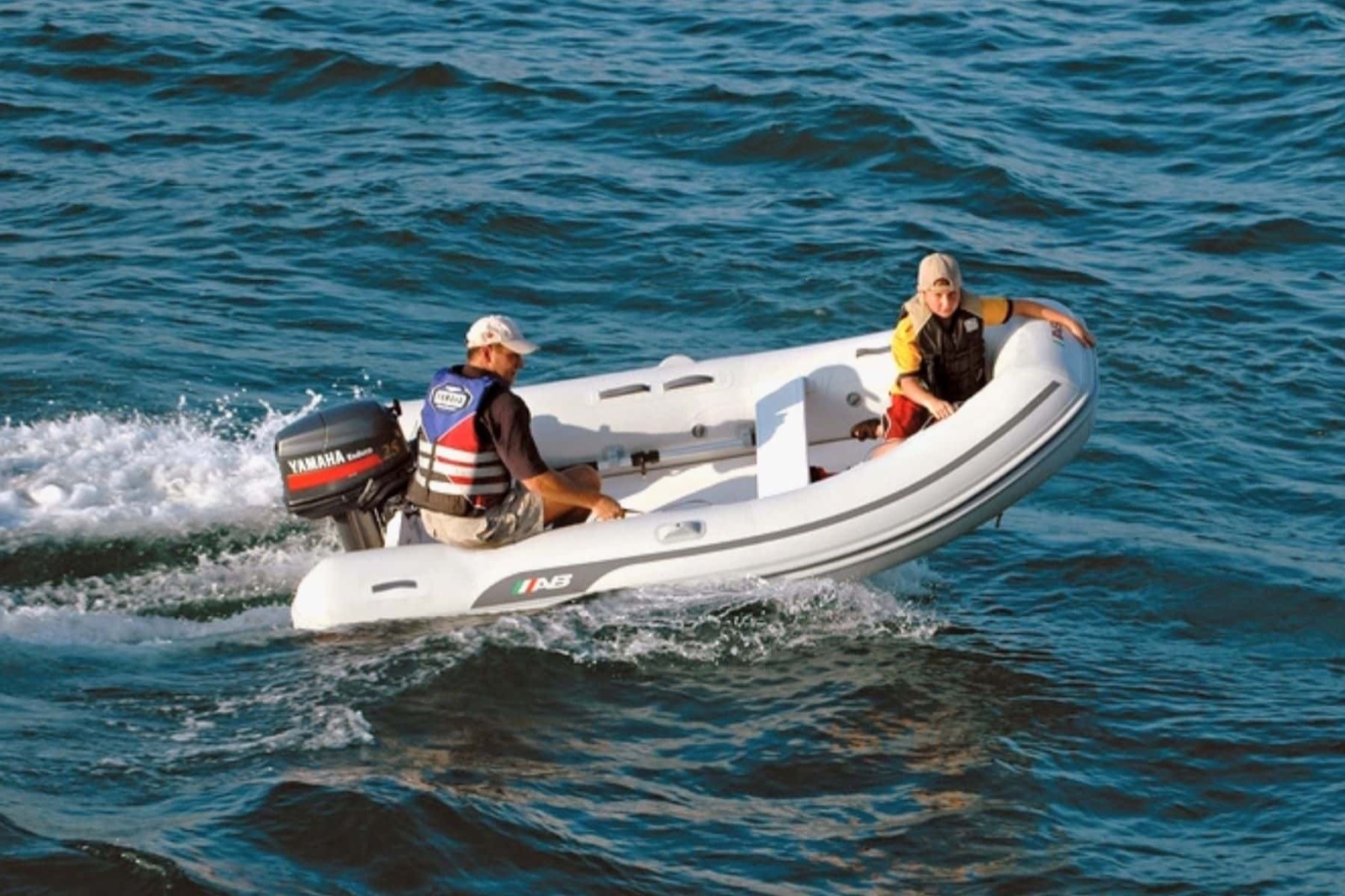
The Walker Bay Genesis 310 is a 10-foot 2-inch foldable-hull RIB. Walker Bay Boats was founded in 1997 in British Columbia and the Genesis line is the company's signature foldable design, a category that sits between a hard-hull RIB and a roll-up packable tender. The Genesis 310 is the mid-size in the line, between the smaller Genesis 270 and the larger Genesis 340.
What is the Walker Bay Genesis 310?
The Genesis 310 is a 10-foot 2-inch fiberglass-hull RIB with a 5-foot 4-inch overall beam (the inflated tube width). The hull is a deep-V fiberglass laminate with a stainless-steel hinge mechanism running across the boat roughly at the midpoint. The hinge unclamps and the hull folds in half, the tubes detach from the gunwale clamp system, and the whole package collapses to roughly 5 feet long by 5 feet wide for storage in a garage or a shed. Tubes are five-chamber PVC fabric on current builds. Assembled dry weight is 125 pounds.
The deep-V hull is what differentiates the Genesis from a packable roll-up. Hull deadrise of roughly 17 degrees at the transom rides chop better than a flat-bottom or air-floor packable. The boat plants cleanly on a 6-hp four-stroke with one adult aboard and takes the rated 15 hp with two adults and a fuel tank. Cruise on a Yamaha F9.9 with one adult sits at 13 mph, climbs to 18 with the F15. The reinforced transom and the integrated keel handle the 15-hp rating cleanly.
The folding mechanism is the headline feature. Two stainless clamps along the hinge line release with a wrench. The tubes detach from the gunwale clamps. The hull folds. The whole assembly stores in a footprint roughly half the assembled length. Reassembly takes 25 to 40 minutes the first few times, dropping to 15 to 20 minutes with practice. The hinge clamp needs periodic re-torquing, which is the maintenance line that doesn't exist on a one-piece hull.
I assembled a 2022 Genesis 310 on the dock at a marina in Friday Harbor in the San Juan Islands one early summer morning, breaking the boat out of a garage at a vacation cottage where the disassembled package had spent the winter. The reassembly took 22 minutes including the tube inflation. The hull plant on a 9.9-hp four-stroke held a 14-mph cruise across the harbor for a six-mile run to a nearby cove with two adults aboard. The folding setup felt different from a one-piece RIB but the hull stiffness once the clamps were torqued was honest. No flex through the seat under hard cornering.
Who is it good for?
Cruising sailors who want a rigid V-hull tender but lack davit space for a full-time hard-hull RIB are the first buyer profile. The folding feature gives owners the option to stow the disassembled boat below or in a deck locker for an offshore passage and reassemble at the next port.
Owners who store the boat at home in a garage for off-season months are the second profile. The folded package fits in roughly half the floor space of an assembled 10-foot RIB. For owners with limited garage space, the storage benefit is real.
Owners trading off between a hard-hull RIB and a roll-up tender are the third profile. The Genesis 310 is a real compromise position. It's not as compact as a roll-up Achilles LEX, but it's much more rigid in the water. And it's not as quick-launch as a one-piece RIB, but it stores in less than half the space.
Who is it not good for?
Owners who want a daily-tender setup should walk past. The 25-to-40-minute assembly time is real friction for daily use. A one-piece hard-hull RIB launches in 2 to 5 minutes off a davit. The folding setup makes sense for a boat that gets used a dozen times a season, not 100 times.
Owners who want the lightest possible davit-rigged weight should look at the Highfield Ultralight 340 instead. The Genesis at 125 pounds is roughly 20 pounds heavier than the Ultralight 340 at a similar length, which is a real difference on a tight stern-davit budget.
The third exclusion is owners who want the longest possible tube life. The Genesis uses PVC tubes, which run 8 to 12 years with reasonable UV care. Hypalon-tube cross-shops on the AB 9 VL or the Highfield Ultralight 340 run 15 to 20 years.
Pricing
New 2026 pricing on the Genesis 310 with PVC tubes and the standard hinge mechanism lands roughly $5,800 to $7,800 boat-only at a Walker Bay dealer. Add a Yamaha F9.9 four-stroke (roughly $3,200 retail) and the rigged package crosses $9,000. The Genesis sits at the mid-tier of the folding-RIB segment, materially cheaper than a Hypalon-tube AB at the same length but more than a roll-up Achilles.
The used market spans $1,800 at the bottom (older pre-2018 hulls or current hulls with hinge-clamp damage and tube UV failure) to $6,800 at the top (current-year demonstrators). The sweet spot is the 2020-2022 Genesis 310 with the post-2020 hinge reinforcement, landing at $3,400 to $5,200 on a clean boat. Five-year depreciation runs roughly 30 to 35 percent off MSRP, which is in line with the upper-mid tier of the tender segment.
What works
- Foldable fiberglass V-hull collapses to roughly half assembled length for storage.
- Rigid V-hull plants cleanly on a 6-hp four-stroke, takes 15 hp with two adults.
- Tubes detach for separate storage, useful for small-space off-season storage.
- 17-degree deadrise rides chop better than a flat-bottom roll-up.
- Reinforced transom takes the rated 15 hp without flex.
- Walker Bay dealer network in North America is broad.
What doesn't
- Assembly time is 25 to 40 minutes the first few times.
- Hinge clamp needs periodic re-torquing.
- 125-pound assembled weight is roughly 20 pounds heavier than the Highfield Ultralight 340.
- PVC tubes have shorter UV life than Hypalon, 8 to 12 years.
- Disassembled storage needs garage or shed space, not a cruising-boat locker.
- Hinge mechanism is proprietary, replacement parts are dealer-only.
Year-by-year notes
The current Genesis 310 hull dates from roughly 2018. The 2020 model added a reinforcement at the hinge clamp after early-build owners reported clamp loosening on hard-cornering use. The 2022 model refreshed the tube fabric weight to address a small share of UV-life reports on 2018-2019 boats. Pre-2020 boats with the older hinge spec are the ones to inspect carefully for clamp wear.
Cost of ownership
Folding-hull RIBs are cheap to own once the engine spend is set. The hull gets a wax and polish once a year, $50 to $150 in materials. The tubes need a UV-protectant spray every six months. The hinge clamp gets a re-torque once a season, a 15-minute job with a torque wrench. Yamaha F9.9 service interval is 100 hours, with a $100 to $200 kit and $150 to $250 dealer labor. The tubes themselves are the recurring line. A tube re-glue at year eight or nine is $250 to $500 at a marine canvas shop.
Insurance is usually rolled into the mothership policy and runs $30 to $100 a year incremental. A five-year hold on a 2021 Genesis 310 with a Yamaha F9.9, bought used at $4,400, used 50 hours a year as a Pacific Northwest cruising tender, lands at $600 to $1,000 a year all-in.
Best year and trim to buy
The 2020-to-2022 Walker Bay Genesis 310 with the post-2020 hinge reinforcement is the right buy in 2026. Verify five things pre-purchase. First, the hinge clamps are tight and the post-2020 reinforcement is in place. Second, the tubes hold pressure overnight on a dry-land test. Third, the fiberglass hull at the hinge line is free of stress cracks. Fourth, the transom mount and the engine bracket are tight without fabric or fiberglass flex. Fifth, the tube-to-gunwale clamp system is intact and the tubes seal cleanly to the hull after reassembly.
Alternatives
The lighter aluminum-hull cross-shop is the Highfield Ultralight 340, a one-piece hull at a slightly longer length and a lower assembled weight. The fiberglass-hull cross-shop at a slightly shorter length is the AB 9 VL, with Hypalon tubes and no fold. The packable roll-up cross-shop is the Achilles LEX-96, materially more compact stowed but much less rigid in use.