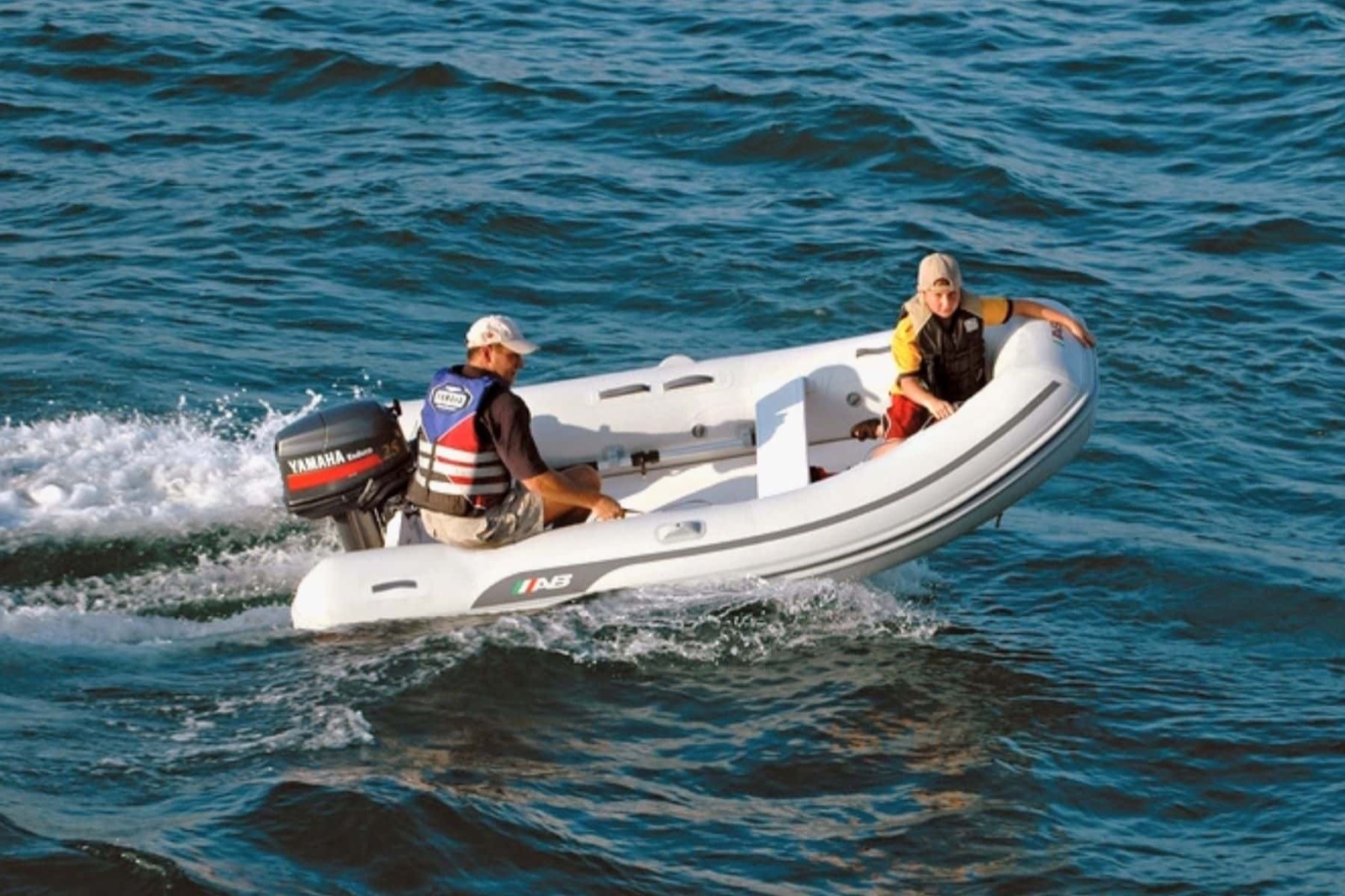
The AB 9 VL is a 9-foot 4-inch fiberglass-hull RIB built by AB Inflatables in Cartagena, Colombia. AB has been building inflatables since 1973 and the VL line is the company's value-leaning lineup, sitting below the heavier VS and ALX models in price but with the same Hypalon tube construction.
What is the AB 9 VL?
The 9 VL is a 9-foot 4-inch fiberglass-hull RIB with a 5-foot 0-inch overall beam. The hull is a deep-V fiberglass laminate with full-length floorboards integrated into the hull mold. Tubes are five-chamber Hypalon (CSM) fabric. Hull-only dry weight is 108 pounds, which puts the rigged davit weight with a 9.9-hp four-stroke, a battery, and a fuel tank around 200 to 225 pounds.
The deep-V is the part of the 9 VL that pays off in use. A 9-foot flat-bottom tender slams in any kind of chop. The 9 VL deep-V takes a 1-foot chop without the bottom-on-bottom contact that defines the cheaper end of the segment. On a calm morning the hull tracks straight off a 6-hp four-stroke with one adult aboard, plants cleanly with two on an 8-hp, and runs three adults on the rated 15 hp without the partial-floor flex that limits stripped-weight tenders.
Transom is rated to 15 hp. The practical sweet spot is 6 to 9.9 hp. A Yamaha F6 or F9.9 four-stroke is the right power for most cruising-tender use. Beyond 9.9 the hull is happy but the weight added by a 15-hp engine and a larger fuel tank starts to push the davit budget on a 38-to-45-foot cruising sailboat.
I ran a 2021 AB 9 VL with a Yamaha F9.9 across the harbor at George Town in the Exumas one March afternoon, dropping a crew of three off a moored 42-foot catamaran. The deep-V into a 1-foot chop on the bay was the difference. A flat-bottom dinghy at the same load would have soaked everyone. The 9 VL planed at 11 mph with three aboard and held the seat dry, which is the part that justifies the price gap over a PVC-tube competitor.
Who is it good for?
Cruising sailors with a 38 to 45 foot boat are the first buyer profile. Stern-davit weight budgets at that size range usually allow 220 to 280 pounds rigged. The 9 VL fits inside that envelope with a 9.9-hp four-stroke. The deep-V is the differentiator over the lighter aluminum-V Highfields and the partial-floor strip-weight tenders.
Owners running short marina shuttles where the deep-V pays off in chop are the second profile. Cruising the Bahamas or the eastern Caribbean, where the wind kicks up a real chop between the anchorage and the marina. The 9 VL rides that chop without soaking the crew.
Liveaboard cruisers running the boat as a daily tender are the third profile. AB's Hypalon construction is one of the longest-lasting in the segment. Owners report 15 to 20 year service life on the tubes with reasonable UV care. The 9 VL is the kind of tender you buy once and run for the life of the mothership.
Who is it not good for?
Owners with the tightest weight budgets should look at the Highfield Ultralight 340 instead. The Ultralight at a slightly longer length is roughly 35 pounds lighter on the davit, which makes a real difference on a 38-foot cruiser with a tight stern-davit rating.
Owners who want a packable tender should walk past. The fiberglass hull doesn't fold. If your dinghy locker is the bow cabin of a 35-foot bluewater cruiser, a roll-up tender is the right product.
The third exclusion is owners who want to run past 9.9 hp routinely. The transom is rated to 15 hp but the cost-benefit on a 9-foot tender is thin past 9.9 hp. A larger tender at 10 to 11 feet is the right step up.
Pricing
New 2026 pricing on the AB 9 VL with the Hypalon tube spec and standard lifting eyes lands roughly $5,400 to $7,800 hull-only at an AB dealer. Add a Yamaha F9.9 four-stroke (roughly $3,200 retail) and a fuel tank and the rigged package crosses $9,000. The 9 VL sits at the price wall for cruising-tender purchases. Anyone shopping under $4,000 rigged is in a different segment.
The used market spans $1,800 at the bottom (older pre-2017 hulls with UV-damaged tubes and gelcoat chalk) to $6,800 at the top (current-year demonstrators). The sweet spot is the 2020-2022 9 VL with the current Hypalon spec, landing at $3,800 to $5,400 on a clean hull. Five-year depreciation runs roughly 25 to 30 percent off MSRP, which is in line with the upper tier of the cruising-tender segment.
What works
- Fiberglass deep-V hull plants cleanly on a 6-hp four-stroke, runs three adults on the rated 15 hp.
- Hypalon tubes hold up to UV in the tropics better than PVC alternatives.
- Deep-V rides chop better than flat-bottom or aluminum-V at the same length.
- AB's tube life is among the longest in the segment, 15 to 20 years with reasonable care.
- Standard lifting eyes are sized for the common cruising-sailboat stern-davit bridle.
- Holds resale well, a clean 2021 hull sells through Caribbean and East Coast brokers in 30 to 60 days.
What doesn't
- 108-pound hull weight is roughly 35 pounds heavier than the Highfield Ultralight 340.
- Transom rated to 15 hp but the practical sweet spot is 6 to 9.9 hp.
- Fiberglass hull doesn't fold.
- Price wall, rigged package crosses $9,000 with a 9.9 four-stroke.
- Hypalon repair is a specialist skill, $400 to $800 for a torn-tube job.
- 5-foot 0-inch beam is wider than some 9-foot davit cradles, may require a cradle widening.
Year-by-year notes
The current 9 VL hull dates from roughly 2017. The 2020 model refreshed the Hypalon tube fabric to a slightly heavier weight and updated the lifting-eye attachment to a thru-bolted hardware spec. Pre-2017 hulls with the older lifting-eye design are a different boat for davit purposes, where the eye is glued to the tube rather than thru-bolted into the hull. The thru-bolted spec is the one to find on used hulls.
Cost of ownership
Fiberglass-hull RIBs are cheap to own. The hull gets a wax and polish once a year, $50 to $150 in materials. The tubes need a UV-protectant spray every six months. Yamaha F9.9 service interval is 100 hours, with a $100 to $200 kit and $150 to $250 dealer labor. The Hypalon tubes themselves are the recurring line. A tube re-glue at the seam at year ten is $300 to $600 at a marine canvas shop.
Insurance is usually rolled into the mothership policy and runs $50 to $150 a year incremental. A five-year hold on a 2021 9 VL with a Yamaha F9.9, bought used at $4,800, used 60 hours a year as a cruising tender in the Bahamas, lands at $700 to $1,100 a year all-in.
Best year and trim to buy
The 2020-to-2022 AB 9 VL with the current Hypalon tube spec and the thru-bolted lifting eyes is the right buy in 2026. Verify five things pre-purchase. First, the gelcoat on the hull is free of chalk and the keel shows no impact damage. Second, the tubes hold pressure overnight without a drop on a dry-land test. Third, the lifting eyes are thru-bolted, not glued. Fourth, the transom mount and bracket are clean and free of stress cracks. Fifth, the floorboards are dry and free of delamination from water intrusion through the drain plug.
Alternatives
The aluminum-hull cross-shop at a slightly longer length is the Highfield Ultralight 340, which is roughly 35 pounds lighter on the davit. The aluminum-hull RIB cross-shop at a similar length is the Achilles HB 310 DX. The folding-hull cross-shop with a different packability story is the Walker Bay Genesis 310.