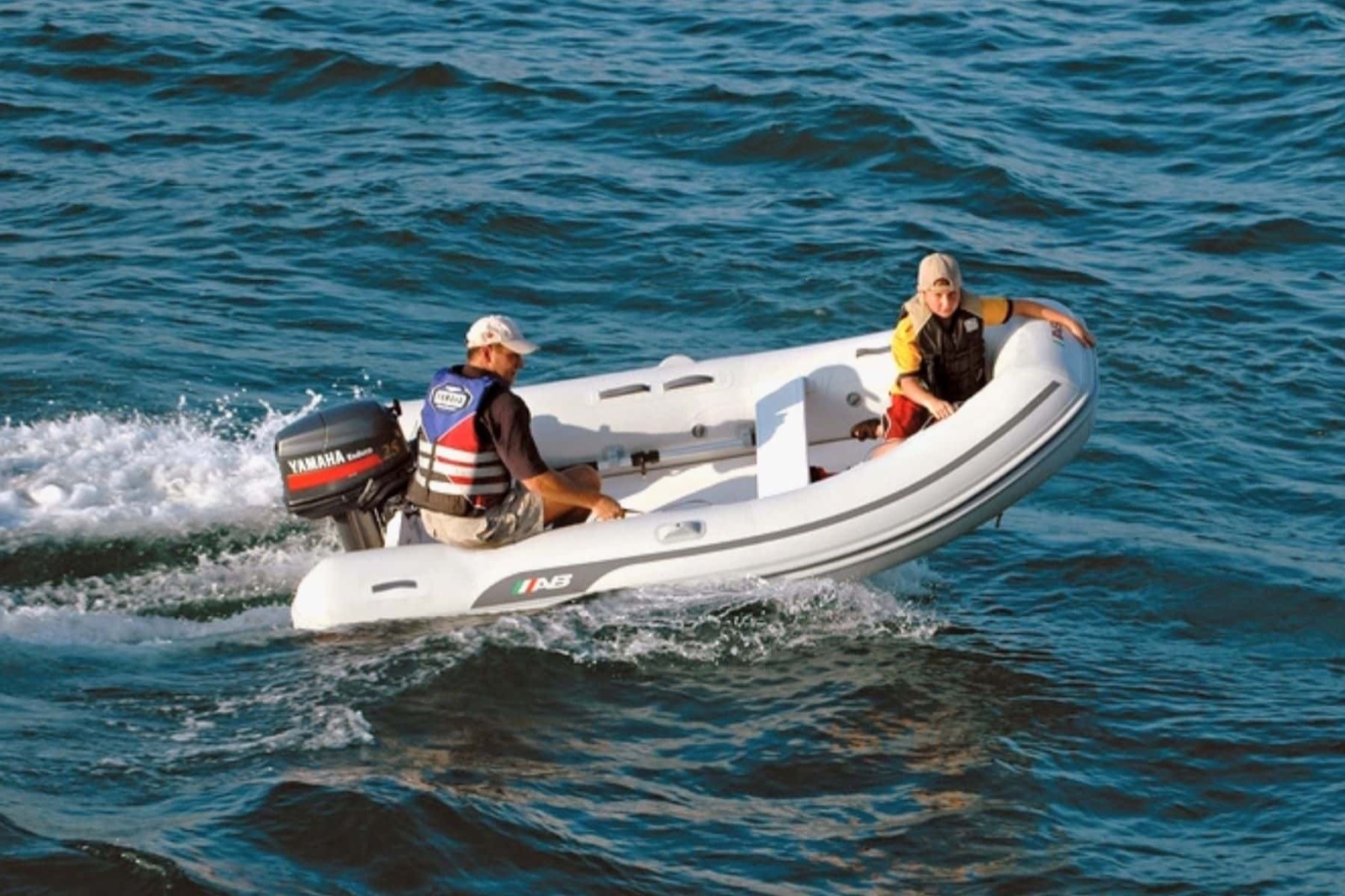
The Achilles LEX-96 is a 9-foot 6-inch roll-up inflatable tender with an air-floor deck, built for cruisers who don't have stern-davit space for a hard-hull tender. Achilles has been building inflatables in Japan since 1952 and the LEX line is the company's roll-up lineup, sitting below the aluminum-hull HB series in stowed bulk and price.
What is the Achilles LEX-96?
The LEX-96 is a 9-foot 6-inch roll-up inflatable with a 5-foot 1-inch overall beam. The hull is fabric, with no fiberglass or aluminum deck. The floor is an inflatable air-floor that runs the length of the boat, inflated to a higher pressure than the tubes (roughly 11 psi versus 3 psi on the tubes), which gives the deck enough rigidity to stand on. Tubes are PVC fabric, three-chamber. Boat-only dry weight is 82 pounds packaged.
The packed package is the headline. The boat rolls up into a 4-foot by 2-foot by 1-foot bundle that fits in a cockpit locker or under a V-berth on a 32 to 38 foot cruising boat. A foot pump or an electric inflator takes the boat from rolled-up to ready-to-launch in 8 to 12 minutes. That's the part that makes the LEX-96 work for bluewater cruisers who stow the tender below for an offshore passage.
Transom is rated to 10 hp. The practical sweet spot is 4 to 6 hp for single-handed light use, 8 to 10 hp for two-up use that needs to plane. A Tohatsu 6 or a Yamaha F6 four-stroke is a common engine pairing. With one adult and a 6-hp engine the boat plants cleanly at 12 mph. With two adults and a 6 the boat sits at displacement speed of 4 to 6 mph. With two adults and a 9.9 or 10 the boat plants at 10 mph. The air-floor flex limits how hard you can push the hull. Hard cornering at full plane and the deck flexes noticeably under the helm.
I rolled up a 2020 LEX-96 on the dock at a marina in Sausalito one September afternoon, fitting the packed boat into the cockpit locker of a 36-foot bluewater cutter before a passage south. The packed-down package fit cleanly. Unpacked the next morning at the next stop, the boat inflated to full pressure in twelve minutes with a foot pump and ran a 6-hp four-stroke between the mothership and the marina without complaint. The single-adult cruise was clean, the deck was stable enough to stand on when stepping in and out at the dock, and the rolled-up bulk had taken up less than a third of the locker.
Who is it good for?
Bluewater cruisers on a 32 to 38 foot boat with no stern davit are the first buyer profile. The packable design is the only thing that makes a 9-foot tender fit on a boat that small. The LEX-96 is one of the cleanest executions of the roll-up format in the segment.
Owners who need to stow the tender below for an offshore passage are the second profile. The packed-down bulk fits in a cockpit locker or a forepeak. A hard-hull tender doesn't, and a davit-stowed tender on an offshore passage is exposed weather.
Light coastal cruising tender use under 3 miles is the third profile. Short shuttles to a dinghy dock from an anchorage. The LEX-96 handles that brief without complaint. The boat isn't a daily-driver tender, it's a passage-ready packable.
Who is it not good for?
Owners who want a hard-bottom RIB feel should look at the AB 9 VL or the Highfield Ultralight 340 instead. The air-floor flex is real and the planing performance lags a fiberglass-hull or aluminum-hull tender. The LEX-96 is a packable, not a performance RIB.
Owners running long shuttles or rough chop should walk past. The LEX-96 is a calm-water short-shuttle tender. A 1-mile shuttle in a 1-foot chop is fine. A 5-mile shuttle in 2-foot chop will leave the crew wet and the air-floor stressed.
The third exclusion is daily-tender use cases. The PVC tubes have a UV life of 6 to 10 years with reasonable care. The air-floor has a service life that's roughly the same. Daily tender duty on a charter boat will wear the LEX-96 out faster than an Achilles HB or an AB equivalent.
Pricing
New 2026 pricing on the LEX-96 with PVC tubes and the air-floor deck lands roughly $2,800 to $3,800 boat-only at an Achilles dealer. Add a Tohatsu 6-hp four-stroke (roughly $2,400 retail) and the rigged package crosses $5,500. The LEX-96 is the value-leaning end of the packable-tender segment, sitting below the heavier-duty Hypalon roll-ups by a clear price tier.
The used market spans $700 at the bottom (older pre-2017 LEX hulls with UV damage and tube delamination) to $3,200 at the top (current-year demonstrators). The sweet spot is the 2020-2022 LEX-96 with the current PVC spec, landing at $1,400 to $2,400 on a clean boat. Five-year depreciation runs roughly 35 to 40 percent off MSRP, which is in line with PVC-tube tenders generally.
What works
- Rolls up into a 4-foot by 2-foot package that stows in a cockpit locker.
- 82-pound packaged weight is single-person liftable.
- Air-floor deck is rigid enough to stand on at full pressure.
- 10-hp transom rating gets the boat onto plane with two adults.
- PVC tube construction is materially cheaper than Hypalon.
- Achilles dealer network in the US and Japan is broad. Repair parts are easy to source.
What doesn't
- Air-floor flex under load. Hard cornering feels different from a hard-hull RIB.
- PVC tubes have shorter UV life than Hypalon, 6 to 10 years with reasonable care.
- Planing with two adults requires the rated 10 hp.
- Packed bulk needs locker space the size of a small duffle.
- Air-floor inflation takes 8 to 12 minutes with a foot pump.
- Not a daily-tender boat. Best for occasional shuttle use.
Year-by-year notes
The current LEX-96 dates from roughly 2017. The 2020 model refreshed the PVC fabric spec to a slightly heavier weight, addressing UV-life reports on 2017-2019 boats. The 2022 model updated the air-floor seam construction at the bow. Pre-2020 boats with the older PVC fabric are a different value proposition for UV life. The post-2020 spec is the one to find on used boats.
Cost of ownership
Packable inflatable tenders are cheap to own. The boat needs a UV-protectant spray every six months. A small Tohatsu or Yamaha 6-hp four-stroke service interval is 100 hours but most cruisers don't reach that in five years on tender duty. Service is $75 to $150 at a local outboard shop. The air-floor and the tubes hold pressure for weeks at a time. A patch kit lives with the boat for puncture repair on the beach, which is a 15-minute job with the included PVC patches and cement.
Insurance is usually rolled into the mothership policy and runs $20 to $80 a year incremental. A five-year hold on a 2021 LEX-96 with a Tohatsu 6, bought used at $1,800, used 40 hours a year as a passage tender on the US East Coast and the Bahamas, lands at $250 to $450 a year all-in.
Best year and trim to buy
The 2020-to-2022 Achilles LEX-96 with the current PVC tube spec and the post-2022 air-floor seam construction is the right buy in 2026. Verify five things pre-purchase. First, the tubes hold pressure overnight without a drop on a dry-land test. Second, the air-floor holds pressure independently and inflates to full rigidity with a foot pump. Third, the seams along the floor-to-tube joint are clean and free of delamination. Fourth, the transom mount is intact and the engine bracket has no fabric tear at the corners. Fifth, the rolled-up package fits cleanly into its included carry bag without snagging.
Alternatives
The fiberglass-hull cross-shop at the same length is the AB 9 VL, with a hard deep-V hull and materially better planing. The aluminum-hull cross-shop is the Highfield Ultralight 340 at a slightly longer length. The classic PVC-tube cross-shop with a hard floorboard is the Zodiac Classic MK2.