Boat & Sail

Top guide · Center consoles · 2026

4 Best Center Consoles in 2026

Center consoles are the volume segment of saltwater fishing boats and increasingly the volume segment of family-day-cruising rigs from 22 to 45 feet. The category covers bay boats with shallow drafts, offshore platforms with quad outboards, and dual-console hybrids that walk into both worlds. This guide ranks four hulls that cleared our 2026 review across the mid and premium tiers.

We sampled 18 candidates across broker-listing data and owner-forum reads through April 2026. Filters below let you narrow by length, drivetrain, primary use, and price tier. Build, performance, accommodations, systems, value, and resale carry equal weight unless the offshore framing pushes performance up.

By Boat & Sail Editorial · Updated May 2026 · 18 hulls evaluated, 4 selected

Filter: | |

Compare all 4 at a glance

Used-market pricing sampled April 2026. Click a boat to jump to its review.

#BoatLength DriveUsed range BuildPerformanceValue Best for
1 Grady-White Freedom 415
Grady-White
40-46ft outboard-quad $680,000–1,050,000 (2021–2024 hulls) ★★★★★ ★★★★★ ★★★★☆ offshore, fishing
2 Boston Whaler 280 Outrage
Boston Whaler
26-30ft outboard-twin $172,000–245,000 (2020–2023 hulls) ★★★★★ ★★★★★ ★★★☆☆ offshore, fishing
3 Robalo R230
Robalo
22-24ft outboard-single $52,000–78,000 (2020–2023 hulls) ★★★★☆ ★★★★☆ ★★★★★ offshore-light, fishing
4 Scout 235 LXF
Scout
22-24ft outboard-single $68,000–96,000 (2020–2023 hulls) ★★★★☆ ★★★★★ ★★★★☆ bay, fishing
1. Grady-White · 40-46ft · outboard-quad · premium

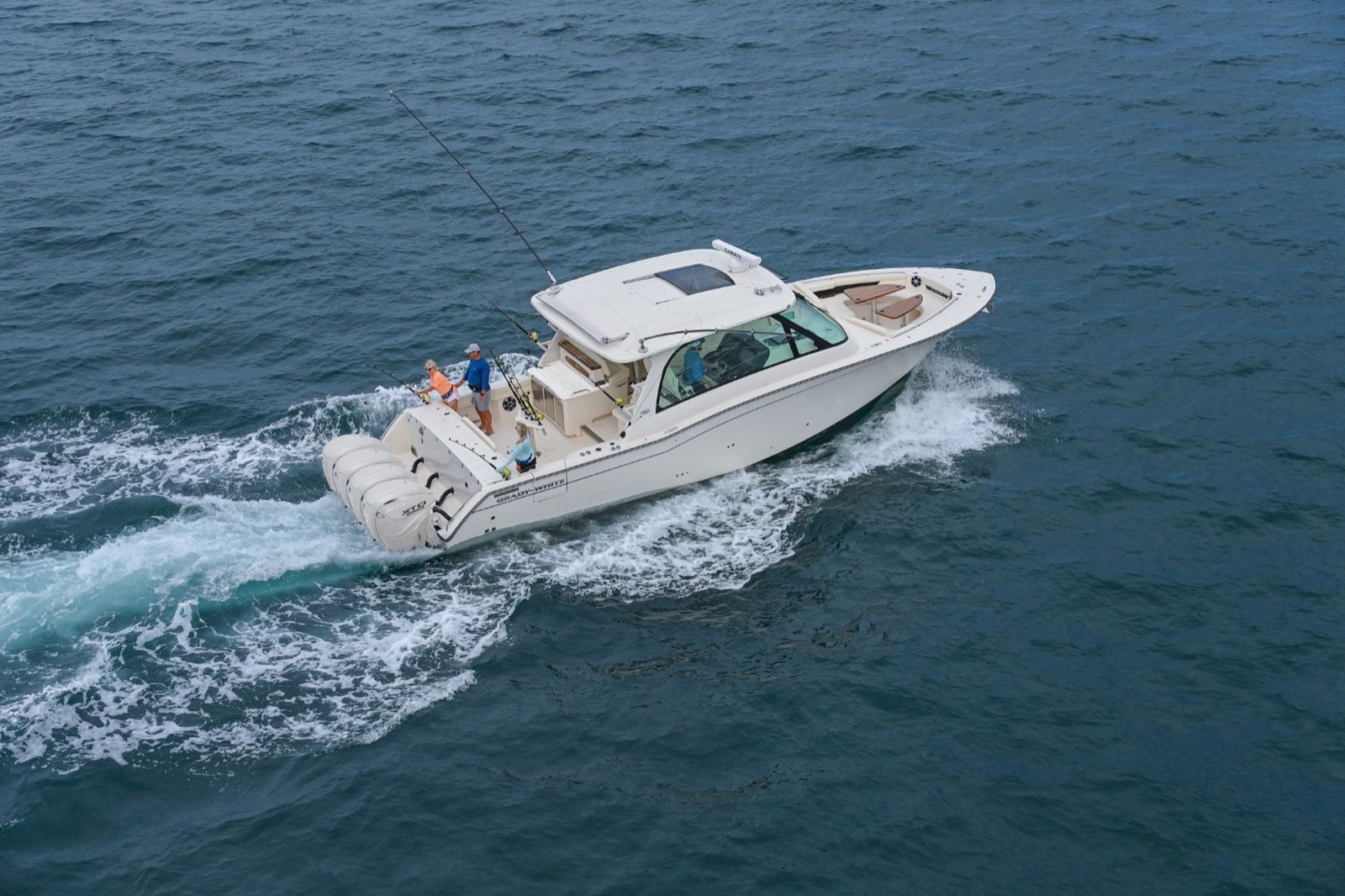
Grady-White Freedom 415

Grady-White Freedom 415

The verdict: Yes, Grady's flagship dual-console runs as both fishing platform and family cruiser

The Freedom 415 is what Grady built when buyers wanted a serious offshore platform that also walked into a marina without apology. Quad Yamaha XTOs on the transom, full-cabin layout with sleeping for four, an enclosed head with stand-up shower, and a SeaV2 hull that holds 4-foot chop at 30 knots without complaint. The trade is the price ceiling, the 415 asks flagship money in any year, and the four-engine fuel burn at WOT clears 80 gph. For owners running 100-plus offshore hours a season with a family aboard, the math is honest.

Build

★★★★★

Performance

★★★★★

Accommodations

★★★★★

Systems

★★★★★

Value

★★★★☆

Resale

★★★★★

Read the full breakdown

Build. Hand-laid fiberglass with Kevlar reinforcement at high-stress points. SeaV2 variable-deadrise hull. All-stainless hardware throughout. Vinyl, headliner, and cabin finish are flagship-tier with hardwood accents in the cabin.

Performance. Quad Yamaha XTO 425s give 60 mph top end with light load. Cruise at 32 knots holds 1.4 mpg combined. SeaV2 hull enters 4-foot seas without slap, runs dry helm at cruise.

Accommodations. Forward cabin sleeps two, settee converts for two more. Enclosed head with stand-up shower. Full galley with refrigerator and stove. Cockpit fits eight comfortably with two pedestal helm seats.

Systems. Triple Garmin GPSMap multifunction displays standard. Yamaha Helm Master EX joystick control. Lithium house bank with shore-power inverter. SeaKeeper-ready transom. Climate-controlled cabin.

Value. Premium-tier money for a flagship dual-console. Used at $720,000-820,000 for a 2022 hull is the strongest buy. New 2026 sticker pushes $1.4M with options, the secondary market hands the second buyer a meaningful gift.

Resale. Grady-White holds resale better than any builder in the segment. Five-year depreciation runs 22-26 percent on quad-rig hulls. The Freedom 415 specifically trades fast on the brokerage market because the layout and brand combination is rare.

What's included

Quad Yamaha XTO 425, triple Garmin GPSMap, Yamaha Helm Master EX joystick, lithium house bank, climate-controlled cabin, full galley, marine head with stand-up shower, hardtop with electronics box.

What costs extra

Tri-axle aluminum trailer (the 415 is dock-stored), SeaKeeper gyro, second helm station, premium audio upgrade, watermaker, full-cabin air conditioning expansion.

What works

  • SeaV2 hull holds 4-foot chop at 30 knots, segment-leading for the LOA
  • Quad Yamaha XTOs run cleaner than competing diesel inboards offshore
  • Full-cabin layout with stand-up shower, family cruising is real
  • Helm Master EX joystick docking eliminates the marina drama
  • Resale floor is the firmest in the dual-console offshore segment

What doesn't

  • Quad XTO fuel burn at WOT clears 80 gph combined
  • Sticker pushes flagship money even on late-model used hulls
  • Marine head and full galley add maintenance lines beyond a fishing platform

Best for

Offshore-fishing families. Owners running 100-plus hours a season including overnight trips. Cross-shoppers from express-cruiser segment who want outboard simplicity.

Not ideal for

Day-fishing-only owners, the cabin amenities are over-spec. Buyers watching fuel burn at WOT, four engines drink seriously.

Best year & trim to buy

2022 onward for the XTO 425 standard and the Helm Master EX. Verify outboard service records, XTO valve adjustments are on a 100-hour schedule.

Pricing, April 2026

New
$1,150,000–1,420,000 new
Used
$680,000–1,050,000 (2021–2024 hulls)
Read the full Grady-White Freedom 415 review →
2. Boston Whaler · 26-30ft · outboard-twin · premium

Boston Whaler 280 Outrage

Boston Whaler 280 Outrage

The verdict: Yes, the unsinkable hull is the brand argument and it lands at 28 feet

The 280 Outrage is the Whaler that ends the build-quality argument before the boat leaves the dock. Foam-injected unibody construction, twin Mercury Verado 300s on the transom, and a deep-V hull that holds 4-foot offshore chop at 28 knots without flinching. The trade is the sticker, Whaler asks 15-25 percent over equivalent length from any competitor, and the cockpit volume runs slightly under Robalo or Sea Hunt at the same LOA. For buyers who weight build and resale highest, the math works.

Build

★★★★★

Performance

★★★★★

Accommodations

★★★★☆

Systems

★★★★★

Value

★★★☆☆

Resale

★★★★★

Read the full breakdown

Build. Foam-injected unibody, the Whaler signature. All-stainless hardware. T-top with welded crossbars, no fiberglass tower fatigue. Vinyl quality is mid-premium, hardware grade is flagship.

Performance. Twin Mercury Verado 300s push the 280 to 56 mph top end. Cruise at 30 knots holds 1.7 mpg combined. 21 degree deadrise, enters 4-foot chop dry and stays dry through the run.

Accommodations. Enclosed head under console. Forward seating with cooler under the bow. Aft jump seats fold flat. Cockpit fits seven for fishing, six for cruising. No cabin, day-fishing primary.

Systems. Twin Garmin GPSMap multifunction displays. Mercury VesselView integration. SeaStar electric steering. JL Audio standard. Trim tabs with auto-adjust.

Value. Premium-tier money. The argument is build and resale, not initial dollars-per-feature. Used at $182,000-205,000 for a 2021 hull is the strongest buy because Whaler depreciation slows after year three.

Resale. Boston Whaler holds resale within 22-25 percent of new at five years. Brand recognition keeps inventory moving fast. Foam-unibody construction documented at 25-plus years still serviceable on owner threads.

What's included

Twin Mercury Verado 300, dual Garmin GPSMap, JL Audio, trim tabs, T-top with welded crossbars, enclosed head under console, livewell with recirculation, swim platform.

What costs extra

Trailer (tri-axle is a $9,000 line), tower upgrade, outriggers, full electronics package, premium audio upgrade.
What works

  • Foam-injected unibody is the unsinkable Whaler signature, no other builder matches
  • Twin Verado 300s give 56 mph top end with 30-knot cruise at 1.7 mpg
  • 21 degree deadrise enters 4-foot chop dry, dry helm at cruise
  • T-top with welded crossbars, no fiberglass tower fatigue at 1,000-plus hours
  • Resale floor is firm, brand demand keeps inventory moving

What doesn't

  • Sticker pushes 15-25 percent over equivalent Robalo or Sea Hunt at same LOA
  • Cockpit volume runs slightly under competitors, fishing space is real but not generous
  • No cabin, the boat is day-fishing primary and overnight is portable-head territory

Best for

Build-first offshore buyers planning 10-plus year holds. Saltwater coastal owners. Cross-shoppers from Robalo or Sea Hunt who can stretch budget for build and resale.

Not ideal for

Recency-first buyers, the budget-equivalent Robalo gets you 2 years newer. Owners needing cabin amenities, the 280 is day-fishing primary.

Best year & trim to buy

2021-2023 with the Verado 300s and the dual Garmin standard. Avoid pre-2019 hulls without Mercury VesselView integration.

Pricing, April 2026

New
$285,000–340,000 new
Used
$172,000–245,000 (2020–2023 hulls)
Read the full Boston Whaler 280 Outrage review →
3. Robalo · 22-24ft · outboard-single · mid

Robalo R230

Robalo R230

The verdict: Yes, the strongest mid-tier value pick in the segment

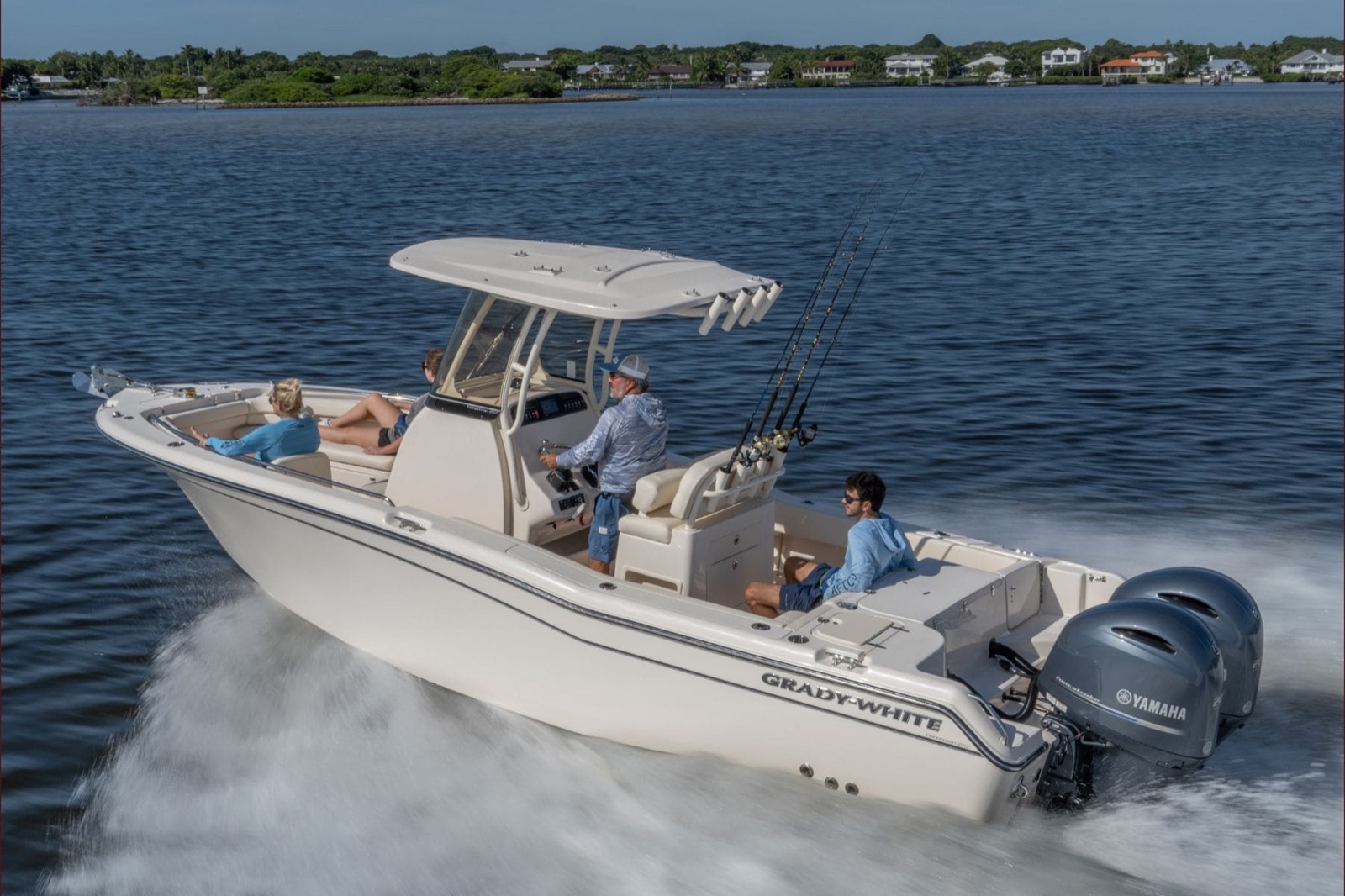
The R230 is the center console that proves you do not need flagship money to get a real fishing platform. A 23-foot deep-V with a Yamaha F250 outboard, a hardtop, dual livewells with recirculation, and a forward casting deck that legitimately fits two anglers. The build is honest, gelcoat quality runs comparable to Whaler at 80 percent of the price, and used at $58,000-68,000 for a 2021 hull is the buy that keeps showing up on owner sell-threads.

Build

★★★★☆

Performance

★★★★☆

Accommodations

★★★★☆

Systems

★★★★☆

Value

★★★★★

Resale

★★★★☆

Read the full breakdown

Build. Hand-laid fiberglass with composite stringer grid. Stainless hardware on visible mounts, plated hidden. Gelcoat quality runs 90 percent of Whaler. T-top is fiberglass with stainless support tubes.

Performance. Yamaha F250 pushes the R230 to 46 mph top end. Cruise at 28 knots holds 3.1 mpg. 22 degree deadrise, enters 3-foot chop with controlled spray.

Accommodations. Enclosed head under console. Forward casting deck with under-deck storage. Aft jump seats. Two pedestal seats at the helm. Cockpit fits five for fishing, four for cruising.

Systems. Garmin GPSMap chartplotter standard. JL Audio. Trim tabs. Single battery with switch standard, dual-battery upgrade is worth ordering.

Value. The strongest pure-value pick in the segment. Used at $58,000-68,000 for a 2021 hull is half the price of an equivalent Whaler with 85 percent of the build.

Resale. Robalo holds resale within 28-32 percent of new at five years. Brand demand on the Gulf Coast and Carolina markets supports inventory turnover. Three-year depreciation tracks Sea Hunt closely.

What's included

Yamaha F250 outboard, Garmin GPSMap, JL Audio, trim tabs, T-top with stainless tubes, enclosed head under console, dual livewells, forward casting deck.

What costs extra

Trailer (dual-axle is a $6,500 line), dual-battery switch upgrade, outriggers, premium audio upgrade, hardtop electronics box.

What works

  • Mid-tier price with build that runs 85-90 percent of Whaler at LOA
  • Yamaha F250 is the simplest single outboard in the segment to service
  • 22 degree deadrise enters 3-foot chop with controlled spray
  • Forward casting deck legitimately fits two anglers, fishing-first design
  • Used 2021 hulls at $58,000-68,000 are the strongest mid-tier value

What doesn't

  • Single battery standard, dual-battery upgrade is worth ordering
  • Gelcoat quality is 90 percent of Whaler, the 10 percent shows after year five
  • T-top is fiberglass, requires inspection at 5-year mark for hairline cracks at mount points

Best for

First-time center-console buyers. Saltwater bay-and-light-offshore households. Cross-shoppers from Whaler who want 85 percent of the build at half the price.

Not ideal for

Build-first owners planning 15-plus year holds, the 5-percent gap to Whaler compounds. Heavy offshore households running 4-foot chop regularly.

Best year & trim to buy

2020-2022 with the Yamaha F250 and Garmin standard. Avoid earlier hulls without the recirculating livewells.

Pricing, April 2026

New
$92,000–112,000 new
Used
$52,000–78,000 (2020–2023 hulls)
Read the full Robalo R230 review →
4. Scout · 22-24ft · outboard-single · mid

Scout 235 LXF

Scout 235 LXF

The verdict: Yes, the running surface is the segment standout for bay-plus-offshore use

Scout's 235 LXF is the bay-and-light-offshore boat that argues running surface is the most important spec on a center console under 25 feet. The N3 hull with bow flare and a stepped pad gives the 235 a holeshot under 4 seconds and a cruise at 32 knots that holds 3.4 mpg with the Yamaha F300. The trade is the brand premium, Scout asks 15 percent over Robalo at the same length, and the value argument runs through the running surface and the cockpit layout rather than the build per se.

Build

★★★★☆

Performance

★★★★★

Accommodations

★★★★☆

Systems

★★★★☆

Value

★★★★☆

Resale

★★★★☆

Read the full breakdown

Build. Hand-laid fiberglass with composite stringer grid. Stainless on visible mounts. Gelcoat quality runs 90 percent of Whaler. T-top is fiberglass with stainless support tubes.

Performance. Yamaha F300 gives the 235 a 53 mph top end. Cruise at 32 knots holds 3.4 mpg. N3 hull plus stepped pad gives 4-second holeshot, segment-leading for LOA.

Accommodations. Enclosed head under console. Forward casting deck. Aft jump seats. Two pedestal helm seats. Bow seating with cooler. Cockpit fits five for fishing, six for cruising.

Systems. Garmin GPSMap chartplotter. JL Audio. Trim tabs. Single battery with switch standard. Hardtop electronics box optional, recommended at this price.

Value. Mid-tier money for a bay-and-offshore platform with segment-leading running surface. Used at $74,000-84,000 for a 2021 hull is the value buy.

Resale. Scout holds resale within 26-30 percent of new at five years. Brand demand on the Southeast and Florida markets supports turnover. Three-year depreciation runs slightly tighter than Robalo.

What's included

Yamaha F300 outboard, Garmin GPSMap, JL Audio, trim tabs, T-top with stainless tubes, enclosed head under console, livewells, forward casting deck, bow seating with cooler.

What costs extra

Trailer (dual-axle is a $7,000 line), dual-battery switch upgrade, outriggers, hardtop electronics box, premium audio upgrade.

What works

  • N3 hull with stepped pad gives segment-leading 4-second holeshot
  • Cruise at 32 knots holds 3.4 mpg with the F300
  • Forward casting deck legitimately fits two anglers
  • Bow seating converts well to family-cruising mode
  • Resale tracks within 28 percent of new at five years

What doesn't

  • Brand premium is 15 percent over Robalo at same length
  • Single battery standard, dual-battery upgrade is worth ordering
  • T-top electronics box is optional, recommended at this price

Best for

Bay-and-light-offshore households. Owners cross-shopping Robalo who value the running surface upgrade. Florida and Carolina coastal buyers.

Not ideal for

Build-first owners cross-shopping Whaler, the gap is build not running surface. Heavy offshore households running 4-foot chop regularly.

Best year & trim to buy

2021-2023 with the F300 and Garmin standard. Verify N3 hull markings on the build plate, the stepped-pad hull is the configuration to target.

Pricing, April 2026

New
$118,000–142,000 new
Used
$68,000–96,000 (2020–2023 hulls)
Read the full Scout 235 LXF review →

How we picked

18 hulls in the 22-to-45-foot center-console window cleared our first-pass screen. We kept the four that show up consistently with clean service records, fair pricing on the secondary market, and known issues that are either solved or transparently priced into the listing. Cross-references included 600-plus owner posts on The Hull Truth, Boating Magazine reviews, and Sport Fishing Magazine offshore tests from the rolling 12 months.

Each boat scored on six dimensions: build (25%), performance (20%), accommodations (10%), systems (10%), value (15%), and resale (20%). Build and resale carry the heaviest weight because saltwater ownership cycles run 5-to-12 years and brand demand on the secondary market is a meaningful share of total cost. Performance is weighted next because hull behavior in 3-to-4-foot offshore chop separates real platforms from large bay boats.

Outboard service intervals (Yamaha F300 and Mercury Verado 300 both run 100-hour schedules), salt-water flush discipline, and Helm Master EX or Mercury Joystick health are documented hot spots that affected our year-range guidance. Quarterly refresh, next revision due August 2026.

What people actually ask

How many engines do I need offshore?

Twin outboards are the practical floor for any boat over 24 feet running 20-plus miles offshore. Single outboard packages are fine for bay-and-light-offshore use but the get-home redundancy argument lands hard the first time you have a fuel-pump failure 18 miles out. Quad-rig packages on 36-plus feet trade fuel burn for redundancy and cruise speed in serious chop.

What does ownership actually cost per year?

Outboard service every 100 hours runs $400-700 per engine. Annual hull wash and bottom paint $400-1,500 for saltwater. Storage $1,800-6,000 depending on length and region. Insurance $800-3,500 for hull values $50,000-300,000. Salt-flushing discipline after every saltwater run extends Yamaha and Mercury outboard life from 1,500 to 2,500-plus hours documented on owner threads.

Bay boat or offshore center console?

Bay boats prioritize shallow draft (12-18 inches), wide forward decks, and trolling-motor mounts. Offshore center consoles prioritize freeboard, deadrise (22-plus degrees), and bow flare for 3-foot chop. The crossover is real on 22-to-24-foot boats like the Scout 235 LXF that run both inshore and 10-15 miles out. Anything past 25 miles offshore wants 22-degree deadrise minimum.

Best resale on this list?

Boston Whaler 280 Outrage first, holds within 22 percent of new at five years. Grady-White Freedom 415 second, brand recognition on the brokerage market keeps inventory moving fast. Scout 235 LXF third, running surface and Florida-market demand support turnover. Robalo trails by 5 percent on three-year depreciation but offers the best initial value.

Should I get a survey?

Yes on any saltwater hull over 4 years old, anything with over 600 hours, and any twin or quad outboard package. Survey runs $600-1,400 depending on length and catches stringer-grid integrity, transom moisture, outboard compression, fuel-system corrosion, and electrical-system salt damage. On a $150,000 hull a survey is under 1 percent of purchase and prevents $15,000-30,000 surprises.

Weekly

Get one honest boat review a week

One boat we ran, one guide worth reading, one model we'd shop next week. No press-release rewrites. Unsubscribe any time.