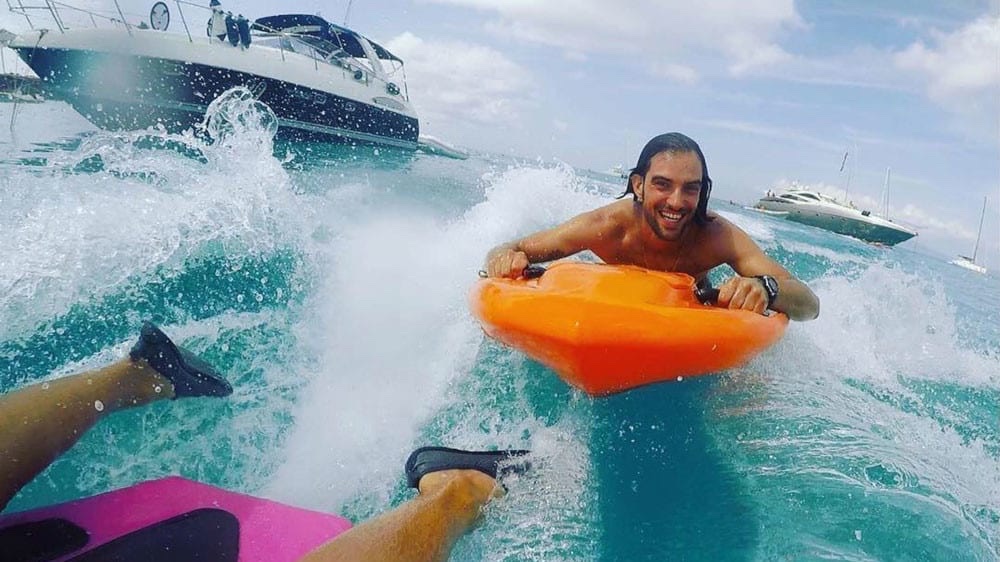
The ASAP Watercraft Sumo is the body board the rest of the category gets compared to when the rider is over 100 kg or there is a snorkeler in the water expecting a tow. ASAP has been building jet body boards for a decade out of a small workshop, and the Sumo is the model that solved the bigger-rider problem nobody else was solving.
What is the ASAP Watercraft Sumo?
The Sumo is a prone-position electric jet body board with a deliberately wider hull and a rear-mounted tow handle. Length is 5 feet 7 inches, beam is just over 2 feet, weight is around 35 kg. The hull is composite with a foam core, finished to a mid-tier standard, not the carbon-laminated laydown a Seabob F5 SR gets at the Cayago plant. The drive is an electric jet pump powered by a 1.3 kWh lithium battery. Top end is around 19 km/h, ride time is 25 to 45 minutes depending on rider weight and throttle use.
The thing that sets the Sumo apart on paper is the displacement. A heavier rider, say 105 to 115 kg, sits higher in the water on a Sumo than on a Cayago F5 of similar length, because there is more hull volume under the chest. The practical effect is that the unit planes earlier and does not push water up the deck onto the rider's face the way a slimmer board does at the same weight. The wider stance also makes balance easier for first-time riders, which matters more than performance buyers admit.
The rear tow handle is the other distinguishing feature. A snorkeler grabs the handle, the rider on the board pulls, and the snorkeler covers reef ground at a couple of knots without kicking. The Sumo is not dive-rated like the F5 SR, so the tow-pull is a surface use case rather than a depth one, but for snorkeling and surface dive work the integrated handle is the cleanest factory solution in the category.
Who is it good for?
The first buyer is the heavier rider. We watched a 115 kg rider get on a Sumo at a Bali test session one winter morning and ride it cleanly within five minutes. The same rider had tried a slimmer Cayago F5 earlier that week and spent most of the session plowing the nose. Displacement is what fixes that, and the Sumo is the only credible answer in the category for that body size.
The second buyer is the dive or snorkel operator using the tow-pull use case. A rider on the board pulling a snorkeler at 3 to 5 knots covers more reef in an hour than a swimmer would in three. The integrated rear handle is the right setup, no aftermarket strap fix needed.
The third buyer is the yacht crew that wants one body board to fit every guest. The Sumo's wider hull and higher displacement mean a smaller rider can still ride it without it feeling too floaty, while a larger rider can ride it without nose-plowing. That body-type tolerance is what makes it useful as a one-board solution on a charter.
Who is it not good for?
Riders under 75 kg should look at a slimmer Cayago. The Sumo is not unpleasant for lighter riders, it just gives up the agility a slimmer hull has. A light rider on a Sumo feels like a small driver in a full-size truck. It works, it is not optimal.
Buyers who care about transport weight should also walk past. At 35 kg, the Sumo is the heaviest credible unit in the category, and carrying it any distance without a wheeled cart will get tiring fast. Yacht crews handle this with a deck rack, but a private owner moving the unit between a garage and a dock will feel it.
Buyers chasing the highest top speed need a different unit. The F5 SR is faster, the Sumo is not the speed answer.
Pricing
New 2026 Sumo units sit between $11,990 and $14,490 depending on the battery configuration and the accessory bundle. The dealer network is concentrated in the US with a few European partners, and shipping is typically included on home orders within the US.
The used market for 2022 to 2024 Sumo units sits between $7,800 and $11,000. The resale curve holds within a few points of Cayago's, which makes the used trade more rational than the budget tier. The depreciation reality is closer to 25 percent over three years on a clean unit with a healthy battery, which is competitive with the segment.
What works
- Wider hull and higher displacement carry 100 kg-plus riders without nose-plowing.
- Rear tow handle is factory-installed, no aftermarket strap retrofit needed.
- About $12,000 entry is competitive with the Cayago F5 base trim.
- 1.3 kWh battery delivers an honest 25 to 45 minute session window.
- Stable platform for first-time riders learning balance.
- Resale curve sits within a few points of Cayago's at three years.
What does not
- Heavier at 35 kg than a Cayago F5, transport without a cart is real work.
- Top end around 19 km/h is below the F5 SR for performance riders.
- Not dive-rated, the tow-pull is a surface use case only.
- Service network outside the US and a few European hubs is thin.
- Resale is 8 to 10 points behind the F5 SR at three years.
- Mid-tier finish, not the hand-laid Cayago aesthetic.
Year-by-year notes
The Sumo line in current form arrived in 2021 with the wider hull and the integrated tow handle. The 2022 update brought the current 1.3 kWh battery pack and a firmware revision that smoothed the throttle response. The 2024 update upgraded the tow handle attachment with a reinforced mount that resolved an early-production wear point. No defect cutover year that needs broad screening, but verify the rear seal and the pump intake on any used unit, because both are the parts owner reports flag most.
Cost of ownership
Annual costs are lower than a petrol motorized board and slightly under the Cayago tier. The battery is the largest recurring line, with a replacement pack in the low four figures from the factory or distributor. The seal kit on the rear access plate and the pump intake grate are seasonal-service items, and an owner can change them with basic tools or pay the distributor to do it.
Charging is cheap, household outlet is fine, and a fast charger is available as an option that gets the pack back to full in under three hours. Transport is the practical cost. A wheeled cart and a foam-lined garage rack are not optional purchases if the unit is going to live anywhere other than next to the water.
We saw a Sumo come out of a dealer service bay at a Florida shop one fall afternoon after a pump-intake clean. The labor was minimal, the cost was reasonable, and the unit was back in saltwater by the next morning. The point is the work itself is simple, the question is whether you live close enough to a service shop that can do it.
Best year and trim to buy
A 2022 or later Sumo with the current 1.3 kWh battery and the reinforced 2024 tow handle attachment is the right buy in 2026. Verify three things. First, the rear seal looks fresh and there is no visible salt staining around the access plate. Second, the pump intake grate is clean and the impeller spins freely. Third, the battery cycle count is reasonable for the model year, which the distributor can pull off the service report.
How the Sumo fits a typical use case
A heavier rider's first session on a Sumo usually clarifies the value proposition within ten minutes. The unit planes earlier, the nose stays up, and the rider can lean into a turn without feeling like they are about to bury the front. We watched a 110 kg rider take a Sumo out at a Florida launch one warm October afternoon, and the difference against the slimmer Cayago F5 he had tried the previous month was immediate. The hull volume is what fixes the larger-rider problem, and the Sumo is the only credible answer for that body type.
For yacht crews, the Sumo's flexibility across rider sizes is the practical advantage. A charter party arrives, guests range from 60 kg to 110 kg, and the same board fits everyone with no awkward conversations at the swim platform. That single-unit flexibility is worth more than the spec sheet suggests, and it is why ASAP has built a real position in the yacht-toy market against the Cayago premium.
The tow-pull use case is the second practical detail. A snorkeler grabs the integrated rear handle, the rider pulls them along a reef edge or a sandbar at 3 to 5 knots, and the snorkeler covers ground without kicking. Operators who have built this into their guest experience report that the integrated handle is meaningfully better than the aftermarket strap solutions on other boards, because the mount geometry is designed for the load.
Alternatives
The category reference is the Seabob F5 SR, faster and with the 40 meter dive rating, but worse for larger riders. The closest cross-shop on price is the Cayago Seabob F5 base trim, slimmer hull and the hand-laid German finish. For casual or budget buyers, the Kymera Body Board sits at a third the cost with the understanding that build and resale are a tier below.