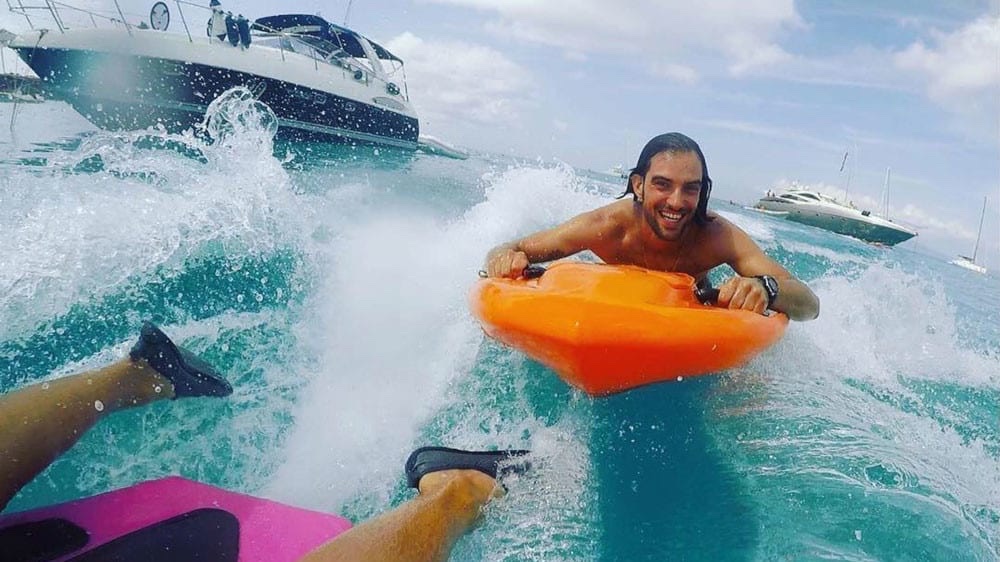
The Seabob F5 SR is the boat-toy other yacht crews compare every new body board to. Cayago has been hand-laying the Seabob line out of Germany since the early 2000s, and the SR sits at the top of the F5 family. It is the unit you see racked on the swim platforms of 80-foot motoryachts in St Tropez, and it is the only product in the category with a factory dive rating that lets a guest take it down to look at a reef without the owner worrying about the depth.
What is the Seabob F5 SR?
The F5 SR is a prone-position jet body board, which means you lie on it and steer with body weight while a thumb or finger throttle controls the jet pump. Length is about 5 feet 4 inches, beam is just under 2 feet, weight is around 35 kg before you add the battery handle. The hull is carbon-fiber-reinforced fiberglass with a foam core, finished by hand at the Cayago plant outside Stuttgart. The drive is the company's own E-Jet Power System, an electric pump with neutral-buoyancy tuning so the unit floats at rest rather than tipping nose-down.
The battery is the 1.4 kWh pack that ships with the SR. Ride time is between 30 and 60 minutes depending on which of the seven speed steps you ride in. Top end is around 21 km/h. The control is the Piezo throttle, a pair of finger-press pads in the handles that read pressure rather than travel. New riders pick it up inside a session.
The thing that separates the SR from the base F5 is the 40 meter factory dive rating. Most jet body boards are surface toys. The SR is rated to take a snorkeler or a diver down to recreational scuba depth without the seal kit giving up. That rating is the reason the SR shows up on dive-operator inventories and on the swim platforms of yachts that actually use a tender for diving rather than just for towing wakeboards.
Who is it good for?
The first buyer is the yacht owner with a swim platform and a fleet of toys. The SR sits next to a Fliteboard 4 or a Lift5, gets used by guests, and the build holds up to a season of charter use where a cheaper board would not. We watched the inventory rotation on a Cayago-stocked motoryacht in Antibes one June afternoon, and the SR units were the ones the crew said they replaced least often. The carbon-laminated hull and the sealed Piezo control are the parts that survive guest abuse.
The second buyer is the dive operator. The tow-pull use case is what the 40 meter rating is for. A snorkeler holds the rear strap, the rider on the board pulls them along a reef edge at 6 to 10 km/h, and the snorkeler covers more ground than they would kicking. Liveaboards in places like Komodo and the Red Sea have been using SRs for this for a few seasons now. The neutral-buoyancy tuning is what makes it work, the unit does not pitch when a second person is hanging off the back.
The third buyer is the private owner with a private dock who genuinely uses the toy. A few sessions a week on a Mediterranean home water or off a Naples Florida dock will run the battery hard, and the SR is the unit built for that frequency.
Who is it not good for?
Casual lake riders should walk past. If the unit is going to get five or ten sessions a year out of a vacation rental or a second-home cabin, the Cayago F5 base or even a Kymera Body Board will do the same job at a fraction of the cost. The SR's build, dive rating, and battery refinement are wasted on light use.
Riders over 110 kg should also look elsewhere. The SR carries weight, but the hull is sized for a 70 to 95 kg rider and starts plowing the nose past that. The ASAP Watercraft Sumo is the right answer for larger riders, with more displacement and a wider footprint.
Anyone wanting a sit-on or stand-up alternative needs a different category. The SR is prone-position only. A jet ski or a stand-up jetboard does a different job.
Pricing
New 2026 SR units sit between $18,990 and $22,490 at the dealer depending on the battery pack ordered and the spare-pack accessory bundle. A second battery is a real line item if you want back-to-back sessions, and it is not cheap. The dealer network handles delivery and a hand-over walk-through, which is part of what the price includes.
The used market for 2022 to 2024 SR units sits between $12,500 and $17,500 in 2026 listings. Older F5 generations from before the seven-step Piezo introduction trade for less but the control feel is meaningfully different. Resale across the SR is 8 to 12 points stronger than the base F5 or a Hadoco at three years, which is why secondhand SR inventory is thin most months. The boat holds its price because the yacht-tender market keeps pulling units off the secondary listings.
What works
- The 40 meter factory dive rating is unique in 2026 and it is genuine, not a marketing line.
- Piezo finger-press throttle reads pressure rather than travel, the response is smooth and intuitive.
- Neutral-buoyancy tuning means the unit floats level at rest, so a tow-pull rider can grab the back without dipping the nose.
- Hand-laid German build with carbon-reinforced laminate finishes that survive saltwater seasons.
- The seven speed steps cover a real beginner setting at the bottom and a usable cruise at the top.
- Quiet at cruise, the unit does not blow out a quiet anchorage the way a petrol jetboard does.
- Resale curve is the flattest in the category for the first three years.
What does not
- About $19,000 entry is the segment's high mark, and the spare battery is extra.
- The 1.4 kWh pack is small compared to a Radinn or an Awake stand-up jetboard in the same price band.
- Prone-position only, no sit-on or stand-up option.
- US service network is thin outside a few coastal hubs, parts can take a week or two.
- The carry case is fine for short transport but a hard travel case is a separate purchase if you fly with the unit.
- Battery replacement at end of life is a real cost item to plan for.
Year-by-year notes
The F5 generation as we know it landed in 2018 and the SR variant with the higher-output motor came shortly after. The seven-step Piezo control reached its current form across the 2021 to 2022 model years, and the current 1.4 kWh battery pack is the one shipping from late 2022 onward. The neutral-buoyancy tuning was refined on the 2023 update. Pre-2021 SR units still work fine if the battery has been replaced, but the control feel on the older Piezo software is not as crisp. There is no defect cutover year that buyers need to screen for, but the seal kit on the rear access plate is the part that ages, and any used unit should have it replaced or inspected before the first season.
Cost of ownership
The SR has fewer recurring lines than a petrol jetboard, but they are not nothing. The battery is the largest line item. A pack holds usable capacity for several hundred cycles, and a replacement runs into four figures when you order through a dealer. The seal kit on the rear access plate wants replacement every season or two depending on use, and the dealer charges a few hundred dollars for the service. Charging is cheap, a full pack costs pennies on a US household tariff.
Storage and transport are where the practical costs hide. The SR is too heavy to carry far without a cart, and most owners build a wheeled rack into the garage or the yacht crew quarters. A protective cover for the unit while it sits on a swim platform is worth the money, gelcoat scratches add up.
We watched a Cayago-trained tech service two F5 SRs side by side at a Mediterranean dealer one afternoon. The seal kit replacement on each was under twenty minutes once the unit was on the bench. The labor cost is not the issue. The issue is getting the unit to a Cayago-trained tech, because a non-Cayago service shop will not touch the seal kit or the Piezo control without voiding the warranty.
Best year and trim to buy
A 2022 or later F5 SR with the seven-step Piezo control and the current 1.4 kWh battery is the right buy in 2026. Verify three things at handover. First, the battery cycle count, which the dealer can pull off the service report. A unit with under 100 cycles still has its prime years ahead. Second, the seal kit on the rear access plate. If it has not been changed in the last season, plan to do it before first use. Third, the warranty paperwork, because Cayago's coverage is one of the things the resale market values, and a transfer needs the dealer signature.
If you genuinely do not need the dive rating, walk down to the Cayago Seabob F5 base trim and save the $5,000. The build is the same, the control is the same, the only thing you give up is the depth rating most riders never use.
Alternatives
The closest in-house cross-shop is the Cayago Seabob F5 base trim, the same build at a lower top end and without the 40 meter dive rating. The closest competitor outside Cayago is the Hadoco T-One, with a German build and a similar price band, but Hadoco does not have the dive rating or the swim-platform installed base. For larger riders the ASAP Watercraft Sumo carries weight better and adds a tow handle the F5 SR does not. Budget buyers looking to try the category at a fraction of the cost should walk to the Kymera Body Board, with the understanding that the build, the battery, and the resale curve all sit a tier below.