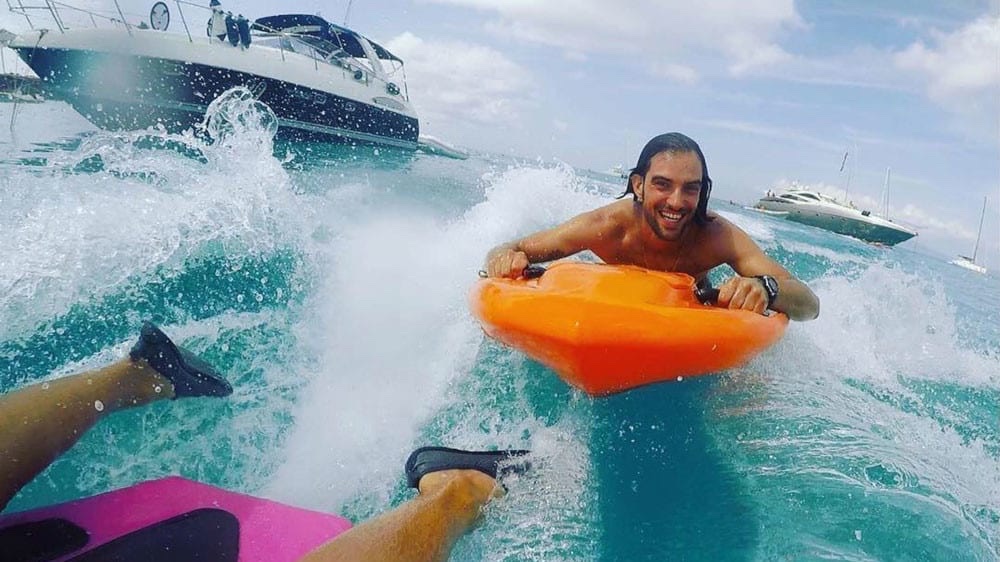
The Cayago Seabob F5 is the entry trim of the same product line as the F5 SR. Cayago has been building powered watersleds in Germany since 2006, and the F5 chassis has carried the brand's mainstream line since 2018. It sits in our jet body board guide because the build, the Piezo throttle, and the ergonomics are the same as the SR, and the $5,000 saved at the dealer is real money on a unit that most owners use inside the surface-recreation envelope anyway.
What is the Cayago Seabob F5?
The F5 is a 4-foot 5-inch electric watersled, 1 foot 7 inches wide, weighing roughly 65 pounds out of the water without the battery, and slightly more with the 1.2 kWh battery installed. The hull is carbon fiber, hand-laid in Cayago's Aukrug plant, the propulsion is a single brushless electric jet drive in the underbody, and the throttle and direction control sits in two Piezo buttons under each thumb at the grips. Top speed is 17 kilometers per hour, run time is roughly 60 minutes at mixed-throttle recreation use, and the unit is factory-rated for surface and shallow snorkel-tow use.
The Piezo control system is the part that makes the boat. Two pressure-sensitive buttons under each thumb, no triggers to pull, no levers to fight. New riders typically figure out the throttle and direction inside 30 seconds of putting their hands on the grips. I handed one to a friend at a marina in Naples one April afternoon, and inside two minutes he was making coordinated turns at half-throttle. That is the spec the brand sells.
The hull and the deck graphics are configurable at the factory across roughly 30 colorways, which is part of how Cayago sells the unit to yacht buyers picking matching units for a tender fleet. The battery is removable for charging or storage, the charger uses a marine-grade locking connector, and the unit fits in most 40-plus-foot motoryacht tender garages or lazarettes without modification.
Who is it good for?
Surface-recreation buyers who want the Cayago build and ergonomics without paying for dive certification are the core buyer. The 17 km/h top speed is plenty for surface fun, the 60-minute run time covers most single-session use, and the snorkel-tow at shallow depth handles the most common reef-and-beach use case. For an owner who wants the brand and the ride feel and does not plan to tow at depth, the F5 base is the right buy at the dealer.
Yacht owners adding a second or third unit to a tender fleet are the second profile. The Cayago line is a yacht-toy staple in the 40-plus-foot motoryacht segment, and many owners specify a single F5 SR for the primary user and one or two F5 base units for guests. The shared chassis means the same dealer service network covers the whole fleet, and the lower entry price on the F5 base makes the multi-unit math more reasonable. I watched a yard hand on a 55-foot motoryacht in Palm Beach pull two units out of the lazarette one morning, an F5 SR and an F5 base, and operate both off the same charging dock without any reconfiguration.
Single-unit rental fleets and resort beach clubs are the third buyer. Insurance and operator-liability factors push most commercial fleets toward the lower-speed unit, and the F5 base hits the sweet spot of brand recognition, build quality, and lower top-end speed for staff-supervised rental use.
Who is it not good for?
Dive operators or owners who tow at depth should walk to the F5 SR. The base unit is not factory-certified for the dive-tow case, the battery and seal package on the SR is the one that supports that operating envelope. For the price premium, the SR is the right buy for that use case.
Performance riders chasing top-end speed are the second exclusion. The 17 km/h ceiling on the F5 base is 4 km/h below the SR, and a side-by-side run makes the difference obvious. For an owner who plans to push the unit at full throttle most of the time, the SR is the right premium to pay.
Buyers who care about the GPS overlay and route logging on the dash should also pay for the SR. The F5 base does not carry the route-logging system, and for an owner who wants to share route data through the Cayago app or log dive-tow patterns, the SR is the unit with the right systems.
Pricing
New 2026 pricing on the F5 base in standard configurations is roughly $13,490 to $15,990 depending on hull and deck colorway, accessory package (charging dock, transport case, extra battery), and dealer location. The most common build, factory white hull with the standard charging dock and a single battery, lands near $14,500 at most US and European dealers.
The used market in 2026 spans roughly $8,800 at the bottom (2018 to 2020 units with high hours and the original battery near end of cycle life) to $12,500 at the top (2023 to 2024 units with under 30 hours and the factory battery inside warranty). The sweet spot is a 2023 or 2024 unit at $9,500 to $11,500 with documented service history. Battery replacement is the line item that drives used pricing, a new 1.2 kWh factory battery runs $2,800 to $3,400 at the dealer, and a unit needing one is worth that much less.
Depreciation on the F5 base is roughly 25 to 35 percent in the first three years, then flatter, which keeps the three-year ownership math credible. The unit holds value better than the lower-tier electric body-boards in the segment, partly because the Cayago dealer service network keeps the supply of serviced units moving.
What works
- Same German Cayago build, hull tooling, and Piezo controls as the F5 SR at $5,000 below the SR
- Carbon-fiber hand-laid hull, segment-shared finish quality and durability
- Piezo throttle and direction control are intuitive inside 30 seconds, segment-best ergonomics for first-time riders
- Surface-recreation envelope fully covered, snorkel-tow at shallow depth works as designed
- Battery removable for charging and storage, marine-grade locking connector
- Resale curve strong enough to keep a three-year ownership cycle credible
- Factory colorway program lets yacht owners spec matching units across a tender fleet
- 60-minute run time at mixed-throttle recreation use, the practical session length most buyers want
What doesn't
- 17 km/h top speed is 4 km/h below the F5 SR, performance riders notice on a side-by-side run
- No factory dive-tow certification, the operating envelope is surface and shallow snorkel only
- No GPS overlay or route logging on the dash, that capability sits on the SR
- Battery service is dealer-only, the Cayago network is dense in Europe and the US but thinner in the Pacific Islands and the Indian Ocean
- Charging brick is bulkier than the package suggests, plan yacht storage accordingly
- Replacement battery at $2,800 to $3,400 is a meaningful line item at end of cycle life
- 1.2 kWh battery is 0.2 kWh below the SR, run-time difference under full-throttle use is noticeable
Year-by-year notes
The F5 chassis has been in production since 2018 with the same hull tooling, the same Piezo control philosophy, and the same propulsion architecture throughout. Battery cells have been refreshed twice during the run, the 2021 and 2024 model years carry the most current cell chemistry. The Piezo control buttons were revised on 2022 units for better cold-water tactile feedback. The factory colorway program expanded in 2022 and again in 2024 with new finishes.
There is no defect cutover year on the F5 base worth screening for. The recurring items in what owners report are the original 2018 to 2020 batteries reaching end of cycle life now and needing replacement, occasional Piezo button replacement on older units (a 30-minute dealer service), and the charging dock connector showing wear on units that lived on yacht charging racks with frequent connect-disconnect cycles.
Cost of ownership
Annual costs on an F5 base used 30 to 50 hours a year are modest by yacht-toy standards. Annual dealer service is $300 to $500 for inspection, seal check, and software update. Battery replacement at end of cycle life is $2,800 to $3,400, with cycle life of roughly 400 to 600 charge cycles depending on storage and use pattern. Insurance is rarely a separate line item, most units are covered under the yacht or homeowner policy. Storage is a non-line for yacht owners and a small line for shore-based owners.
A three-year hold on a 2026 used F5 base bought at $10,500, used 40 hours a year, ends at roughly $1,800 to $3,000 a year all-in including service and amortized capital cost. The resale at year three sits inside 20 to 30 percent of the buy on a clean unit with documented service.
Best year and trim to buy
A 2023 or 2024 F5 base at $9,500 to $11,500 with under 30 hours of run time and a factory battery inside its warranty window is the right buy in 2026. The 2024 model carries the most recent battery cell chemistry and the longest expected cycle life from purchase. The 2023 unit costs slightly less and is a reasonable buy if the seller can document storage conditions and charge cycle count.
Five things to verify pre-purchase. First, the battery has been stored and cycled to manufacturer guidance and is inside its warranty window. Second, the Piezo control buttons respond crisply across the full range with no dead zones. Third, the hull shows no impact damage at the nose or the stern, both are pickup points that catch dings on improperly stored units. Fourth, the charging dock and connector are clean and unmodified. Fifth, the unit has a documented dealer service history, the Cayago service file is what supports resale.
Alternatives
The closest cross-shop is the Seabob F5 SR, which is the same chassis at the top trim with 4 km/h more top speed, a 1.4 kWh battery, factory dive-tow certification, and GPS route logging at a $5,000 premium. For buyers stepping down to a less expensive electric body-board, the Kymera body board trades the Cayago build, ergonomics, and resale for a materially lower entry price. As a performance cross-shop in roughly the same money, the ASAP Watercraft Sumo gives a different ride character with stronger emphasis on towing capacity and surface-recreation duty.