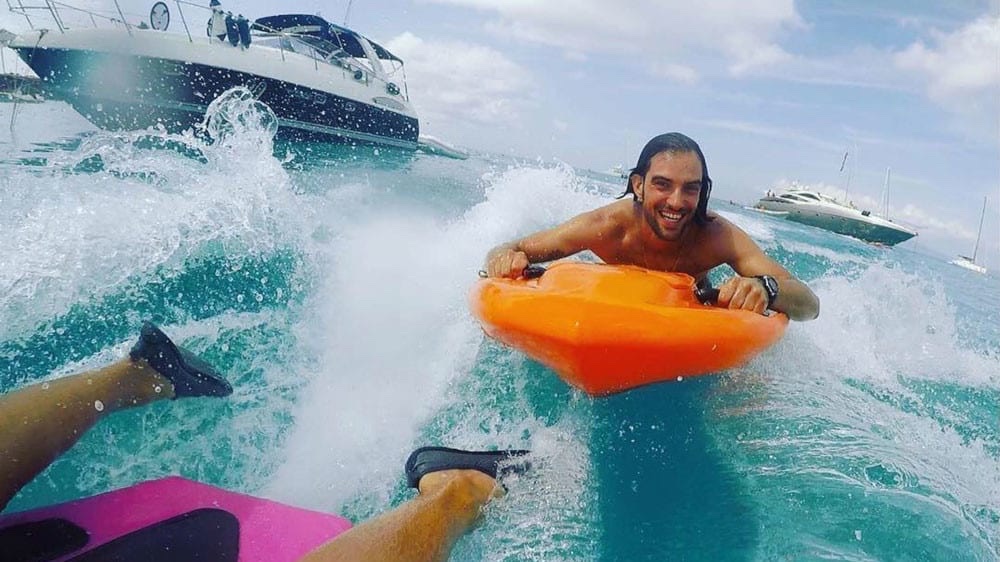
The Kymera Body Board is the boat-toy that makes the jet body board category accessible without writing a five-figure check. It is not a Cayago, it is not built like one, and it does not pretend to be. What it is is a reasonable way for a family with a lake cabin or a second home on Lake of the Ozarks to try the segment and decide whether the bigger-money toy is worth it later.
What is the Kymera Body Board?
The Kymera is a prone-position electric body board. You lie on it, steer with body weight, and run the jet pump with a thumb throttle on the handle. Length is 5 feet, beam is under 2 feet, weight is about 22 kg. The hull is a glass-reinforced composite with a foam core, not the carbon-laminated laydown that a Seabob F5 SR gets at the Cayago plant in Germany. The drive is an electric jet pump powered by a 0.7 kWh lithium battery. Top end is around 12 km/h, ride time is 25 to 45 minutes depending on rider weight and how much full throttle you ask for.
The control set is simple. A thumb throttle on each handle, a power switch on the deck, and a mode toggle that drops the top end to 6 km/h for kids and first-time riders. The slow mode is the feature parents will use most. It is the difference between a unit a 9-year-old can try safely and a unit you would not hand them. Charging is a household outlet, no special infrastructure.
Who is it good for?
The first buyer is the casual lake family. A few sessions a weekend in summer, kids cycling through with adult supervision, no one trying to set a Strava record. We watched a Kymera get passed around a swim raft on a Tennessee lake one July afternoon, with three kids and two parents taking turns over about two hours. The unit charged on shore power between sessions and the family was on their second weekend of ownership. That is the right use case.
The second buyer is the second-home owner who wants the toy to be there when guests show up. Five to ten sessions a season, casual use, the boat does not need to perform like an SR because nobody is asking it to. The math works because $4,000 is what a single bellows replacement costs on a sterndrive cabin cruiser, and the family gets more direct fun out of it.
The third buyer is the rider who wants to try the category before committing. A used Kymera at $2,500 is cheaper than renting an F5 SR for a week at most charter operations, and you can sell it on at the end of the summer if the category is not for you.
Who is it not good for?
Performance riders should walk past. The 12 km/h top end is a problem if you have spent any time on a Cayago or a Hadoco T-One. The Kymera is not slow in a useful sense, it is just slow, and the riding feel reflects that.
Anyone planning to ride twenty-plus times a year should also look up the tier. Owner reports converge on the same observation: the rear seal and the throttle handles are the parts that age out first, and a heavy-use season ends with a service call. For a buyer that committed, the Cayago F5 base will pay for itself in build longevity inside three seasons.
Charter operators or yacht crews running heavy duty cycles need the premium-tier build. The Kymera is not designed for the hands of fifty different guests a season.
Pricing
New 2026 Kymera units sit between $3,990 and $5,490 depending on the battery option and the carry case bundle. The dealer network is thinner than Cayago's, most US sales go through a single distributor and a small set of retail partners. Shipping is included on most home orders, and the unit shows up ready to charge.
The used market for 2022 to 2024 units sits between $2,200 and $3,800. The depreciation curve is the category's steepest, which works against you if you sell but works for you if you buy used. A 2023 unit at $2,800 with a battery that still holds reasonable cycle count is the value buy. Verify the rear seal and the throttle handles before paying.
What works
- Under $5,000 entry is the category's lowest credible price.
- Slow mode caps top end at 6 km/h, the right setting for kids.
- Light enough at 22 kg to carry to the water without a cart.
- Casual five to ten session per year use is what the unit was built for.
- Household outlet charging, no special infrastructure on the home side.
- Replacement battery is cheaper than two trips to a Cayago dealer.
What does not
- Top end around 12 km/h is meaningfully slower than premium options.
- Build durability past 80 hours of use is the category's weakest, owner accounts converge on this.
- Resale curve drops faster than the premium tier, trade-up math is rough.
- US service outside the central distributor is thin, mail-in is common.
- 0.7 kWh battery gives short session length, plan for charging breaks.
- The carry handle is mounted to take rider weight at speed, not for hauling across a long dock without a cart.
Year-by-year notes
The current Kymera generation arrived in 2022 with a cleaner pump assembly than the original board. The 2023 update tightened the rear seal kit, which was the part owners complained about most on the first generation. The 2024 unit added the slow mode firmware as standard rather than a separate purchase. There is no major defect cutover, but anything from before 2022 is a different unit and should be priced as such. Verify the battery cycle count and the firmware version before any used purchase.
Cost of ownership
Annual costs are lower than any premium body board, which is most of the point. The battery is the line that matters most. A pack holds usable capacity for several hundred cycles, and replacement is in the low four figures. The seal kit on the rear access plate is the second line, and owners can change it themselves with a basic tool kit if the unit is out of warranty. Charging cost is negligible.
Transport and storage are where casual owners stumble. The unit is not delicate, but it is not military grade either. A protective bag or a foam-lined garage rack will keep gelcoat from getting beaten up across a season. Saltwater use needs a freshwater rinse on every recovery, and the throttle handle area benefits from a wipe-down after each session.
Best year and trim to buy
A 2023 or 2024 Kymera with the current rear seal kit and a battery under 150 cycles is the right buy in 2026. Verify three things at purchase. First, the rear seal looks fresh and there is no visible water staining around the access plate. Second, the throttle handles work cleanly without sticking, because that is the second-most-common failure. Third, the battery is the one the unit shipped with, because owner-replaced packs are not always genuine and some have caused range complaints.
If a 2026 Kymera makes financial sense, it is for a buyer who has already decided that the boat-toy use case fits a casual five-to-ten-session year. For anything more, take the $4,000 and put it toward a used Cayago Seabob F5 base trim.
How the Kymera fits a typical season
A casual buyer's first season usually goes the same way. The board arrives, the family charges it overnight, the kids try it for the first time on a calm Saturday with the slow mode engaged, and an adult takes a turn at standard mode that afternoon. Across the rest of the summer, the unit comes out for guests, for cookouts, and for the occasional weekend ride before dinner. By season two the family knows whether the toy is going to stick or whether it sits in the garage most weekends.
We watched a family at a Lake of the Ozarks dock cycle a Kymera through six kids and two adults over an afternoon, with no failures and no complaints other than the wait for a charge between sets. That is the right use case for the unit. The build holds up, the slow mode works, and nobody is asking the board to do more than it was built for. The family that uses the unit this way will get years of value out of it, and the depreciation does not bite because they did not pay for it expecting to sell.
The flip side is the buyer who tries to push the unit past casual use. Owner accounts converge on the observation that the rear seal and the throttle handles age fastest under heavy duty cycles, and a buyer riding fifty or sixty sessions a season will see service needs that a Cayago at three times the price would not have at the same usage. The price tier honesty cuts both ways. The Kymera is not pretending to be a Seabob, and the buyer should not be either.
Alternatives
The step up to the premium tier is the Cayago Seabob F5 base trim, which costs three times as much but delivers the build that supports heavy use. The reference unit at the top of the category is the Seabob F5 SR, which adds the 40 meter dive rating. For larger riders past 100 kg the ASAP Watercraft Sumo is the correct cross-shop, with a wider hull and a tow handle the Kymera does not have.