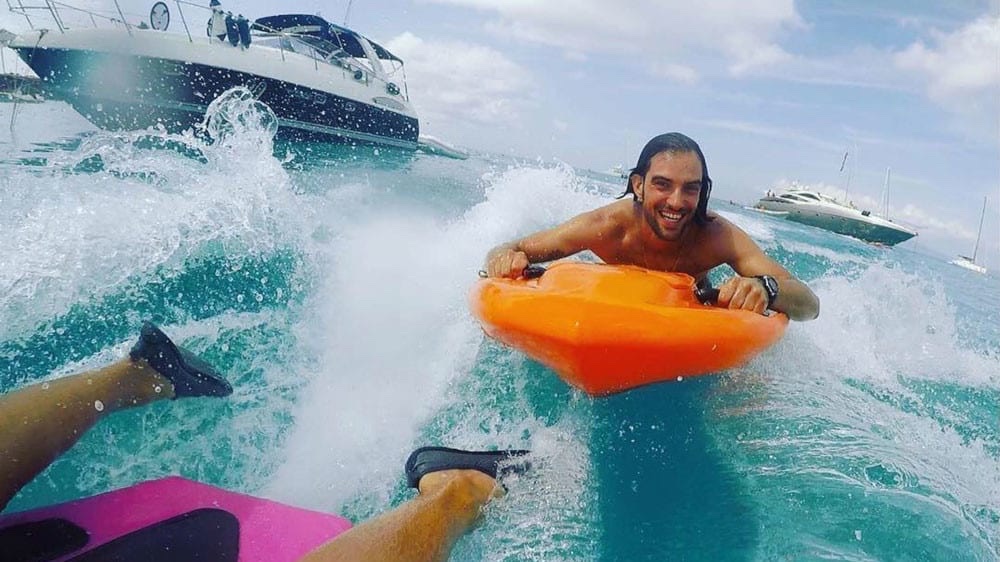
The Hadoco T-One is the mid-tier answer to the Seabob ecosystem. Cayago set the price ceiling in jet body boards. The F5 and F5 SR define the category at the premium tier, and the secondary market for those boards has the depth of a real used market. The T-One is the boat for buyers who looked at a $14,000 Cayago, looked at the calendar of how often they actually swim, and decided to spend less.
What is the Hadoco T-One?
The T-One is an electric jet body board built around a sealed brushless motor, a 1.0 kWh lithium battery, and a fiberglass hull with a carbon-skin laminate. Top speed is 18 km/h. Ride time at the cruise setting is roughly 30 to 35 minutes. Ride time at the top setting drops to 20 to 25 minutes. The board weighs about 35 kilograms with the battery installed and 25 kilograms without. Five speed settings on the throttle, dual-trigger handgrip for control.
The build is honest for the price. The carbon-skin laminate is a glass laminate with a thin carbon outer skin, not a full carbon-fiber-reinforced structure. The cosmetic finish is good and the hardware is stainless on the visible fittings. Inside the hull, the motor and battery are sealed in a removable cassette, which makes service straightforward. The replacement battery is sold through Hadoco directly.
The control system is the part that defines the ride. Cayago uses a Piezo finger-press at the front of the grip, which is the segment standard at the premium tier. Hadoco runs a dual-trigger throttle that operates like a motorcycle grip. Riders who have used both tend to prefer one or the other on the first session, and the preference holds up. The dual-trigger is the more intuitive of the two for buyers who have not used a Piezo before.
The dash is bare. A battery-state LED bar and a speed-setting indicator are the full picture. There is no GPS overlay, no depth gauge, no app pairing on the standard build. The dash on a Cayago F5 has all of those, and the gap is one of the things buyers compare when they cross-shop. For a buyer using the board for recreation, the dash gap does not matter much. For a buyer who wants the full instrumented experience, it matters.
Who is it good for?
The buyer running 15 to 30 sessions a year on flat water and protected coastal coves is the right profile. The T-One does that job well, holds together over a multi-year ownership cycle if rinsed after saltwater use, and saves the $5,000 against the Cayago at the entry point. We took a T-One out at Lake Pleasant in Arizona last summer on a 105-degree afternoon, ran the battery from full to about 15 percent over a 28-minute session pushing the top two speed settings, and the only complaint at the end was that the water was warmer than the rider would have liked. The board itself behaved exactly as the spec sheet promised.
The second profile is the buyer who has never owned a jet body board and is not sure whether the category fits the household. A $9,000 entry buys a credible ride. If the household uses the board, the next purchase is either a second T-One or a step up to a Cayago F5 at trade-in time. If the household does not use the board, the loss on resale is bounded by what the buyer paid in the first place, not by Cayago's depreciation curve from a $14,000 starting point.
The third profile is the rental or resort operator looking for a unit that does not need premium-tier resale to make the math work. The T-One's purchase price is low enough that the depreciation pattern fits a 200-session-a-year rental use cycle without breaking the financial model.
Who is it not good for?
Buyers who want resale parity with Cayago at three years should not buy the T-One. The Seabob brand recognition supports a resale curve the Hadoco brand has not yet built. A clean three-year-old F5 trades at 60 to 65 percent of new. A clean three-year-old T-One trades at 50 to 55 percent of its lower new price. The dollar loss is smaller, but the percentage decline is larger.
Operators planning daily commercial or heavy charter use should also look elsewhere, or at least factor in a shorter service life. The carbon-skin hull and the build margin holds up to recreational use. Daily commercial cycling tends to show wear on the through-board hardware faster than the premium-tier alternatives.
Buyers who want a GPS or depth overlay on the dash are buying the wrong board. The T-One does not have it. If those features matter to the use case, the Seabob F5 or F5 SR is the right answer at the higher price.
Pricing
The T-One MSRP for 2026 runs $8,990 to $10,490 depending on the battery option and the dealer-installed accessory package. Used 2022-to-2024 units land at $5,800 to $8,200 with a battery in good cycle health, depending on hours and cosmetic condition. The used market is thin because the production volume is modest and the boards tend to stay with their first owners.
For comparison, a Cayago Seabob F5 new in 2026 sits at roughly $13,500 to $15,000. The F5 SR is $17,000 to $19,500. The T-One opens the segment at around 60 percent of the F5's entry price.
What works
- $5,000 below a Cayago F5 base price brings the segment into reach for buyers who would have walked away at the premium tier
- The dual-trigger throttle is intuitive and rides well for buyers who have not used a Piezo control
- The 22-minute hard-ride cruise time matches what owners log on the water, so the spec sheet is honest
- Carbon-skin hull is a credible build at the price tier and the cosmetic finish holds up after a season of saltwater rinses
- The cassette battery makes service and replacement straightforward, and Hadoco sells the replacement battery directly
- The board is light enough at 35 kilograms loaded that one adult can carry it from a beach to the water without help
What does not
- The dash is bare. No GPS, no depth, no app pairing. Cayago has all of those and the gap is real
- Resale curve at three years runs 12 to 18 percentage points harder than the comparable Seabob
- Battery capacity at 1.0 kWh sits below the F5's 1.2 kWh, and the ride time difference shows up in real sessions
- Service network outside the Asia-Pacific region is still building, and North American dealer coverage is thin
- The top-speed ride time drops to about 20 minutes, so the cruise setting is the honest number for planning a session
- No factory-supplied transport case at the base price. The accessory case is a $400 to $600 add-on
Year-by-year notes
The T-One launched in 2022 with the original hull, the 1.0 kWh battery, and the dual-trigger throttle. The 2023 model added a slightly revised motor controller that smoothed the throttle response under load. The 2024 and 2025 boards carried minor cosmetic refinements and a different battery cell chemistry that improved the charge cycle count. The 2026 model is largely unchanged from 2025 in any rider-noticeable way. Used buyers in 2026 can look at any year from 2023 onward without a meaningful ride difference.
Cost of ownership
Annual cost is low compared to the rest of the boats Boat & Sail covers. A T-One does not need slip rental, insurance is bundled into a homeowners policy for most owners, and the battery is the only meaningful consumable. Battery replacement at end of life is roughly $1,800 to $2,400 through Hadoco direct, with a service life of 300 to 500 charge cycles depending on use pattern.
The other recurring line is the bearing service in the propulsion unit, which Hadoco recommends after 100 hours of use. The service is dealer-only and runs $200 to $400 in parts and labor. Owners who rinse the board after saltwater use and store it dry tend to push the bearing service interval to the longer end.
A five-year hold on a 2025 T-One bought new at $9,500, used 25 sessions a year, lands at roughly $1,200 to $1,800 a year all-in including the amortized capital cost, occasional service, and the eventual battery replacement.
Best year and trim to buy
A 2024 or 2025 T-One with under 30 hours and the battery cycle count documented in the file is the right buy in 2026. The price difference between new and a 2024 used unit is enough to make the used buy the better math if the battery is in good shape. Verify three things pre-purchase. First, the battery cycle count is below 100. Second, the propulsion unit has been bearing-serviced if the hour count is at or above 100. Third, the cosmetic finish has not been compromised at the bow or the rails (impact damage shows there first, and on the carbon-skin laminate it is worth checking).
Alternatives
The premium benchmark is the Cayago Seabob F5, with the full carbon-fiber-reinforced hull, Piezo throttle, GPS and depth on the dash, and the segment-leading resale curve. The sport variant within Cayago is the Seabob F5 SR, aimed at the higher-speed rider at a top-of-segment price. In a different format, the Kymera Body Board is the motorized body-board alternative aimed at a similar recreational rider with a different ride feel.