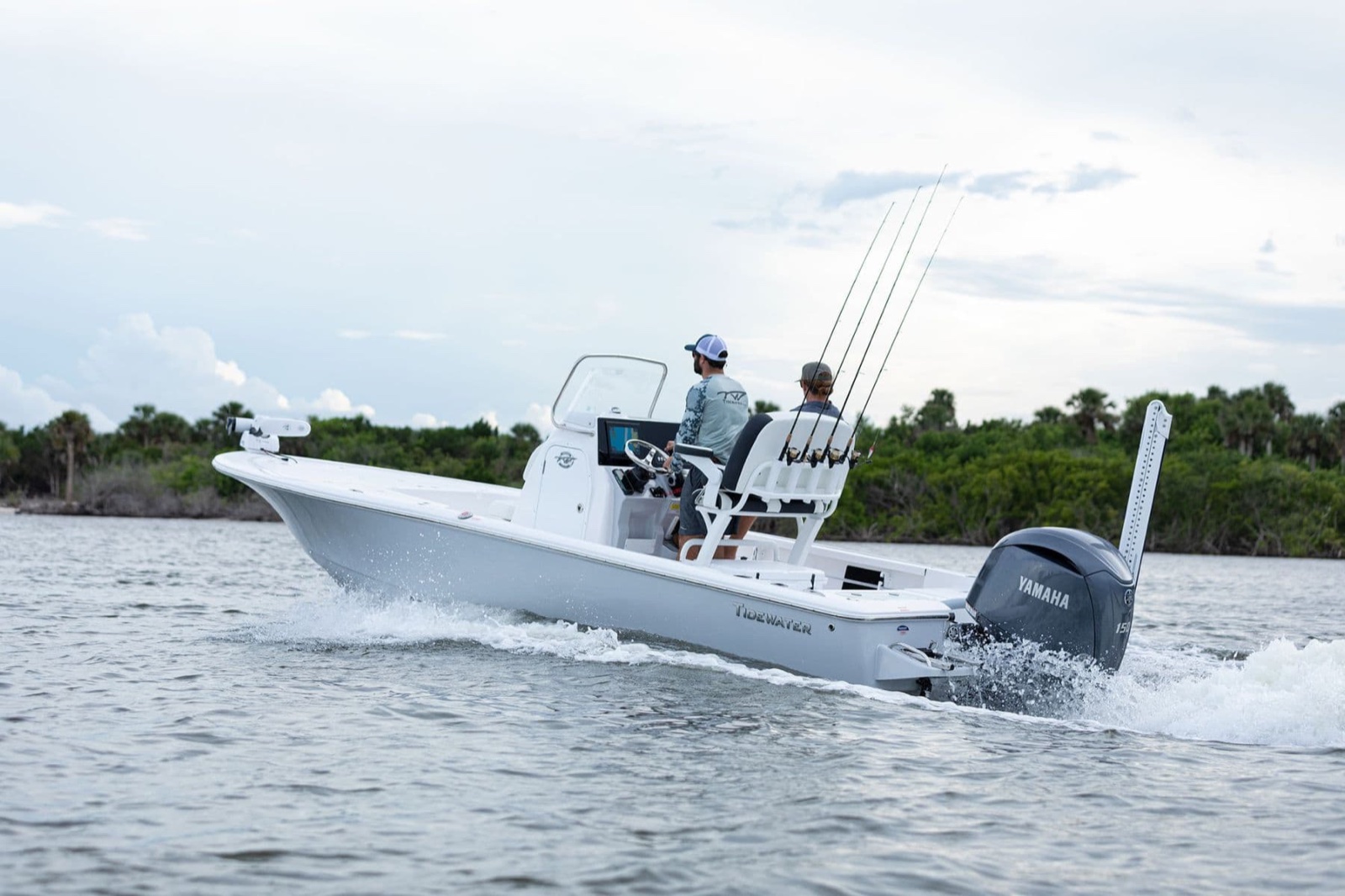
The Kingfisher 2025 Bay is a 20-foot welded-aluminum bay boat built in Vernon, British Columbia by Kingfisher Boats, a sister company under the same group that builds the Weldcraft welded-aluminum range. The 2025 Bay has been in production in its current form since 2018, and the 2026 catalog keeps the same hull with updated electronics and a slightly refreshed console layout.
What is the Kingfisher 2025 Bay?
The 2025 Bay is a 20-foot 6-inch welded-aluminum center-console bay boat. Beam is 8 feet, dry weight is about 1,950 pounds with no engine, and the boat trailers easily behind a mid-size truck. The hull is a welded-plate aluminum layup with a deadrise sized for protected coastal water and flats fishing rather than open chop. Draft is about 10 inches with a trolling motor down and the engine tilted, which is the number that matters most to a flats angler.
Single-outboard rigging up to 200 horsepower covers the range. The Yamaha F150 and Mercury 150 are the common builds, with a Yamaha F200 or Mercury 200 as the upper-trim option for buyers who want more pull on a long run between fishing grounds. Fuel is 50 gallons, which is enough for a full day on a coastal flat plus a fast return run.
The layout is a flats-fishing layout. A casting platform forward with a cooler-seat option, a center console with an electronics flat that fits a 9-inch Garmin or Simrad, a leaning post with rod holders, and a poling-platform option aft that mounts above the engine. The fishing-feature package includes a 20-gallon livewell, an in-deck fishbox, vertical and horizontal rod storage along the gunwales, and a freshwater washdown. The console is the only weather shelter on the boat.
I ran a 2022 2025 Bay across Pine Island Sound on the Florida Gulf coast in early March, two anglers aboard, looking for redfish on a falling tide. The boat poled cleanly across an 8-inch flat that I would not have crossed in a glass bay, and the aluminum hull bumped a couple of oyster shells on the way back without anyone wincing. The hull noise at the 28 mile per hour cruise speed was noticeably louder than a fiberglass equivalent, which is the standard tradeoff with welded aluminum. The boat felt like the right tool for the job and the wrong tool for the run back home across a stiff chop.
Who is it good for?
Coastal flats anglers who fish skinny water. Pine Island Sound, Mosquito Lagoon, Florida Bay, Charleston-area marshes, the Texas coast. The 10-inch draft and the welded-aluminum hull are the two features the boat is built around, and the fishing setup is laid out to match.
Pacific Northwest and Gulf Coast anglers who already own and trust welded-aluminum boats. The Kingfisher dealer network is concentrated in the Pacific Northwest, and the brand has built a strong following in the freshwater and protected-saltwater markets there.
Trailer-heavy owners who want a light boat. The 1,950-pound dry weight means a half-ton truck or even a properly equipped mid-size truck can handle the boat. The trailer math is materially easier than a fiberglass bay at the same length.
Who is it not good for?
Anglers who fish open chop regularly. The hull is built for protected coastal water and the ride above a foot and a half of chop is busier than a 22-foot fiberglass bay. A buyer who spends half their days outside the inlet should look at a bigger fiberglass boat.
Families who want a day-boat layout. The 2025 Bay is a fishing boat. The console is the only shelter, there is no real seating beyond the leaning post and a couple of cooler seats, and the boat is not built for sun-bathing or for kids who want to swim off the back.
Buyers who care about the look of a fiberglass bay. The welded-aluminum aesthetic is functional and the powder-coat finish is durable, but it does not have the gelcoat sheen of a Shearwater 23 LTS or a Pathfinder 2400 TRS. Buyers who shop on the look should walk to fiberglass.
Pricing
New 2026 Kingfisher 2025 Bay pricing lands between roughly $68,000 and $92,000 rigged, depending on engine choice, dealer, and option package. The most common dealer build includes the Yamaha F150 or Mercury 150, the upgraded helm electronics with a 9-inch Garmin or Simrad, the poling-platform option, the trolling-motor mount, and the cooler-seat package on the forward casting platform, which puts the typical out-the-door price near $80,000.
The used market for 2019-to-2023 hulls in clean shape with 150 to 400 hours falls between $38,000 and $62,000. The bottom of that band is a high-hour boat in a region where the Kingfisher brand is less established. The top is a low-hour 2022 with the right rigging and a Pacific Northwest or Gulf Coast dealer service file.
Five-year depreciation on a clean 2025 Bay sits around 30 to 36 percent off new. That is competitive with the fiberglass-bay segment and stronger than most welded-aluminum competitors in protected coastal markets.
What works
- Welded-aluminum hull handles oyster bars, dock pilings, and the kind of structure that destroys gelcoat. Owners do not flinch when they bump something.
- Dry weight of about 1,950 pounds makes the boat easy to trailer behind a mid-size truck.
- Shallow draft of around 10 inches handles flats work that a 22-foot fiberglass bay cannot reach.
- Casting platform forward and a poling-platform option aft give the boat a real flats-fishing layout.
- Single-outboard rigging up to 200 horsepower covers fast runs between fishing grounds.
- Kingfisher's welded-aluminum construction is what owners point to as worth the price.
- Standard livewell, in-deck fishbox, and rod storage match what a fiberglass competitor gives at the same length.
What doesn't
- Hull noise is louder than fiberglass at speed. Aluminum-deck slap in chop is the part new owners notice first.
- Ride in chop above a foot and a half is busier than a 22-foot fiberglass bay.
- Dealer network is concentrated in the Pacific Northwest and parts of the Gulf. Atlantic buyers pay freight on parts and warranty work.
- Cabin space and weather shelter are nonexistent. The console is the only shelter on the boat.
- Resale is strong on the West Coast and weaker in Atlantic markets where the brand is less established.
- Powder-coat finish on the rails shows scratches earlier than a painted fiberglass equivalent.
Year-by-year notes
The 2025 Bay launched in 2018 on the current welded-aluminum hull. The 2020 model added an upgraded electronics flat sized for a 9-inch display. The 2021 model went to a refreshed leaning-post design with built-in rod storage. The 2023 model added a wireless trolling-motor remote as a standard dealer option and updated the helm wiring harness to a NMEA 2000 backbone. The 2025 model refreshed the powder-coat finish on the rails and added a couple of color options. There is no defect cutover year to screen for on the current production.
Cost of ownership
Annual recurring costs run lower than the fiberglass-bay segment average. Yamaha or Mercury 100-hour service costs $400 to $700 in parts and $300 to $500 in labor. Aluminum hulls do not need bottom paint in the same way a fiberglass hull does, though saltwater owners still apply a hull treatment annually. Insurance on a $50,000 hull is $700 to $1,100 a year in coastal markets.
A five-year hold on a 2022 2025 Bay bought at $48,000 with 200 hours, used 70 hours a season on the Texas coast with trailer storage and an annual flush after each saltwater outing, lands at roughly $3,400 to $5,000 a year all-in including insurance, fuel, service, and the spread-out capital cost. The maintenance line is materially smaller than a sterndrive day boat at the same length.
Best year and trim to buy
The 2021-to-2023 Kingfisher 2025 Bay with a Yamaha F150 or Mercury 150, the upgraded 9-inch helm display, the poling-platform option, the trolling-motor mount, and a current livewell pump in the file is the right buy in 2026. Five things to verify pre-purchase. First, the welds along the chine and the keel are clean and free of any visible cracking. Second, the powder-coat finish on the rails and the leaning post has not started to bubble where saltwater has worked under the coating. Third, the livewell pump and the freshwater washdown both run on the sea trial. Fourth, the trolling-motor mount is solid and the wiring is clean. Fifth, the trailer is sized for the boat and the bunks have been replaced if the boat is more than five years old. A clean 2022 with 220 hours and the right rigging should land between $48,000 and $56,000 with a Kingfisher-experienced dealer.
Alternatives
The fiberglass-bay cross-shop is the Shearwater 23 LTS, which gives a quieter ride and a step up in finish at materially more money and a heavier trailer. The Gulf-Atlantic fiberglass-bay alternative is the Sea Hunt BX 22, which sits at a closer price point with the standard fiberglass-bay finish and a deeper hull. The premium-fiberglass cross-shop at slightly larger length is the Pathfinder 2400 TRS, which is the boat flats-first anglers most often compare with a Kingfisher when budget allows.