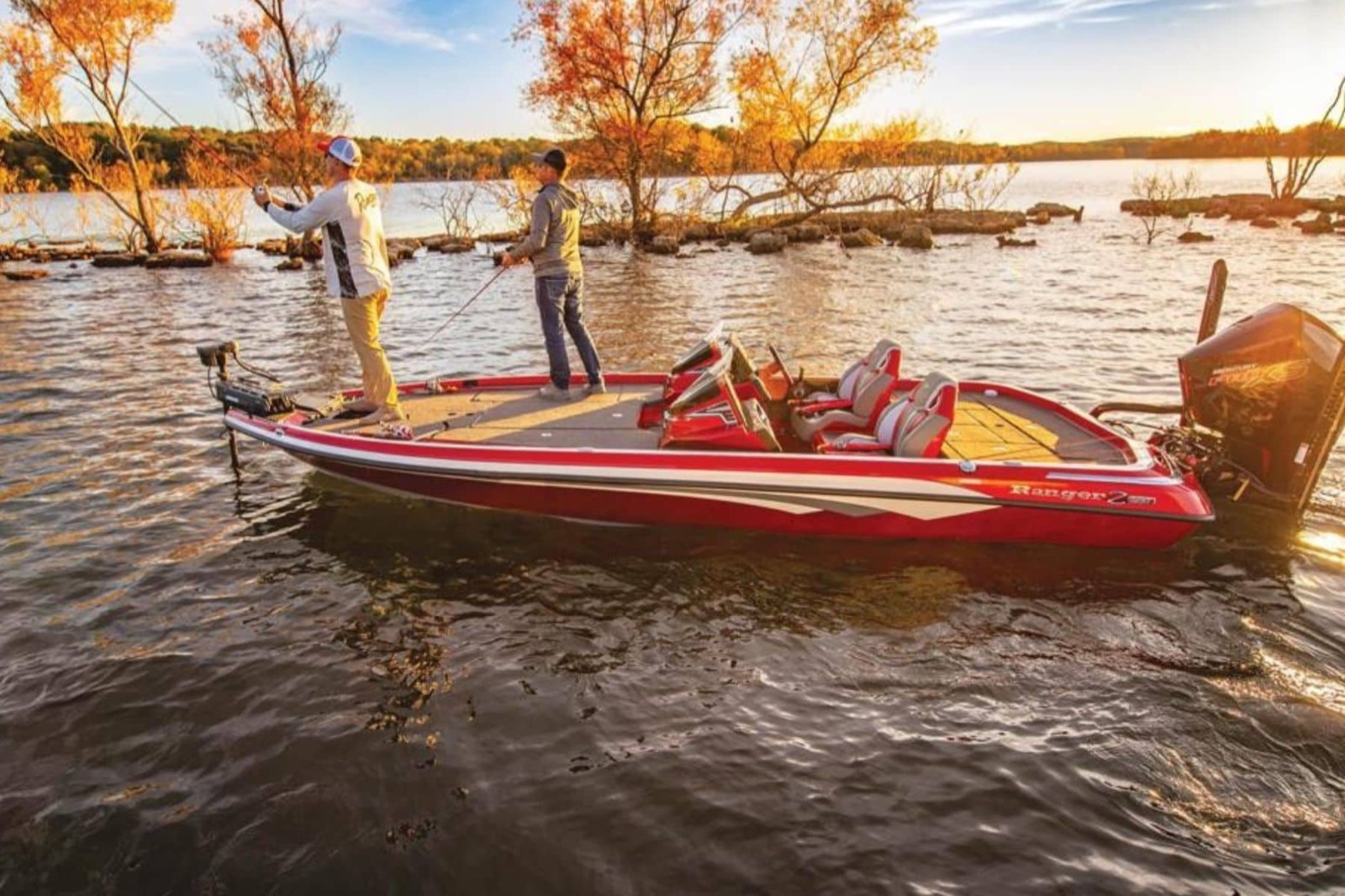
The Ranger 2310 Bay is Ranger's case that bay-boat layout works as well on freshwater lakes as it does on saltwater flats. Ranger Boats has been building bass and bay hulls in Flippin, Arkansas since 1968, and the 2310 sits in the catalog as the crossover bay boat for owners whose fishing spans both worlds. It ranks fourth in our 2026 best-bay-boats guide because the holeshot, the draft, and the casting-deck layout all add up to a hull that works on freshwater reservoirs and saltwater flats alike, with the honest caveat that the hardware grade is freshwater-first.
What is the Ranger 2310 Bay?
The 2310 Bay is a 23-foot fiberglass bay boat with an 8-foot 6-inch beam and a 17-degree transom deadrise. Hand-laid fiberglass with a composite stringer grid and a one-piece liner, which is the construction approach Ranger carries from the bass-boat side of the catalog. The hull draws 13 inches with the engine trimmed up, which puts it at the shallow end of the 22-to-24-foot bay-boat segment. Dry weight comes in at around 2,800 pounds before the engine, which is light for the length and is the reason the holeshot is what it is.
Rigging is a single Yamaha F250 four-stroke on most current production. The boat carries the F250 well: four-second holeshot to plane, a 30-knot cruise rpm that holds 3.5 miles per gallon, and a 50 mile-per-hour top end with two aboard and a half tank. We ran a 2022 hull on a Texas coastal bay in fall conditions, a one-foot chop on the open water and dead-flat protected stretches, and the boat planed inside three boat lengths from a stop and held 38 knots without strain. The light displacement plus the F250 is what makes the holeshot number look the way it does.
The deck plan is bay-boat standard. A forward casting deck that fits two anglers comfortably, an aft casting platform with the trolling-motor mount and storage hatches, two pedestal helm seats with rotating bases, a center console with a portable head compartment, and a single 25-gallon livewell aft with recirculation. Storage volume in the lockers runs deeper than the Sea Hunt at the same length, which owners point to as the small detail that pays back over a season. Garmin GPSMap chartplotter and a JL Audio stereo are standard from the 2021 model year forward. Trim tabs come standard.
Who is it good for?
Texas and Louisiana inland-bay owners are the core profile. Owners running between freshwater reservoirs and saltwater bay systems with the same boat, fishing largemouth bass in the morning and redfish in the afternoon. The crossover is real and the 2310 was designed against it. The composite stringer grid handles freshwater duty without the heavy-saltwater hardware that adds weight and cost, and the 17-degree deadrise handles both protected freshwater chop and protected saltwater chop without complaint.
Freshwater-to-saltwater crossover anglers are the broader profile. Anyone who spends meaningful time on both water types and does not want to buy two boats. The 2310 sits at the intersection. It is not the best dedicated saltwater bay boat (a Sea Hunt BX 22 or a Pathfinder 2400 TRS does that better), and it is not the best dedicated freshwater bass boat (Ranger's own 521 series does that better), but it is the best crossover at the price.
Cross-shoppers from Sea Hunt who want shallower draft and faster holeshot are the third group. We pulled into a private boat ramp on a small Louisiana inland bay in summer, late afternoon, two boats in the water already (one Sea Hunt, one 2310), and watched the 2310 come off the trailer and plane to fishing speed in noticeably less distance than the Sea Hunt next to it. That is the difference the spec sheet implies, and the on-water observation confirms it.
Who is it not good for?
Pure saltwater-coastal buyers running long crossings are the wrong profile. The 17-degree deadrise handles bay chop but does not handle the head sea you find running 20-plus miles to a bay-mouth grounds in real conditions. The freshwater-first hardware grade is also a long-term concern in full-time saltwater service. Dedicated saltwater bay-boat buyers should look at the Sea Hunt BX 22 or the Pathfinder 2400 TRS instead.
Anglers who want dual livewells fit the second exclusion. The 2310 carries a single 25-gallon livewell with recirculation, which works for most bay-fishing trips but is a step behind the dual-livewell rivals in the segment. Tournament-level redfish anglers who carry mixed live bait usually want two compartments.
Pacific Northwest, Great Lakes, and Northeast coastal buyers should think about the dealer network. Ranger's footprint is concentrated in the South and Southwest, and the parts pipeline for the 2310 specifically (rather than the volume-seller bass models) is thinner outside Ranger's core geography. Buyers in those markets should check the closest dealer relationship before committing.
Pricing
New 2026 Ranger 2310 Bay builds with the Yamaha F250, Garmin GPSMap, JL Audio, T-top, and trim tabs land in the $82,000 to $98,000 range depending on dealer and option lines. Stepping up to a Power-Pole, a second livewell as a retrofit, a hardtop electronics box, premium audio, and a trailer can push the build past $115,000 at the dealer. The base build trims roughly $5,000 to $8,000 off the high spec.
The used market spans $32,000 at the bottom (2020 first-production hulls with deferred service and original electronics) to $78,000 at the top (2023-2024 hulls with low hours and full option packages). The sweet spot for 2026 buyers is the 2021-2023 hull with the F250, Garmin GPSMap, current 100-hour Yamaha service, and 150 to 400 hours, which lands in the $44,000 to $66,000 band.
Ranger holds resale on the 2310 within 28 to 32 percent of new at the five-year mark in freshwater-heavy markets. In dedicated saltwater coastal markets, the resale drops slightly more because the freshwater-first hardware spec is a known caveat among saltwater buyers. The geographic spread on resale is one of the larger I see in the bay-boat segment, and it is worth thinking about at purchase time if you might sell the boat in a different region than you bought it in.
What works
- Thirteen-inch draft plus a four-second holeshot. Segment-leading numbers for the LOA.
- Forward casting deck design works for both saltwater and freshwater fishing without compromise to either.
- Yamaha F250 cruise at 30 knots holds 3.5 miles per gallon. The light displacement helps the fuel math.
- Storage volume in the lockers runs deeper than the Sea Hunt at the same length.
- Composite stringer grid and one-piece liner give the hull a stiff feel at cruise rpm.
- Resale is firm in freshwater-heavy markets, particularly the Texas and Louisiana inland bays.
- Ranger's build-consistency reputation from the bass-boat heritage carries forward to the bay line.
What doesn't
- Hardware grade is freshwater-first. Saltwater coastal use requires a more careful hardware audit at survey, and accelerated corrosion is what owners report on saltwater-only hulls.
- 17-degree deadrise is the limit. Long offshore crossings in real chop are not the 2310's brief.
- Single 25-gallon livewell where Pathfinder and Sea Hunt rivals carry dual compartments.
- Dealer network is concentrated in the South and Southwest. Pacific and Great Lakes coverage is thinner.
- T-top and Power-Pole are option lines on the base build, not standard.
- Engine compartment access is tighter than the Sea Hunt at the same length, oil changes take longer.
Year-by-year notes
The 2310 Bay launched for the 2020 model year and has been in production through 2026 with incremental refinements through the run. The 2020-2021 first-production hulls carried the original electronics and audio spec. The 2022 model year brought the standardized Garmin GPSMap and JL Audio package along with a trim-tab refinement and minor hardware upgrades on the deck. The 2023 model year added factory Power-Pole pre-rigging as an option and refined the helm-seat pedestal mounts. There is no single defect cutover year buyers need to screen on, but the 2022-onward hulls are the most-sorted production years.
Cost of ownership
Annual operating costs on a 2310 Bay sit in line with the mid-tier bay-boat segment. Yamaha F250 service every 100 hours runs $300 to $500 in parts and $250 to $400 in dealer labor. The 300-hour valve-clearance check at the three-year mark is a bigger labor budget. Bottom paint is not a recurring line on trailer-stored hulls, which is most of the fleet. Insurance on a $55,000 hull runs $800 to $1,500 a year in coastal US markets.
A trailer-stored 2310 used 100 hours a season across freshwater and saltwater on the Texas Gulf Coast costs roughly $4,500 to $7,500 a year all-in including insurance, fuel, ramp fees, service, and amortized capital cost on a five-year hold. The trailer-storage math is what makes the boat work as a crossover. Slip storage on either side of the fence would double the running cost.
Best year and trim to buy
The 2021-2023 Ranger 2310 Bay with the Yamaha F250, Garmin GPSMap, JL Audio, current 100-hour service, and 150 to 400 hours is the right buy in 2026. The 2022-2023 hulls are the most-sorted production. The 2021 boats are correct buys at a slightly lower price point if the service file is current. The 2024-onward hulls carry less depreciation absorbed and are priced accordingly.
Verify five things before purchase. The Yamaha 100-hour service file is current and the 300-hour valve-clearance check has been done if the boat is at or past that hour mark. The hardware on saltwater-history hulls (cleats, rod holders, rub-rail fasteners, pedestal-seat mounts) shows no corrosion or pitting. The trolling-motor mount and the foredeck stand-on pad show no soft spots. The livewell pump cycles cleanly. The trailer (if included) has working brakes and current bearings, a boat that splits time between freshwater and saltwater puts more demand on trailer bearings than a single-water-type owner does. A clean 2022 hull with these five boxes ticked lands in the $50,000 to $60,000 range from a Ranger-experienced dealer in Texas or Louisiana.
Alternatives
The dedicated saltwater cross-shop is the Sea Hunt BX 22, which carries full saltwater hardware spec, dual livewells, and slightly more deadrise at roughly the same price. The technical-poling cross-shop is the Pathfinder 2400 TRS, which leans further into dedicated saltwater flats use with a deeper layout at a higher price. For inshore-first fishing at a smaller LOA, the Scout 215 XSF is the smaller center-console alternative with less draft, less livewell, and a lower price.