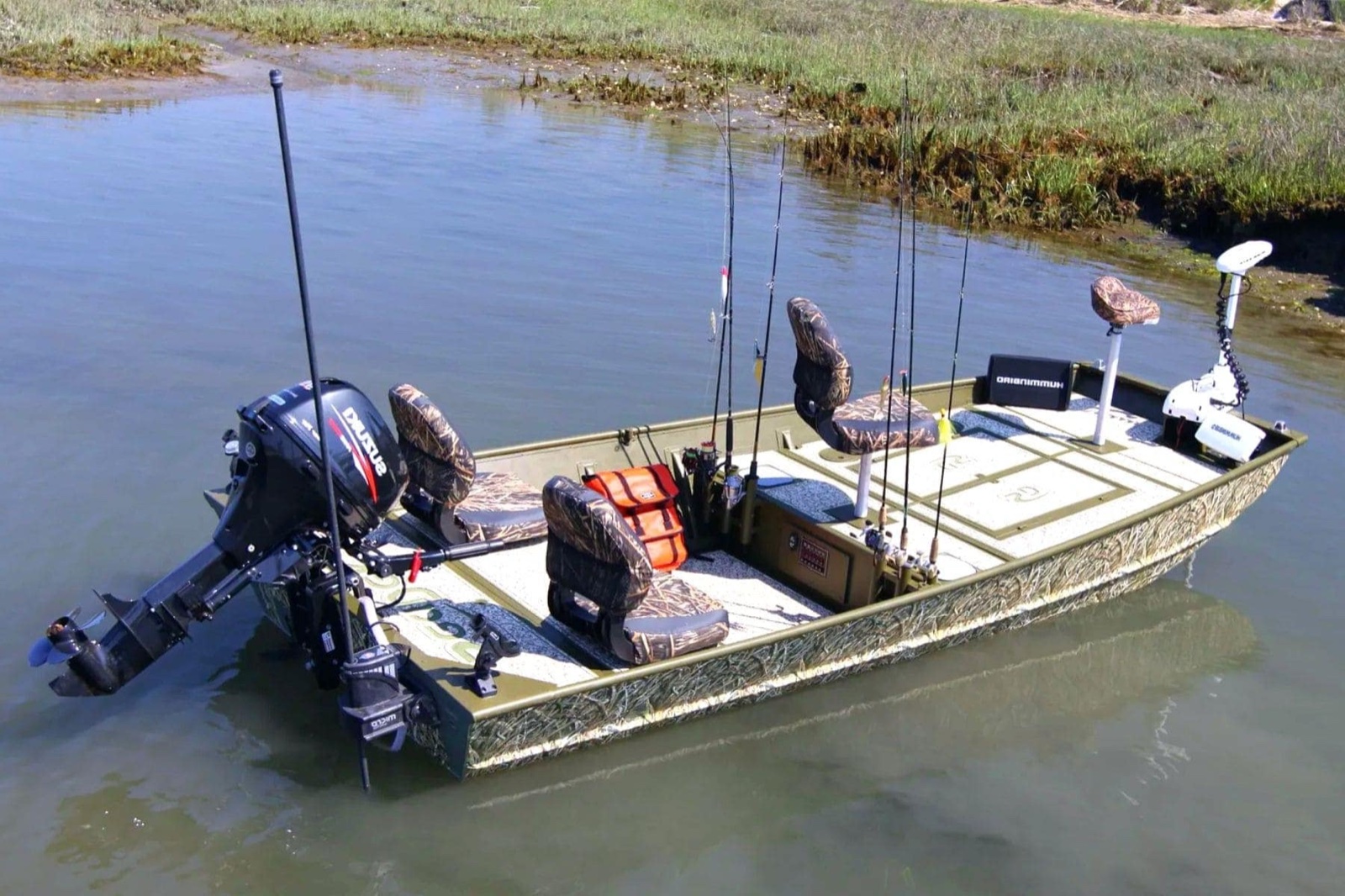
Weldbilt is a Louisiana family-owned aluminum boat builder that ships most of its production factory-direct to buyers across the Gulf-coast and inland markets. The 1648VS is one of the company's signature mud-motor jons. The hull spec lines up with the heaviest welded competition in the segment, but the factory-direct sale path means the price comes in below the dealer-network alternatives. For buyers who know exactly what they want and can manage the buying process without a dealer in the middle, the value is real.
What is the Weldbilt 1648VS?
The 1648VS is a 16-foot all-welded aluminum jon with a 48-inch bottom width, a mod-V bow, and a beam at the gunwale of 6 feet 8 inches. Dry weight sits at 560 pounds. Hull construction is heavy-gauge welded aluminum with reinforcement at the chine, the keel, and the transom. There are no rivets in the structural hull.
The VS designation in the model name indicates the mod-V hull with the heavy transom reinforcement, which is the build setup for mud-motor service. A Pro Drive, Gator Tail, or Mud Buddy mounts cleanly with the necessary backing plate already part of the build. The transom also takes a standard outboard, but the design priority is mud-motor compatibility.
Layout is plain. Bench seats forward, mid, and aft. Bare-aluminum floor option as standard, with a sprayed coating available. Mounting points for bow trolling motors and stern transducers. The boat ships in a basic build, and most buyers spec the hunting-specific options such as camo paint, blind brackets, and dog stand mounts.
The factory-direct sale is the defining commercial detail. A buyer calls or visits the Louisiana factory, picks the spec, and arranges either a pickup at the factory or a freight delivery. There is no dealer network in the way of the transaction, which saves the dealer margin but also means the warranty service path runs through the factory directly rather than through a local shop.
Who is it good for?
Bayou hunters running mud motors are the core buyer. The 1648VS is a common boat in the Louisiana and southeast Texas hunting markets, often as a second or third boat in a hunter's fleet alongside a larger hunting rig. The heavy-gauge construction handles the abuse of pushing through cypress knees and oyster bars, and the transom takes the mud motor without flexing.
I spent a long cold morning aboard a 1648VS pushing through a shallow Louisiana bayou one December, two hunters and a dog aboard, the mud motor cranking us through marsh grass thick enough to stop an outboard cold. The boat did the job without complaint, and the hull at the end of the morning had picked up a few new scratches but no dents or weld cracks. That is the brief Weldbilt is built for.
Value-first buyers who know what they want are the second profile. The factory-direct sale path is a real saving compared to a War Eagle bought through a dealer at the same hull spec. For owners who have already bought one or two jons in their lives and know how to manage the warranty pathway, the Weldbilt is the smart-money choice.
Outfitters running a small fleet are the third use case. The factory-direct pricing and the heavy build line up for outfit operators who buy in volume and self-maintain their boats.
Who is it not good for?
Buyers who want a local dealer warranty experience should walk past. The factory-direct sale path means that warranty service travels back to Louisiana. Most years of ownership do not require warranty work, but for buyers who want the comfort of a local dealer to handle issues, the Weldbilt is not the right buying experience.
Entry-price buyers who do not need mud-motor durability are the second wrong fit. A Tracker Grizzly 1648 Jon or an Alumacraft 1448 at riveted construction is the right tool for owners who fish 20 days a year on a small lake. The Weldbilt premium is paying for build durability that recreational owners do not need.
Buyers outside the Gulf-coast freight zone are the third exclusion. Freight from the Louisiana factory to a buyer in the Pacific Northwest or the Northeast adds meaningful cost, and the resale market in those regions is weaker for the brand.
Pricing
New 2026 pricing on the 1648VS hull lands roughly $7,200 to $11,800 depending on options, hunting package, and paint finish. Freight to the buyer's location adds $400 to $1,400 depending on distance. Add a Pro Drive or Gator Tail mud motor, a trailer, and basic electronics, and the out-the-door build sits $15,000 to $27,000 depending on motor choice.
The used market is strongest in Louisiana, southeast Texas, and the broader Gulf-coast region. Clean hulls with motor and trailer range $5,500 to $10,500 depending on year, condition, and spec. Weldbilt resale outside the Gulf-coast is weaker because dealer support is concentrated near the factory.
What works
- Heavy-gauge welded construction at a factory-direct price.
- Mod-V bow handles wind chop and small open water.
- Mud-motor transom reinforcement is standard on the VS build.
- Louisiana builder with deep mud-motor credentials. The factory understands the customer.
- Factory-direct pricing saves the dealer margin.
- Resale is strong in the Gulf-coast market.
What doesn't
- No local dealer means warranty work travels back to the factory.
- Factory-direct sale means buyers manage their own freight or pickup.
- Trailer is not included in the base hull price.
- Build options are limited compared to the bigger-volume competitors.
- Resale outside the Gulf-coast is weaker.
- Build hardware is functional, not premium.
Year-by-year notes
The 1648VS has been in production since the late 2000s on broadly the same hull. Weldbilt has refined the welded seam pattern, the transom reinforcement, and the floor options across the years, with 2018-onward hulls carrying the current spec. Older hulls from the early 2010s are still in heavy service across the Louisiana bayou, which speaks to the durability of the build. There is no defect cutover year worth screening for.
Cost of ownership
Annual costs are dominated by the mud-motor service, not the hull. A Pro Drive or Gator Tail wants regular gear case and impeller service, which adds labor over a standard outboard. The hull itself needs almost no attention. Insurance on a $18,000 package in a Louisiana market runs $300 to $550 a year. Trailer bearings repack annually.
A five-year hold on a 2022 1648VS with a Pro Drive mud motor, used 50 days a year hunting and summer fishing in the Louisiana bayou, lands at roughly $2,400 to $3,800 a year all-in over the hold. The factory-direct purchase price is the biggest single saving compared to a dealer-bought competitor at the same spec.
Best year and trim to buy
2018-onward 1648VS hulls with the current welded seam pattern, the reinforced transom, and the sprayed-floor option are the right buy in 2026. Verify five things before signing. First, the welds along the chine, the keel, and the transom are clean and continuous, with no signs of repair. Second, the transom reinforcement plates are intact if the boat has run a mud motor. Third, the factory paperwork is in the file, because the factory-direct sale path sometimes leaves a thinner document trail than a dealer sale. Fourth, the hull sides have no hard dents at the chine. Fifth, the trailer matches the hull weight and the bunks are in good order.
Sea trial notes
A sea trial on a 1648VS should focus on the welded hull's behavior in real conditions. First, launch and load from the trailer. At 560 pounds dry, the boat handles cleanly off a working trailer. Second, run the boat at cruise on whatever water is available. The mod-V should soften wind chop and the hull should track straight under power, with a mud motor or a standard outboard. Third, watch the bilge under load. A welded Weldbilt should not be taking on water at the seams. Standing water in the bilge after a run is a flag. Fourth, listen to the welded seams and inspect the transom for any flex under power.
A January morning in the Atchafalaya basin in southern Louisiana is a typical environment for this boat. Cool fog rising off the slack water, two hunters and a dog aboard, decoys stacked forward, the mud motor pushing through marsh grass that would foul a propeller in seconds. The 1648VS does the work without complaint, and the hull at the end of the morning has picked up surface scratches but no welding damage. That is the brief.
A second walk-around on a used hull should focus on the welds and the transom reinforcement. Look for continuous, clean weld lines along the chine, the keel, and at the transom-to-side joints. Inspect the transom reinforcement plates if the boat has run a mud motor. Check the floor coating, the bench seats, and the trailer condition. The factory-direct sale path means the file is sometimes thinner than a dealer file, so pull what records exist and call the factory if anything is unclear. Weldbilt's service team is direct and willing to answer questions.
Alternatives
The closest heavy-gauge cross-shop with a broader dealer network is the War Eagle 754 VS, which sits at a similar spec at a higher price tier with dealer support across the South. For buyers stepping up in length and down in hull gauge, the Lowe Roughneck 1860 is the lighter welded cross-shop. Buyers stepping down to riveted construction at a lower entry price should look at the Tracker Grizzly 1648 Jon.