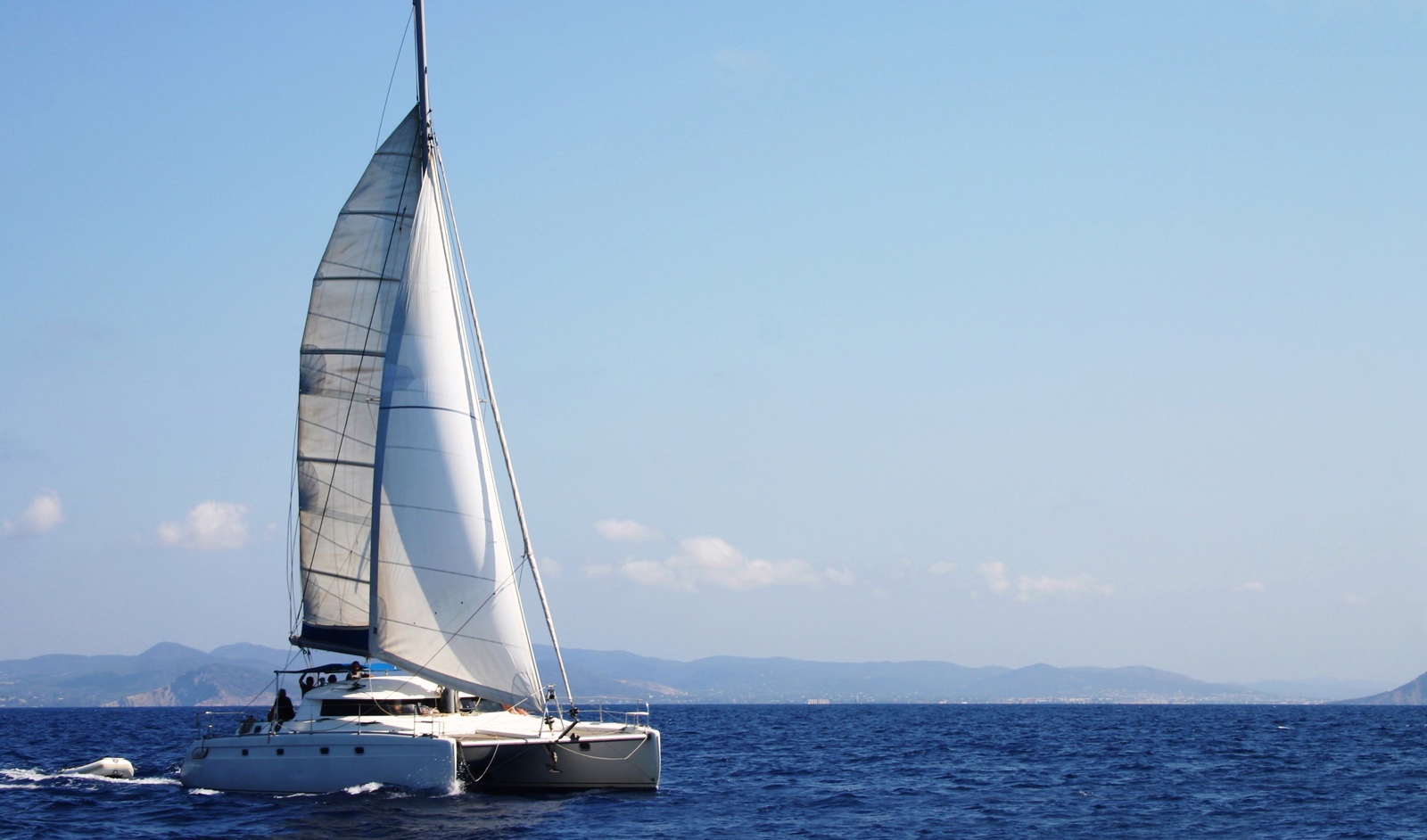
The Beneteau Oceanis 320 is the boat that gives first-time cruisers an aft-cabin layout, factory refrigeration, and a Yanmar diesel for under $50,000 in 2026. Beneteau built the 320 from 1994 to 2003 in their Vendée facility, and the model became one of the most-chartered designs of its size in the world. The boat sits near the top of our under-$50k first-cruiser guide because no other production thirty-footer of the era combined the interior layout, the systems, and the Yanmar drivetrain in one hull.
What is the Beneteau Oceanis 320?
The 320 is a 31-foot 6-inch fiberglass cruising sloop. Beam is 10 feet 9 inches, draft is 5 feet 9 inches in the standard fin-keel layout, and displacement sits around 9,500 pounds. The hull is solid fiberglass below the waterline and cored above. The deck is balsa-cored, which is the source of most of the survey concerns on older hulls. The rig is fractional, single-spreader, with discontinuous wire standing rigging. The mainsail is slab-reefed with two reef points, and the headsail is a furling genoa on a Profurl or Facnor system from the factory.
The interior is the part that sells the boat used. A V-berth forward sleeps two adults with a centerline filler. A saloon settee sleeps two more on opposing sides of a folding centerline table. Aft, a real aft cabin behind the navigation station sleeps two on a transverse double, with a sliding door for privacy. The head is amidships to starboard with a stand-up shower, an electric or manual marine toilet (year-dependent), and a holding tank. The galley is L-shaped to port at the foot of the companionway, with a deep stainless sink, a two-burner gimballed stove with oven, and a 12-volt refrigerator built into the cabinetry from the factory. Headroom in the saloon is 6 feet 2 inches. Pressure freshwater is standard.
The drivetrain is the second selling point. The 1994 to 1998 boats came with the Yanmar 2GM20F two-cylinder, 18 hp. From 1999 onward, the 3YM20 three-cylinder, 21 hp, became the standard option. Both engines are the most-serviced small marine diesels in the world. Any small-yard mechanic on any coast knows them. Parts are stocked at any Yanmar dealer and at most generic marine-engine houses. Cruise rpm of 2,400 sits the boat at 5.5 to 6 knots burning roughly 0.5 gallons per hour, which works the standard 26-gallon fuel tank into a real 250-mile motoring range.
Who is it good for?
First-time cruising buyers who want a real aft-cabin layout under $50,000 are the core. Most boats at this price are Catalina 30s, Hunter 30s, or Pearson 30s with a V-berth and a quarterberth setup that does not give a couple privacy from guests or kids. The 320 is the only widely-available production thirty-footer at this money that actually has a private aft cabin behind a door. For a couple cruising with a teenager or with parents who come aboard for a long weekend, that single layout decision is the buy.
Coastal weekenders running Long Island Sound or the Chesapeake or San Diego Bay on a 50-to-100-hour-a-season schedule are the second profile. The systems are good enough that the boat covers a real weekend without compromises. The refrigerator runs off the house bank and a 30-watt solar panel keeps the boat self-sufficient at anchor for two to three nights without a generator. I spent a long weekend aboard a 1999 Oceanis 320 in Mystic one September, and the thing I remember most clearly is that nothing on the boat felt like a compromise. The shower worked, the fridge worked, the stove worked, and the aft cabin slept two adults without anyone bumping a knee on a bulkhead. For under $50,000 used, that combination is rare.
Cross-shoppers coming from a Catalina 30 who want a more modern layout are the third buyer. The Catalina 30 is the better-supported and better-resale boat in this segment, but the layout is the older V-berth-and-quarterberth configuration. Buyers who actually use the aft cabin on a 320 do not go back.
Who is it not good for?
Buyers expecting Bristol-tier joinery or pedigree-builder construction should walk past the 320 to a Tartan 30 or an Ericson 32. Beneteau's 1990s production-line construction is honest entry-tier. Bulkhead tabbing, hardware grade, and interior cabinetry all show their production origins. The interior is well-laid-out and lives nicely, but it is not hand-built and does not pretend to be.
Sailors planning offshore passages without a refit should also walk past. The original chainplates, the original standing rigging, the original through-hulls, and the original rudder bearings on a 25-plus-year-old hull are all due for inspection or replacement. A coastal cruiser can defer some of that. An offshore boat cannot. A proper offshore refit on a 320 is a $20,000 to $40,000 job depending on what is found.
Buyers who want a deep parts pipeline are the third exclusion. Beneteau stopped supporting the 320 with model-specific parts years ago. Generic systems (Yanmar engine, Lewmar winches, Profurl furler) are easy. Beneteau-specific interior cabinetry, port-light gaskets, and rudder hardware require sourcing through specialist suppliers or fabricating. Owners report it is solvable, just not fast.
Pricing
The 320 has been out of production since 2003. The replacement boats in the Beneteau Oceanis range have changed model designation several times since. The new market is the current Oceanis 31 or Oceanis 34, both very different boats at very different prices.
Used 320 hulls in 2026 sit between $30,000 and $48,000 depending on year, condition, deck-core dryness, and refit history. A 1996 to 1998 hull with the 2GM20F engine, original rigging, and deferred maintenance sits at the low end. A 2001 to 2003 hull with the 3YM20, replaced rigging, dry deck core, and a recent electronics update sits at the high end. The sweet spot is a 1999 to 2001 boat in the $35,000 to $42,000 range that has had at least one major systems refresh in the last decade.
The 320 holds its value 8 to 12 percent worse than a Catalina 30 of the same year over a five-year hold, primarily because the parts pipeline is thinner and the used buyer pool is smaller. Buyers planning a 10-plus-year hold should not worry about that gap. Buyers planning to flip in three to five years should consider it part of the math.
What works
- Aft-cabin layout gives real privacy. The only sleep configuration in this segment with a private aft double under $50,000.
- Refrigeration, pressure water, and a stand-up shower standard from the factory.
- Yanmar 2GM20F or 3YM20 diesel. The most-supported small marine engine in the world.
- 6 feet 2 inches of saloon headroom. The boat lives like a 35-footer below.
- Sailing is honest. The hull tracks well, points to roughly 35 degrees apparent, and sails to its polars under a furling genoa and a slab-reefed main.
- Profurl or Facnor furler standard. Reefing under load is straightforward.
- 26-gallon fuel tank gives real coastal range under power.
What does not
- Build is honest entry-tier. Bulkhead tabbing, winches, blocks, and cabinetry are production-line.
- Beneteau-specific parts inventory has thinned. Sourcing model-specific gaskets, hardware, and trim requires specialist suppliers.
- Resale lags a Catalina 30 of the same year by 8 to 12 percent.
- Deck core moisture is a real concern on older hulls. Survey before buying, every time.
- Original rigging is 25-plus years old on most listings. Budget for replacement.
- Chainplates are bolted through deck and tabbed inside. They need inspection on every used purchase.
Year-by-year notes
The 320 ran from 1994 to 2003 on a stable platform. The 1994 to 1995 boats are the early production with smaller chainplates and a different rudder construction. The 1996 to 1998 boats are the volume years with the 2GM20F Yanmar. From 1999 onward, the 3YM20 became the standard engine, and the helm gained a wheel option in place of the tiller on some trims. The 2001 to 2003 boats are the final production with the matured systems, slightly updated cabinetry, and the cleanest electrical work. None of the year changes are large enough to drive the buy decision on their own. Condition, refit history, and engine choice matter more than model year.
The 2003 model was the last 320 produced. After that, Beneteau renumbered the Oceanis range and moved to wider-beam designs. The replacement boats are different hulls with different sailing characteristics.
Cost of ownership
Annual costs for a coastal weekender running 50 to 100 hours a season at a wet slip are $7,500 to $13,000 all-in. A slip in a typical East Coast or West Coast marina is $3,500 to $7,500 a year. Bottom paint annually is $400 to $700 in materials. Yanmar service at 250-hour intervals is $250 to $400. Insurance on a $40,000 hull is $700 to $1,200 a year. Sail replacement at 10 to 15 years is $4,000 to $7,000 for the main and $2,500 to $4,000 for the genoa. Standing rigging replacement at the 15-to-20-year mark is $4,500 to $7,500.
Buyers who do their own systems work save roughly 40 percent of the labor lines. A 320 is a manageable DIY boat. The Yanmar is straightforward, the systems are conventional, and the interior is laid out so that almost every line and pump is accessible without a yoga move.
Best year and trim to buy
The 1999 to 2003 Oceanis 320 with the 3YM20 Yanmar, the standard fin keel at 5 feet 9 inches, an updated furler, replaced standing rigging, and a dry deck core on survey is the right buy in 2026. Expect to pay $38,000 to $48,000 for a boat in that condition. Budget another $5,000 to $10,000 for first-year systems work (battery bank, electronics, cosmetic touch-up, sail inspection).
Verify five things pre-purchase. First, the deck core moisture-tests dry. The balsa core on these boats is the single biggest survey issue. Second, the chainplates are accessible and not weeping into the interior. Third, the rudder bearing has no play and the rudder post shows no signs of laminate separation. Fourth, the original Yanmar runs smoothly at all rpm with normal exhaust water flow and no soft-mount cracks. Fifth, the standing rigging has documented replacement history or budget the rerig into the offer.
Alternatives
The American direct cross-shop is the Catalina 30, which trades the aft-cabin layout for stronger parts support, a wider US dealer network, and better-than-Beneteau resale. The other production-builder option at similar money is the Hunter 33, which uses a B&R rig and a wider stern at the cost of slightly older systems. For buyers willing to give up the aft cabin in exchange for craftsman-tier build, the Ericson 32 is a step up at slightly higher used money. Buyers willing to add a few thousand for hand-laid construction should also look at the Pearson 323.