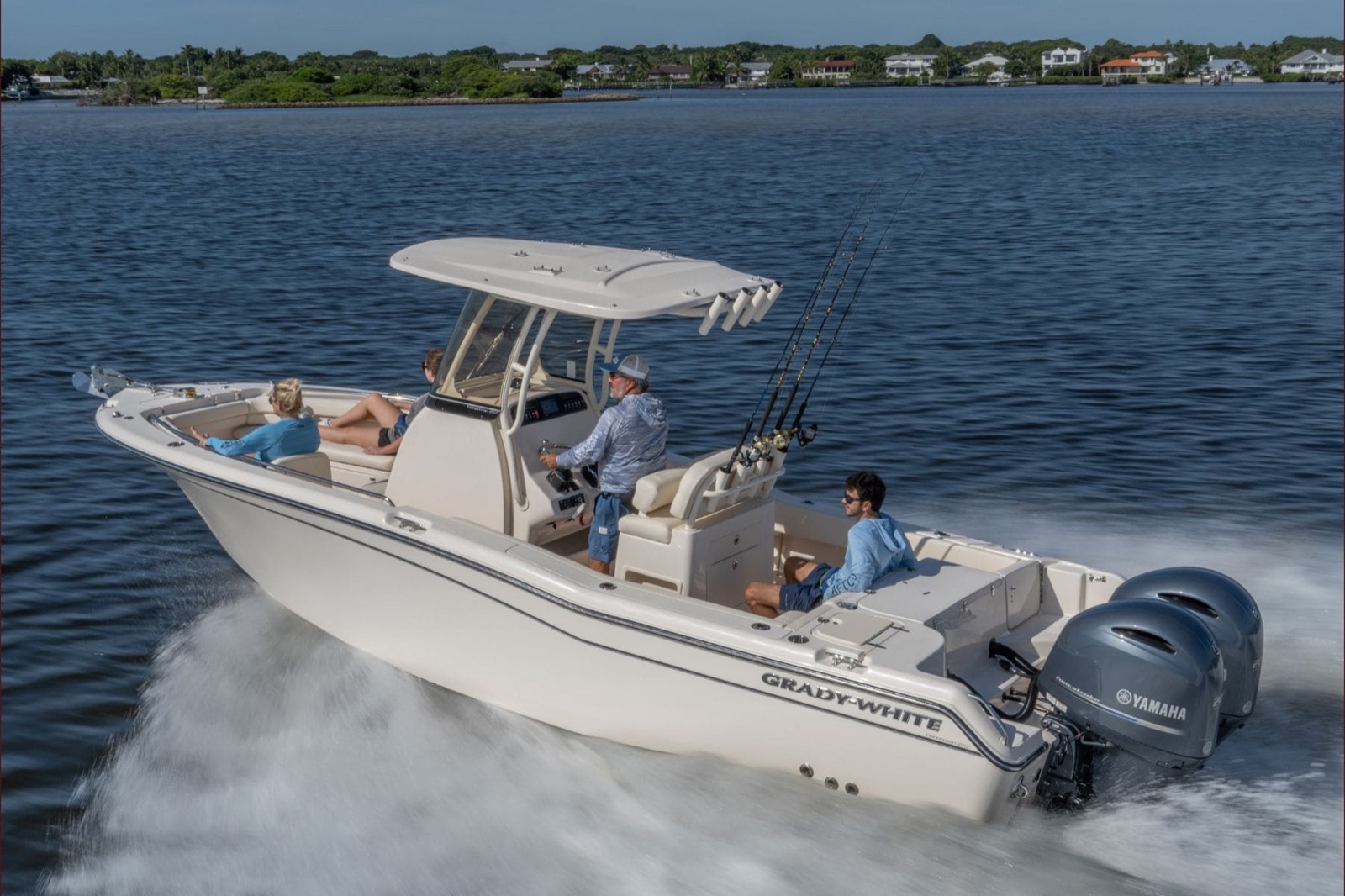
The Cobia 262 CC is a 26-foot offshore center console built by Maverick Boat Group in Fort Pierce, Florida. Maverick has been building boats on the Treasure Coast since the early 1980s, and Cobia is the offshore center-console brand in the family that sits alongside Pathfinder bay boats and the Hewes and Maverick flats boats. The 262 launched for 2017 and runs current through the 2026 catalog as one of the value-tier 26-foot offshore boats on the East Coast.
What is the Cobia 262 CC?
The 262 is a 26-foot 2-inch fiberglass center console. Beam is 9 feet flat, dry weight is 5,800 pounds, fuel is 175 gallons, deadrise at the transom is 22 degrees. The hull is a modified-V with a wide chine forward and a moderate flare at the bow. The boat sits a step below the 24-degree deep-V Carolina-flare boats like the Regulator 26 on hull spec, which is part of how the entry price stays a tier under Grady-White and Regulator at the same length.
Standard rigging is twin Yamaha F200 or F250 outboards depending on dealer build, with the F250s being the common spec on Atlantic and Gulf orders. Mercury rigging is available through some dealers. The fishing-feature package on the standard build covers the working brief: a 36-gallon transom pressurized livewell, two in-deck fish boxes that double as macerated wells, a forward console seat with rod storage underneath, gunwale-mounted rod holders, raw-water washdown, and a hardtop with electronics box on most dealer builds.
The helm runs a Garmin GPSMap setup standard from 2020 onward, with hardtop-mounted radar an option on the higher-trim builds. The console pop-up head is the only weather shelter on the boat. There is no real enclosure, no cabin, no berth. The 262 is a fishing day boat that pulls weekend family duty when the wind comes up too hard for offshore.
Who is it good for?
East Coast and Gulf anglers running 10 to 30 miles offshore are the core buyer. Florida Keys reef-fishing households, North Carolina inlet runners, Gulf coast snapper grounds, Stuart and Jupiter sailfish drifters. The hull handles a 2-to-3-foot head sea at 25 mph without pounding, and the 175-gallon fuel tank holds the boat to a real all-day range with reserve. On a Stuart inlet morning last summer I watched a 262 owner head out with two friends and a cooler of bait at 6 a.m., come back at 4 p.m. with a sailfish flag flying, and refuel at the marina pump with about 30 gallons still left in the tank. That is the use case the 262 was built around.
Families who want a center console that fishes during the week and runs the kids on the weekend are the second profile. The cockpit fits four anglers actively fishing, or two anglers plus a family of four for a swim and a sandbar lunch. The forward console seat with rod storage is the detail that makes the boat work for both jobs.
Value-tier buyers stepping into a 26-foot offshore boat for the first time are the third. The 262 sits 20 to 30 percent under a Grady-White 236 Fisherman at the dealer, and the build is honest enough that the value math works for a five-to-seven-year hold.
Who is it not good for?
Canyon anglers running 40-plus miles offshore in real sea state should walk past the 262 toward a 28-foot or 30-foot premium center console. The 22-degree deadrise handles inshore chop fine but is a step softer than the 24-degree Carolina-flare boats in big-water sea, and owners report spray reaching the helm in conditions where a Regulator 23 or a larger Regulator hull would keep things drier.
Buyers who weight the segment-leading resale curve should also pause. The Cobia holds its price well enough but not as well as Grady, Regulator, or Boston Whaler. The math over a long hold flips back toward the premium boats once depreciation is included.
Buyers who want a real head enclosure or any cabin space at all should also look elsewhere. The console pop-up is the only weather shelter on the boat. A Pursuit S 268 Sport or a Grady-White 263 covers a similar length with a real enclosure at materially more money.
Pricing
New 2026 Cobia 262 CC builds at the dealer land between roughly $165,000 and $205,000 depending on engine choice, hardtop and electronics package, and option lines. The standard build with twin Yamaha F250s, a hardtop with electronics box, Garmin GPSMap helm, and a usable fishing-feature package lands near $185,000 at most Atlantic and Gulf dealers.
The used market spans roughly $95,000 at the bottom (2017-2018 hulls in the 600-plus-hour range with average maintenance) to $160,000 at the top (clean 2023 boats with low hours and a loaded electronics package). The sweet spot is the 2020-2023 build with twin Yamaha F200 or F250 outboards, the current Garmin helm, 150 to 400 hours, and a clean service file. Those land in the $115,000 to $145,000 band.
Five-year depreciation on a clean 262 lands somewhere near 30 to 35 percent off MSRP. That is fine in absolute terms but a step behind the segment leaders, which is the entry-price-versus-resale tradeoff the buyer signs up for at the dealer.
What works
- 175-gallon fuel tank gives a real all-day offshore range with reserve at most cruise speeds.
- 22-degree deadrise on a modified-V hull handles 2-to-3-foot chop at 25 mph without pounding.
- Twin Yamaha F200 or F250 outboards on the standard build give long-day redundancy and a current drivetrain.
- Cockpit fits four anglers comfortably. Forward console seat with rod storage underneath is a useful detail.
- Maverick Boat Group dealer network is strong on the Atlantic and Gulf coasts.
- Entry price is 20 to 30 percent under Grady-White and Regulator at the same length.
What doesn't
- No real head enclosure. The console pop-up is the only weather shelter, and even calling it shelter is generous.
- Deadrise is less than the 24-degree Carolina-flare premium boats. Spray reaches the helm in big chop where a Regulator or Grady stays drier.
- Resale curve is fine but not segment-leading. Depreciation runs 5 to 10 points steeper than Grady or Regulator at the same model year.
- Cockpit gunwale height is on the lower side for big-water fishing comfort. Kids and dogs aboard want gunwale-mounted rails on the option list.
- Hardtop electronics package on used boats varies by dealer build. No two used 262s are identical.
- T-top fasteners and rod-holder welds want checking on a pre-purchase inspection. Cosmetic issues at those joints come up in owner reports.
Year-by-year notes
The Cobia 262 CC launched for 2017 on the current 26-foot 2-inch hull. The 2019 model year brought refinements to the hardtop and the helm electronics. The 2020 build standardized the current Garmin GPSMap setup at the helm. 2022 onward carries the latest Yamaha and Mercury rigging options and the current upholstery patterns. There is no defect cutover year. Buyers should screen on engine hours, the service file, hatch sealing, and T-top fastener condition rather than chasing a specific model year.
Cost of ownership
Annual service on twin Yamaha F200s or F250s lands at the manufacturer's 100-hour intervals, $500 to $900 in parts per engine plus $250 to $400 in dealer labor per engine. The 300-hour valve-clearance check at the three-year mark steps the labor budget up materially. Bottom paint costs $400 to $700 in materials annually for slip-stored boats, less for trailer-stored hulls. Insurance on a $130,000 hull value is $1,500 to $2,500 a year in Atlantic and Gulf coastal markets.
A five-year hold on a 2021 used Cobia 262 bought at $135,000 with 250 hours, used 90 hours a season offshore on the Carolina coast with marina-slip storage and saltwater rinse-down after each trip, lands at roughly $11,000 to $16,000 a year all-in. Trailer storage drops the line by $3,000 to $6,000 a year. The capital cost line is the biggest variable, and the math gets better the longer you hold the boat.
Best year and trim to buy
The 2020-2023 Cobia 262 CC with twin Yamaha F200 or F250 outboards, the current Garmin GPSMap helm, the hardtop with electronics box, and 150 to 400 hours is the right buy in 2026. Single-engine builds exist but are rare and not the recommended spec for offshore work.
Verify five things pre-purchase. First, the hatches seal cleanly on a hose test and the lockers stay dry on a long-day sea trial. Second, the T-top fasteners and rod-holder welds show no corrosion or stress cracks. Third, the engine service file shows current 100-hour Yamaha service plus the 300-hour valve-clearance check at the appropriate mark. Fourth, the livewell pump cycles cleanly through a long soak without surging. Fifth, the transom-mounted hardware (rod holders, tow eye, jack-plate if equipped) shows no corrosion at the through-bolts.
Alternatives
The premium cross-shop is the Grady-White 236 Fisherman, which trades the Cobia value tier for SeaV2 hull and dealer-network strength at 20 to 30 percent more money. The direct value cross-shop is the Robalo R230 at the same tier with a different hull philosophy and a similar entry price. For the unsinkable-fiberglass alternative, the Boston Whaler 230 Outrage covers a step-down length with foam-cored construction and segment-leading resale.