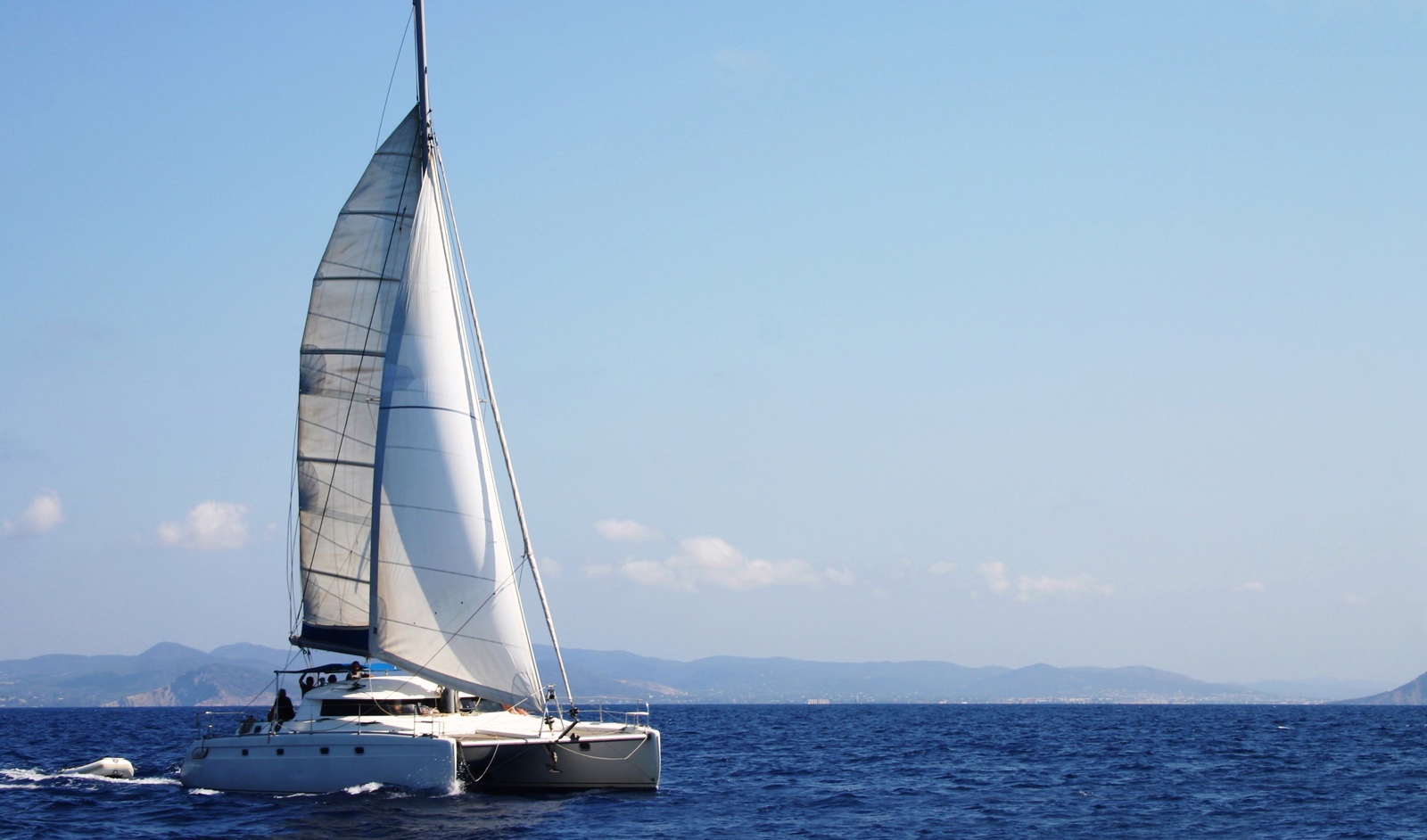
The Fountaine-Pajot Elba 45 took over from the Helia 44. Fountaine-Pajot has been building catamarans in La Rochelle, France since 1976, and the Elba was the mid-range cruiser between the smaller Astrea 42 and the larger Saona 47 from 2019 to 2024. Berret-Racoupeau drew the hull. Fountaine-Pajot presold more than 100 hulls before the first came out of the mould, and the yard added a second tooling line to turn out 50-plus boats a year.
What is the Fountaine-Pajot Elba 45?
The Elba is a 44-foot 7-inch fiberglass cruising catamaran. The beam is 25 feet 3 inches, draft is 3 feet 11 inches, and displacement is around 29,100 pounds. The hull has a finer entry, a small chine aft, and a reverse-sheer bow. Drag is about 10 percent lower than the Helia 44 at speed. Owners who have sailed both describe the Elba as noticeably better in light air, and the reverse bow stops the older boat's tendency to plunge in head sea.
Power comes from twin Volvo Penta D2-50 diesels, one in each hull, at 50 horsepower each, driving sail-drive units. The 60-horsepower upgrade is a common option. The boat does about eight knots at cruise rpm and over nine flat-out. Fuel capacity is 127 gallons split between the hulls. Water capacity is 140 gallons in twin 265-liter tanks, enough for eight people to shower for a week without watching the gauge.
The rig is an 18.1-meter mast with double diamond stays, a 74-square-meter fathead main, and a 45-square-meter genoa. Pointing is 43 to 45 degrees apparent, normal for a cruising cat and a degree or two tighter than the Lagoon at the same length.
The Elba comes in three or four-cabin layouts. Owner version puts a master cabin with a private head and stowage in the starboard hull, a guest cabin and head in the port hull, and a third cabin forward in the starboard hull for kids or gear. Charter version puts four equal cabins and four heads across both hulls. The saloon is at deck level with 360-degree visibility and a direct line to the aft cockpit. We rode aboard a 2021 owner-version hull at the dock in Nassau one breezy spring morning, and the coachroof sun-pad was the feature the family aboard used most: shade, breeze, and a working seat for the crew calling sail trim.
What's it like on the water?
We sailed a 2022 hull out of English Harbour, Antigua last winter in 12 knots true. With the full main and the 120 percent genoa, the boat did an easy 7 to 8 knots on a close reach without anyone trimming. Tacking is clean if you back the headsail through the eye of the wind, which is the trick most charter crews learn after one missed tack. Where the older Helia would punch and slow, the Elba's finer bow keeps the speed.
Off the wind the Elba does what cruising cats do: 9 to 10 knots in 15 to 18 knots true on a beam reach, more in a puff. We saw 11.2 knots SOG running toward Falmouth Harbour with the asymmetric up. The motion is flat for the segment. Bridgedeck slamming is a recurring owner observation upwind in short head sea. The clearance is adequate, not generous, and the slap is loud below in a forward cabin. It is not a structural concern. It is a cruising-cat trade.
Under power the twin D2-50s push the boat at eight knots at cruise rpm, burning around two gallons per hour combined. Top end is a little over nine. Maneuvering in a slip is easy: split the throttles, spin the boat in place, no bow thruster needed. The bulkhead helm has a clean sightline forward and to the port bow, but you cannot see the starboard quarter from the wheel. Crew on the aft step is normal for backing into a Med moor.
The helm position is the one thing buyers debate. Fountaine-Pajot kept a bulkhead helm with a coachroof lounge above it, not a true flybridge. The choice keeps weight low, keeps the boom at a normal height, and gives the cockpit headroom. The trade is that sail handling asks for crew comfortable moving between the helm, the coachroof, and the winches.
Who is the Fountaine-Pajot Elba 45 for?
Cruising couples and families running multi-month tropical or Mediterranean cruising are the core buyer. The Elba is built for a Caribbean season, a Bahamas spring, or a Med summer. The finer entry pays back in light-air pace, the saloon works for living aboard for months, and the water-tank capacity works for the cruising rhythm of week-long stops.
Owners who plan to charter the boat through a management company for part of the year are the second profile. Fountaine-Pajot fits charter-fleet programs in the BVI, the Grenadines, Croatia, and Greece, and the brand has enough used-market presence that the boats sell when the program ends.
The third buyer is the owner who wants a cat that sails better than the Lagoon or Leopard at the same length. The Berret-Racoupeau hull is a measurable improvement over the Helia, and Elba owners cite the light-air pace as the thing that pushed them past the segment's higher-volume competition.
The Elba is not for performance sailors. The hull is better than the cruising-cat average but it is still a cruiser, not a racer. Buyers who want a fast cat are looking at an Outremer 45 or a Catana in similar length.
It is not for buyers on a tight budget either. Twin diesels, twin sail drives, watermaker service, electronics, and the slip costs of a 25-foot 3-inch beam all add up.
It is also not for owners cruising far from European and Caribbean service hubs. Lagoon has a wider North American dealer network, and the difference is felt at haul-out and when a major part needs to come in.
Pricing
The Elba 45 is no longer in current production. Fountaine-Pajot replaced it with a newer model. New-boat pricing in the final production years sat around $700,000 to $850,000 depending on layout, electronics, watermaker, and a few other build options.
On the used market, 2020 to 2023 owner-version hulls in clean condition are listed in the $565,000 to $755,000 band. A 2022 owner-version hull is currently listed at $699,000, a 2023 hull at $819,000, and a 2020 hull in Fort Lauderdale at $899,999 with a refit and full electronics. Charter-fleet boats with hard hours and a four-cabin layout list lower, between $445,000 and $585,000. European listings in euros range from 420,000 to 560,000 for 2019 to 2024 hulls depending on hours and specification.
Depreciation on a clean owner-version Elba has held up reasonably well. A boat that sold new for around $825,000 in 2021 is around $625,000 to $695,000 today, which reflects the limited inventory of clean owner hulls coming back to market.
Year-by-year notes
The Elba ran from 2019 to 2024. The twin Volvo Penta D2-50 platform was the standard powerplant throughout, with the D2-60 a common option. Electronics shifted toward B&G across the run. Interior trim and finish got small updates without a major cutover. The Berret-Racoupeau hull form did not change.
There is no defect cutover year worth screening on. On any Elba over four years old, the sail-drive seals, standing rigging, bridgedeck through-hulls, and watermaker (if fitted) all deserve a close look. Charter-fleet hulls in particular reward a careful pre-purchase survey by a surveyor who knows the boat.
Cost of ownership
An Elba 45 kept in a tropical slip with 150 sailing days a year costs roughly $33,000 to $52,000 a year all-in. Two hulls and a 25-foot 3-inch beam scale every recurring cost above a monohull at the same nominal length.
Annual haul-out and bottom paint is $2,300 to $4,300. Twin Volvo Penta diesels each want oil and impeller service every 100 hours or annually, at $350 to $550 per engine in parts. Sail-drive service every 200 hours is $700 to $1,100 per drive. Standing rigging replacement comes due every 10 to 15 years and costs $13,000 to $20,000. Sail life on the original main and headsail is 5 to 7 seasons, with replacement at $9,000 to $15,000 in cruising fabric. Insurance on a $625,000 hull value is $4,500 to $7,500 a year depending on cruising area and named-storm exposure.
We refueled a 2021 owner-version Elba at a marina in St Martin last winter after a 60-mile motor in light air. The boat used 14 gallons of diesel across the two tanks. The bill was $98.
Best year and spec to buy
The right buy in 2026 is a 2020 to 2023 Elba 45 in owner version with the twin Volvo Penta D2-50 diesels (or the D2-60 upgrade), a B&G plotter at the helm, a watermaker fitted (or budget the install), and a recent standing-rigging service. Owner version costs more than charter version, but the layout, the lower hours, and the stowage pay back over a long ownership.
The starboard hull gives the master a proper berth, a private head, and stowage that the charter four-cabin build cannot match. Boats coming back to market after a few years in private ownership tend to be cleaner than ex-charter hulls, but the inventory is thinner. Buyers who want owner version often wait two or three months for the right boat.
Ex-charter hulls are a serious option for buyers planning a refit. The price discount is 20 to 30 percent off a comparable owner-version hull, which leaves budget for sail-drive service, possible engine work, a watermaker install if not fitted, an electronics upgrade, and interior modifications. The math works if you go in understanding what comes with a charter hull. It does not work if you buy one expecting an owner boat at a lower cost.
Check five things before you sign. First, sail-drive seals and lower-unit service log on both drives. Cat-specific failure mode and expensive. Second, standing rigging age and condition. Third, bridgedeck through-hulls and seacock service. Fourth, engine-hour logs and heat-exchanger service on both Volvo diesels. Fifth, the watermaker if fitted.
Alternatives
The smaller cross-shop in the same family is the Fountaine-Pajot Lipari 41, the previous-generation 41-footer with a slightly different hull and a lower used-market asking price. The most-compared direct competitor is the Lagoon 42, which trades the Elba's slightly better hull form for a wider dealer footprint and a different helm layout. The Robertson and Caine cross-shop is the Leopard 45, which trades the Elba's sailing pedigree for the signature forward cockpit and a stronger Caribbean charter presence. For buyers who want a faster cat and will trade interior volume for it, the Outremer 45 is the next step up.