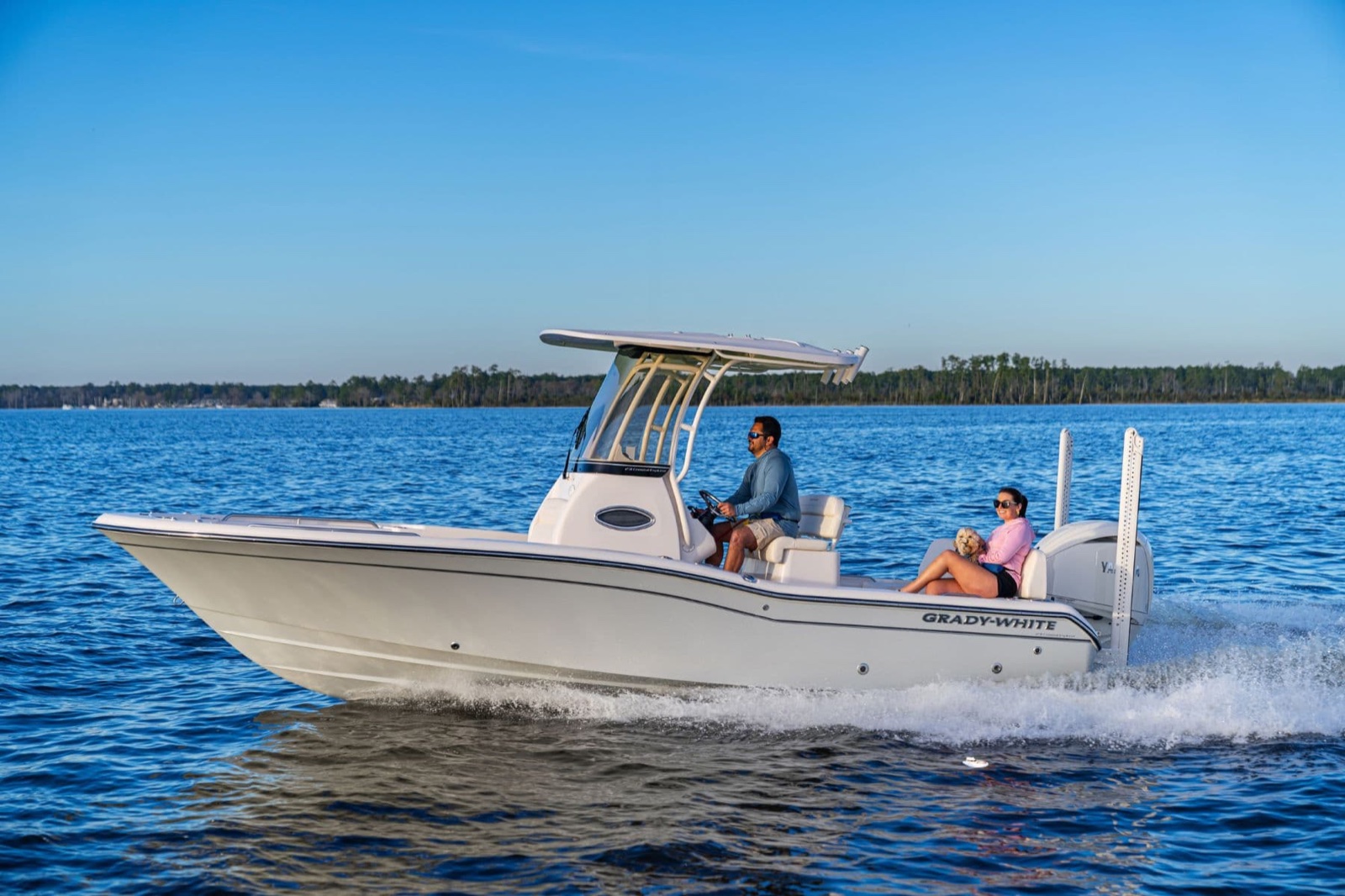
What is the Grady-White 231 Coastal Explorer?
The Grady-White 231 Coastal Explorer is a 23-foot 1-inch hybrid bay-and-coastal boat made in Greenville, North Carolina. For 2026, it comes standard with a single Yamaha F250 four-stroke outboard, giving a cruise of about 32 mph at 4,500 rpm and a top end around 48 mph. The boat weighs about 4,200 pounds dry, has an 8-foot 6-inch beam, a 14-inch draft with the outboard tilted, and an 80-gallon fuel tank. Grady-White has been building the SeaV2 hull family for over forty years, and the 231 launched in the Coastal Explorer line for the 2022 model year. The hull has a 16-degree transom deadrise, sharper entry at the bow, and hard chines aft that split the difference between a flat-bottom bay boat and a deeper offshore center console.
The 2026 model comes standard with a raised bow casting deck, a glass-fiber console wired for twin 9 or 12-inch Garmin or Simrad displays, a leaning post with a built-in livewell, rod storage in the leaning post and the gunwales, an in-deck fishbox, and the Yamaha digital throttle and shift package. An optional folding rear bench seat turns the cockpit from a fishing platform into family seating in about ten seconds, and a fiberglass T-top is the most common factory option.
What's it like on the water?
The first thing you notice is how the bow takes a 2-foot chop. The SeaV2 entry is sharper than a flats-style bay boat, and the hull does not slap and pound the way a 16-degree-deadrise hull at this length usually does. Push the throttle up and the F250 brings the boat on plane in 4 to 5 seconds. At 28 to 32 mph cruise the boat tracks straight and the helm stays dry through the front of the console.
We took a 2023 hull out of a small marina near the Outer Banks last fall in 1-to-2-foot chop on a falling tide. The boat handled the run out to the inlet at 28 mph without anyone complaining, the bow casting deck still worked for plug fishing on the way in, and three anglers fit on the cockpit without anyone in the way. The ride back to the ramp through the same chop was comfortable. That is the job the 231 is built for, and the hull does it well.
At wide-open throttle on flat water the single F250 pushes the boat to about 48 mph, in line with what owners report. The boat does not feel light at speed. Docking is straightforward with a single outboard, and the Yamaha digital electronic controls have a clean throttle response. What owners say matches what we noticed: the boat is more comfortable in chop than the segment average, and the cockpit was designed for both fishing and family from the start.
Who is the 231 Coastal Explorer for?
The 231 is for the coastal family who fishes inshore on a Tuesday and takes the kids out on a Saturday. Florida Atlantic and Gulf coasts, the Carolina inshore, the Texas bays, Chesapeake tributaries. The bow casting deck takes a fly rod or a plug rod, the cockpit takes three anglers, and the optional rear bench takes the family without anyone giving anything up.
It is also for the owner moving from a pure bay boat to a hybrid. Flats-style hulls at this length pound when the wind comes up. The SeaV2 gives up some shallow-draft capability and gains a hull that gets the crew home through afternoon chop without beating anyone up.
And it is for the buyer who wants the Grady-White name and the resale that comes with it. A clean 231 stays within 18 to 24 percent of new at five years, which is the segment-leading number for a hybrid bay boat at this length.
It's not for you if you fish 90-plus percent of the time and do not need the family layout, look at a Pathfinder 2400 TRS or a dedicated center console like the Regulator 23. It's also not for the offshore angler running 30-plus miles in 3-to-4-foot chop, the Grady-White 236 Fisherman or a 25-plus-foot Grady is the right answer. And it's not for the budget buyer. The Grady dealer network does not discount, and a comparable coastal hull is available from Robalo at roughly 25 percent less money.
Pricing
A 2026 Grady-White 231 Coastal Explorer with the standard Yamaha F250 starts at $98,000. Dealer models with the F300 upgrade, twin Garmin 12-inch displays, the T-top, the folding rear bench, and an audio package usually cost between $115,000 and $138,000.
The 231 has been in production since 2022, so the used market is still tight. Clean 2022 to 2024 hulls run $72,000 to $115,000 depending on engine choice, options, and hours. The broader market average across model years is about $94,000. Good-condition 2024 hulls with low hours can reach $115,000. For 2026 buyers, the sweet spot is a 2023 hull with the F250, the rear bench, the T-top, and a Garmin package in the 100-to-400-hour range, generally landing between $90,000 and $105,000.
Brokers move clean 231s in 60 to 90 days at fair money, which is the Grady-White used-market pattern across the line.
Year-by-year notes
If you are looking at used hulls, two years stand out. The first is 2023. The 2022 hulls are first-year production and have not produced systematic issues that buyers should screen on, but the 2023 boats brought the Yamaha F250 as the standard engine and made the folding rear bench a more widely-installed option. If you want an early boat, look for a 2023 over a 2022 for the standard F250 alone.
The next key year is 2024. Boats from 2024 on have the updated Garmin electronics package at the helm and refined leaning-post livewell plumbing. The 2025 and 2026 hulls are essentially the 2024 platform with cosmetic and trim updates. There are no defect-screen years to avoid in production so far.
Cost of ownership
Annual operating costs are moderate for the segment. The Grady-White build uses higher-quality parts than value-tier hulls, but the single-outboard rig keeps the running costs lower than a twin-engine 23.
Yamaha F250 service at 100-hour intervals costs $300 to $500 for parts and $300 to $500 for dealer labor. The 300-hour valve-clearance check, usually done at the three-year mark, adds $400 to $700 to that year's service line.
Slip rental and bottom paint costs depend on location. In Atlantic and Gulf coastal areas, bottom paint materials for slip-stored boats are about $400 to $700 a year, and slip fees range from $3,000 to $8,000 a year. Insurance for a $90,000 hull is $1,200 to $2,200 a year on most coastal policies. Trailer storage cuts the slip line out entirely.
If you buy a 2023 used 231 for $95,000 with 200 hours, use it 70 hours a season inshore in coastal Florida or the Carolinas with trailer storage and a saltwater rinse after each trip, your total yearly cost over five years is about $6,500 to $10,500 all-in.
We refueled a 2023 231 with the F250 last fall in North Carolina after a 55-mile day at mixed speeds. The boat used about 18 gallons of 89-octane, so the bill was $115.
Best year and spec to buy
The best buy for 2026 is a 2023 or 2024 hull with the Yamaha F250, the folding rear bench installed, a fiberglass T-top, the Garmin electronics package, and 100 to 350 hours on the engine. Expect to pay $90,000 to $112,000 at a Grady-experienced dealer or broker.
Verify five things pre-purchase. First, the Yamaha service file is current at 100-hour intervals with the 300-hour valve-clearance check completed at the right hour mark. Second, the hatches seal cleanly on a hose test and the in-deck fishbox drains. Third, the livewell pump cycles correctly and the seal at the leaning post shows no saltwater intrusion. Fourth, the toe-rail and gunwale finish has no impact damage or significant scuffing. Fifth, the helm electronics power up cleanly and the chartplotter has current chart updates.
We talked to a 2023 owner at a fuel dock near Charleston. He had 300 hours on the boat. He had replaced an impeller and added a Power-Pole, but nothing else had been done to it. He said the boat does what he bought it for, family on the weekend, redfish during the week. This kind of owner pattern comes up often when you talk to people who own this boat.
Alternatives
The closest deep-V cross-shop is the Regulator 23. Regulator uses a 24-degree deep-V with a Carolina flare, and the boat handles offshore chop better than the 231. It costs more new and holds value at the segment-leading rate. The Robalo R230 is the value cross-shop, similar coastal brief at roughly 25 percent less money with a build a tier below Grady. For a pure inshore boat at the same length, the Pathfinder 2400 TRS trades the hybrid versatility for a flatter, shallower-running flats-and-inshore platform. The Boston Whaler 230 Outrage is the foam-cored alternative at the same length, less inshore-focused than the 231 but with the Whaler unsinkable construction.